Institute of Membrane and Systems Biology, University of Leeds, Leeds, LS2 9JT, UK.
J Mol Cell Cardiol. 2012 Feb;52(2):388-400. doi: 10.1016/j.yjmcc.2011.06.014. Epub 2011 Jun 26.
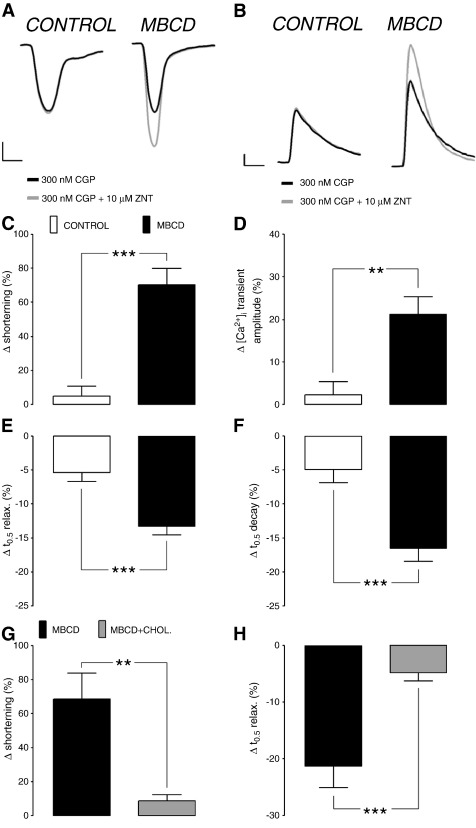
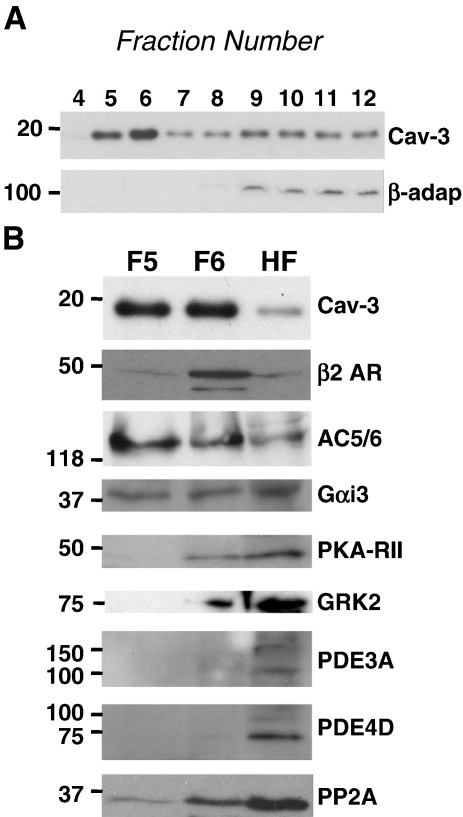
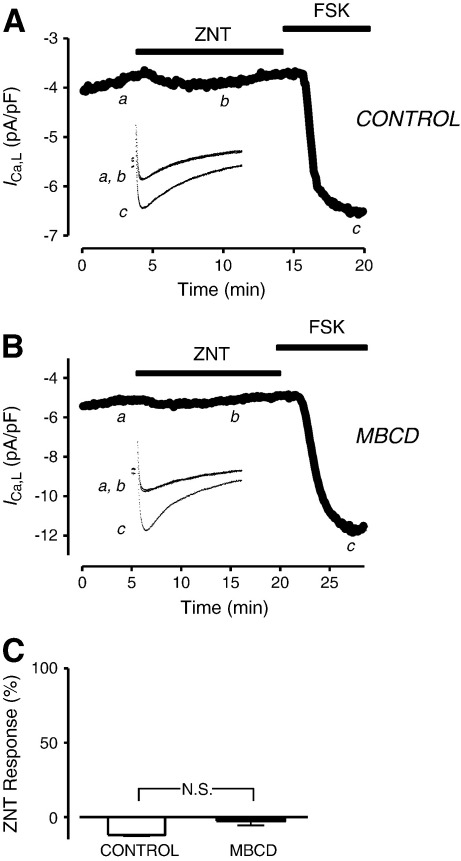
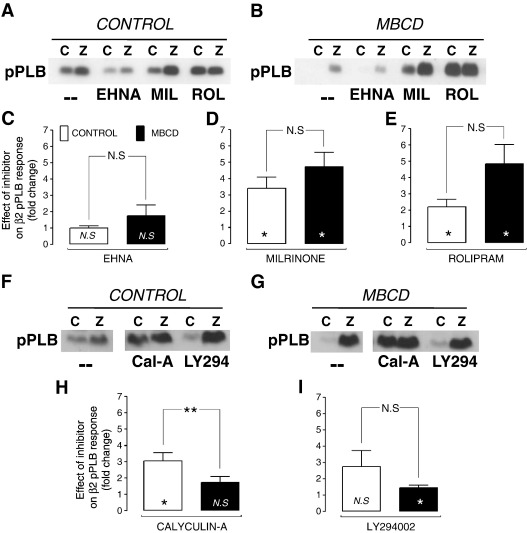
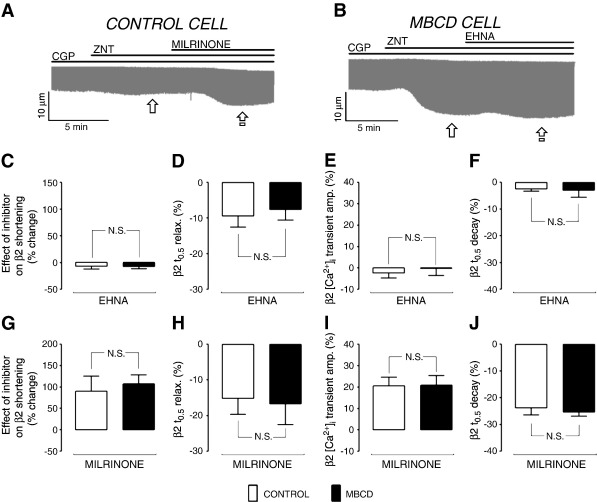
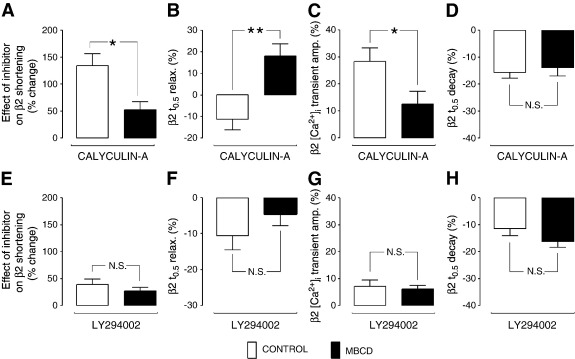
Inotropy and lusitropy in the ventricular myocyte can be efficiently induced by activation of β1-, but not β2-, adrenoceptors (ARs). Compartmentation of β2-AR-derived cAMP-dependent signalling underlies this functional discrepancy. Here we investigate the mechanism by which caveolae (specialised sarcolemmal invaginations rich in cholesterol and caveolin-3) contribute to compartmentation in the adult rat ventricular myocyte. Selective activation of β2-ARs (with zinterol/CGP20712A) produced little contractile response in control cells but pronounced inotropic and lusitropic responses in cells treated with the cholesterol-depleting agent methyl-β-cyclodextrin (MBCD). This was not linked to modulation of L-type Ca(2+) current, but instead to a discrete PKA-mediated phosphorylation of phospholamban at Ser(16). Application of a cell-permeable inhibitor of caveolin-3 scaffolding interactions mimicked the effect of MBCD on phosphorylated phospholamban (pPLB) during β2-AR stimulation, consistent with MBCD acting via caveolae. Biosensor experiments revealed β2-AR mobilisation of cAMP in PKA II signalling domains of intact cells only after MBCD treatment, providing a real-time demonstration of cAMP freed from caveolar constraint. Other proteins have roles in compartmentation, so the effects of phosphodiesterase (PDE), protein phosphatase (PP) and phosphoinositide-3-kinase (PI3K) inhibitors on pPLB and contraction were compared in control and MBCD treated cells. PP inhibition alone was conspicuous in showing robust de-compartmentation of β2-AR-derived signalling in control cells and a comparatively diminutive effect after cholesterol depletion. Collating all evidence, we promote the novel concept that caveolae limit β2-AR-cAMP signalling by providing a platform that not only attenuates production of cAMP but also prevents inhibitory modulation of PPs at the sarcoplasmic reticulum. This article is part of a Special Issue entitled "Local Signaling in Myocytes".
在心室肌细胞中,β1-肾上腺素能受体(AR)而非β2-AR 的激活可以有效地诱导变力性和变时性。β2-AR 衍生的 cAMP 依赖性信号的分隔是这种功能差异的基础。在这里,我们研究了 caveolae(富含胆固醇和 caveolin-3 的特殊肌膜内陷)如何有助于成年大鼠心室肌细胞分隔的机制。选择性激活β2-AR(使用 zinterol/CGP20712A)在对照细胞中几乎没有产生收缩反应,但在用胆固醇耗竭剂甲基-β-环糊精(MBCD)处理的细胞中产生明显的变力性和变时性反应。这与 L 型 Ca2+电流的调节无关,而是与 PKA 介导的肌球蛋白轻链磷酸化酶 at Ser(16)的离散磷酸化有关。细胞通透性 caveolin-3 支架相互作用抑制剂的应用模拟了 MBCD 对β2-AR 刺激期间磷酸化肌球蛋白轻链(pPLB)的作用,这与 MBCD 通过 caveolae 起作用一致。生物传感器实验表明,只有在用 MBCD 处理后,β2-AR 才能在完整细胞的 PKA II 信号域中动员 cAMP,这提供了 cAMP 从 caveolar 约束中释放的实时证明。其他蛋白质在分隔中也有作用,因此在对照和 MBCD 处理的细胞中比较了磷酸二酯酶(PDE)、蛋白磷酸酶(PP)和磷酸肌醇-3-激酶(PI3K)抑制剂对 pPLB 和收缩的影响。单独抑制 PP 在对照细胞中显示出强大的β2-AR 衍生信号去分隔作用,而在胆固醇耗竭后则效果相对较小。综合所有证据,我们提出了一个新概念,即 caveolae 通过提供一个平台来限制β2-AR-cAMP 信号,该平台不仅可以减弱 cAMP 的产生,还可以防止 PP 在肌浆网上的抑制性调节。本文是题为“肌细胞中的局部信号”的特刊的一部分。