School of Public Health, the University of Hong Kong, Hong Kong.
Am J Infect Control. 2012 Mar;40(2):113-7. doi: 10.1016/j.ajic.2011.03.017. Epub 2011 Jul 8.
Community determinants of antibiotics nonadherence, an important contributor of antibiotics resistance, remained unclear.
Our objective was to investigate whether deficient antibiotics knowledge could contribute to nonadherence in a community with high prevalence of antibiotics resistance.
We recruited 465 people by random sampling from 5 urban areas in Hong Kong. A structured questionnaire was used to assess antibiotics knowledge and adherence. Adherence was defined as completing the most recent course of antibiotics entirely according to physicians' instructions. An antibiotics knowledge score ranging from 0 to 3 (highest) was composed based on the number of correctly answered questions.
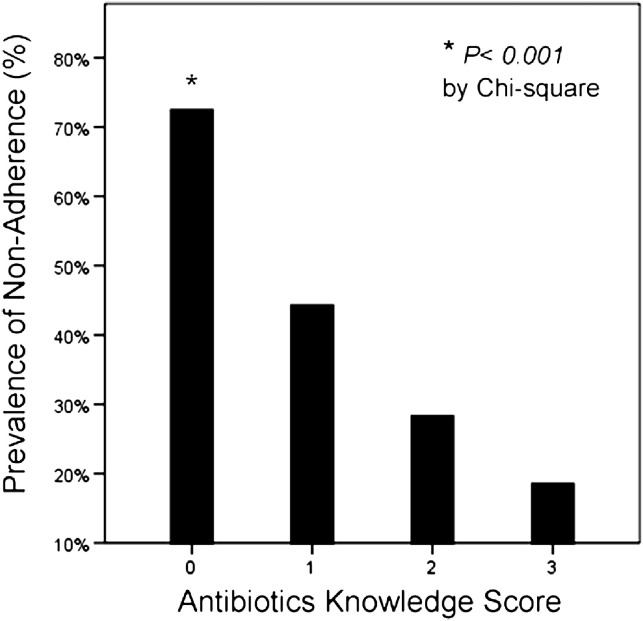
Of the 465 participants interviewed, 96.3% had heard of the term "antibiotics," and 80.6% recalled having previously received antibiotics prescription. Among the eligible 369 subjects, 32.9% showed nonadherence. Percentages of participants with antibiotics knowledge scores of 0, 1, 2, and 3 were 11%, 27%, 33%, and 29%, respectively. There was a higher prevalence of nonadherence among people with lower antibiotics knowledge score (P < .001). Furthermore, people with nonadherence had a significantly lower mean antibiotics knowledge score (1.3 ± 1.0 versus 2.0 ± 0.9, P < .001), with no interaction with education (P < .05). Adjusted for potential confounders, antibiotics knowledge scores of 2, 1, and 0 independently predicted increased risk of nonadherence by 1-fold (odds ratio [OR], 2.00; 95% confidence interval [CI]: 1.01-3.94; P = .047), 4-fold (OR, 4.77; 95% CI: 2.30-9.92; P < .001), and 17-fold (OR, 18.41; 95% CI: 6.92-48.97; P < .001) respectively, compared with the maximum score of 3.
Lack of antibiotics knowledge is a critical determinant of nonadherence independent of education in the community.
社区中抗生素不依从的决定因素,是抗生素耐药性的一个重要因素,但仍不清楚。
我们的目的是调查在一个抗生素耐药性高发的社区中,缺乏抗生素知识是否会导致不依从。
我们通过随机抽样从香港 5 个城区招募了 465 人。采用结构化问卷评估抗生素知识和依从性。依从性定义为根据医生的指示完成最近一次抗生素疗程。抗生素知识得分范围为 0 至 3 分(最高),根据正确回答的问题数组成。
在接受采访的 465 名参与者中,96.3%听说过“抗生素”一词,80.6%回忆起以前曾接受过抗生素处方。在符合条件的 369 名受试者中,32.9%表现出不依从。抗生素知识得分分别为 0、1、2 和 3 的参与者百分比分别为 11%、27%、33%和 29%。抗生素知识得分较低的人群中,不依从的比例更高(P<0.001)。此外,不依从的人群抗生素知识得分明显较低(1.3±1.0 与 2.0±0.9,P<0.001),与教育无交互作用(P<0.05)。调整潜在混杂因素后,抗生素知识得分分别为 2、1 和 0 独立预测不依从的风险增加 1 倍(比值比 [OR],2.00;95%置信区间 [CI]:1.01-3.94;P=0.047)、4 倍(OR,4.77;95% CI:2.30-9.92;P<0.001)和 17 倍(OR,18.41;95% CI:6.92-48.97;P<0.001),与最高得分为 3 分相比。
缺乏抗生素知识是社区中独立于教育的不依从的关键决定因素。