DePina Ana S, Iser Wendy B, Park Sung-Soo, Maudsley Stuart, Wilson Mark A, Wolkow Catherine A
Laboratory of Neurosciences, NIA Intramural Research Program, NIH, Baltimore, MD 21224, USA.
BMC Physiol. 2011 Jul 12;11:11. doi: 10.1186/1472-6793-11-11.
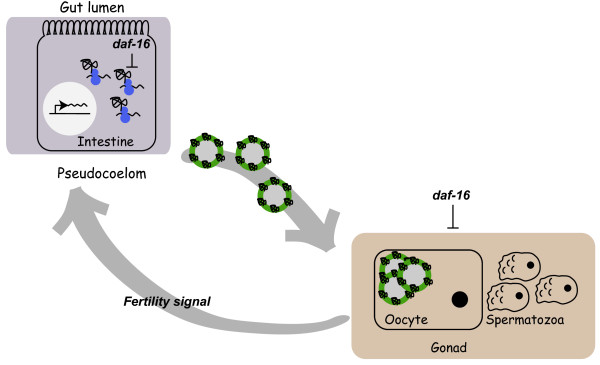
Evolutionary theories of aging propose that longevity evolves as a competition between reproduction and somatic maintenance for a finite pool of resources. Reproduction is thought to shorten lifespan by depleting resources from processes promoting somatic maintenance. Maternal yolk production, vitellogenesis, represents a significant maternal cost for reproduction and is suppressed under genetic and environmental conditions that extend lifespan. However, little is known about the pathways regulating vitellogenesis in response to prolongevity cues.
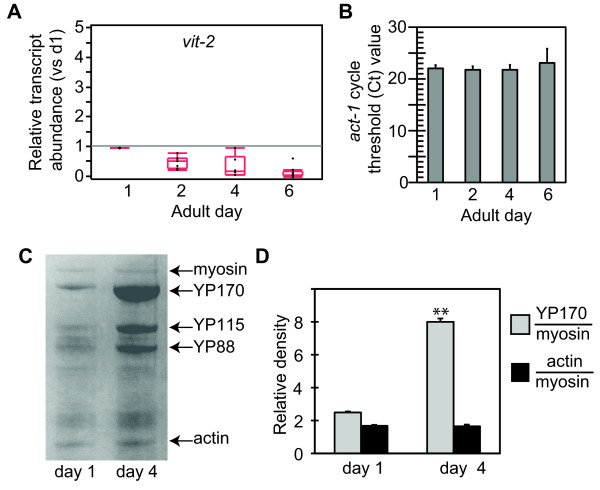
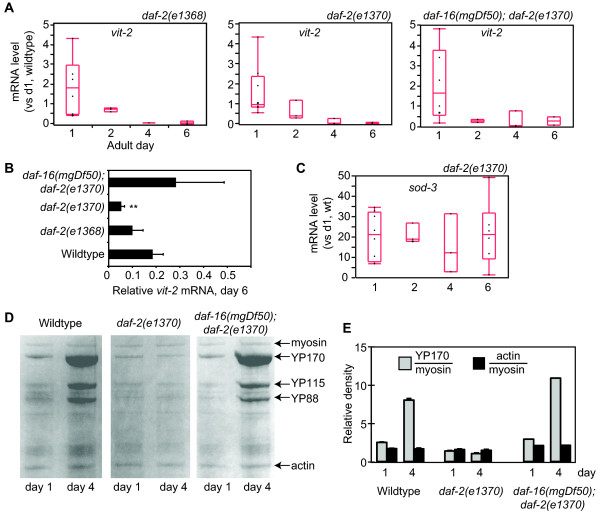
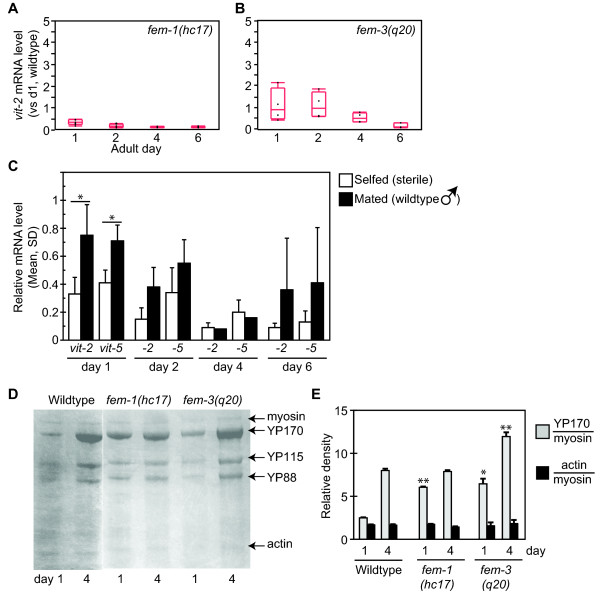
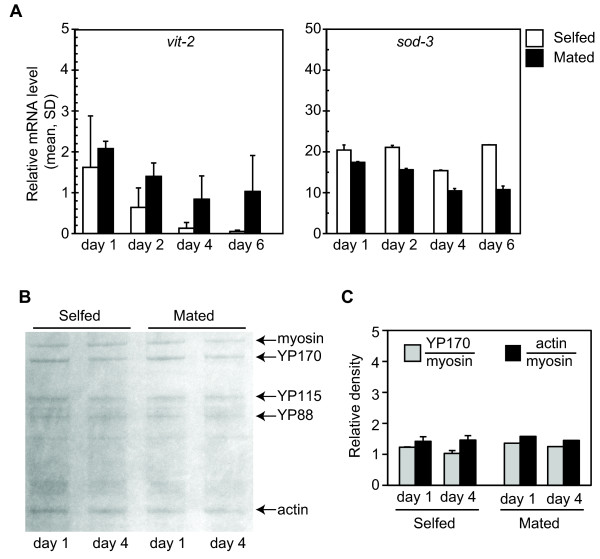
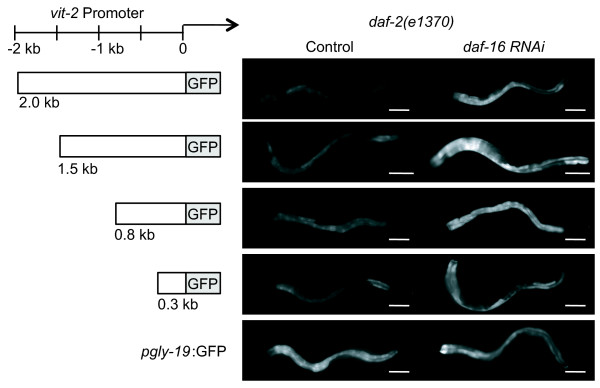
In order to identify mechanisms that suppress vitellogenesis under prolongevity conditions, we studied factors regulating vitellogenesis in C. elegans nematodes. In C. elegans, vitellogenesis is depressed in the absence of insulin-like signaling (IIS). We found that the C. elegans daf-2/IIS pathway regulates vitellogenesis through two mechanisms. vit-2 transcript levels in daf-2 mutants were indirectly regulated through a germline-dependent signal, and could be rescued by introduction of daf-2(+) sperm. However, yolk protein (YP) levels in daf-2 mutants were also regulated by germline-independent posttranscriptional mechanisms.
C. elegans vitellogenesis is regulated transcriptionally and posttranscriptionally in response to environmental and reproductive cues. The daf-2 pathway suppressed vitellogenesis through transcriptional mechanisms reflecting reproductive phenotypes, as well as distinct posttranscriptional mechanisms. This study reveals that pleiotropic effects of IIS pathway mutations can converge on a common downstream target, vitellogenesis, as a mechanism to modulate longevity.
衰老的进化理论提出,长寿是作为繁殖和体细胞维持之间对有限资源库的竞争而进化的。繁殖被认为会通过消耗促进体细胞维持的过程中的资源来缩短寿命。母体卵黄生成,即卵黄发生,是繁殖的一项重大母体成本,在延长寿命的遗传和环境条件下会受到抑制。然而,对于响应延长寿命线索调节卵黄发生的途径知之甚少。
为了确定在延长寿命条件下抑制卵黄发生的机制,我们研究了秀丽隐杆线虫中调节卵黄发生的因素。在秀丽隐杆线虫中,缺乏胰岛素样信号(IIS)时卵黄发生会受到抑制。我们发现秀丽隐杆线虫的daf-2/IIS途径通过两种机制调节卵黄发生。daf-2突变体中的vit-2转录水平通过一种依赖生殖系的信号间接调节,并且可以通过引入daf-2(+)精子来挽救。然而,daf-2突变体中的卵黄蛋白(YP)水平也受到不依赖生殖系的转录后机制的调节。
秀丽隐杆线虫的卵黄发生在转录和转录后水平上受到环境和生殖线索的调节。daf-2途径通过反映生殖表型的转录机制以及不同的转录后机制抑制卵黄发生。这项研究表明,IIS途径突变的多效性效应可以汇聚到一个共同的下游靶点——卵黄发生,作为调节寿命的一种机制。