Department of Plant and Microbial Biology, University of California, Berkeley, Berkeley, California, USA.
mBio. 2011 Jul 12;2(4):e00044-11. doi: 10.1128/mBio.00044-11. Print 2011.
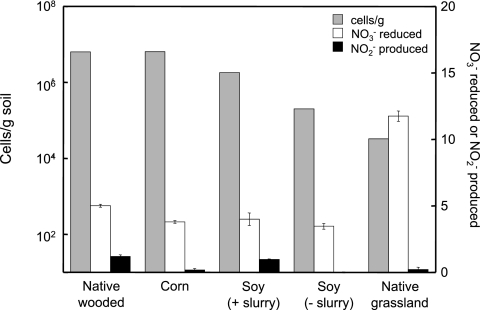
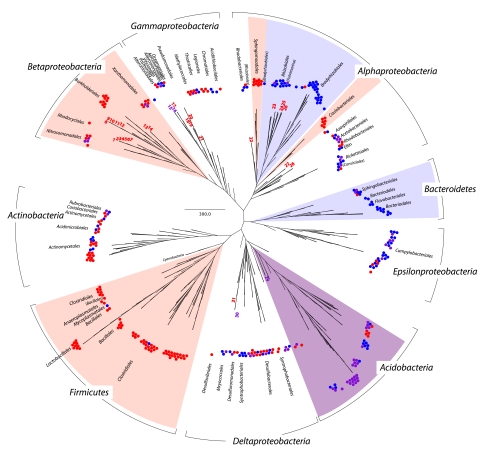
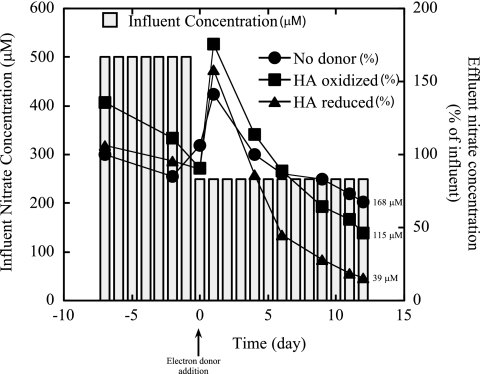
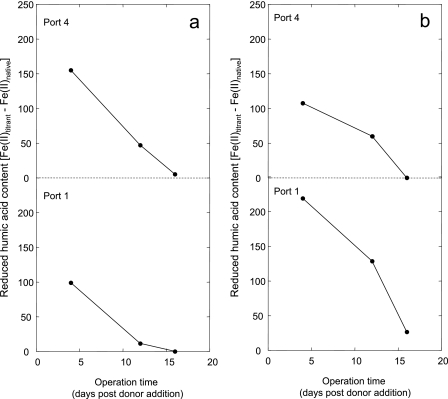
This study demonstrates the prevalence, phylogenetic diversity, and physiology of nitrate-reducing microorganisms capable of utilizing reduced humic acids (HA) as electron donors in agricultural soils. Most probable number (MPN) enumeration of agricultural soils revealed large populations (10(4) to 10(6) cells g(-1) soil) of microorganisms capable of reducing nitrate while oxidizing the reduced HA analog 2,6-anthrahydroquinone disulfonate (AH(2)DS) to its corresponding quinone. Nitrate-dependent HA-oxidizing organisms isolated from agricultural soils were phylogenetically diverse and included members of the Alphaproteobacteria, Betaproteobacteria, and Gammaproteobacteria. Advective up-flow columns inoculated with corn plot soil and amended with reduced HA and nitrate supported both HA oxidation and enhanced nitrate reduction relative to no-donor or oxidized HA controls. The additional electron donating capacity of reduced HA could reasonably be attributed to the oxidation of reduced functional groups. Subsequent 16S rRNA gene-based high-density oligonucleotide microarray (PhyloChip) indicated that reduced HA columns supported the development of a bacterial community enriched with members of the Acidobacteria, Firmicutes, and Betaproteobacteria relative to the no-donor control and initial inoculum. This study identifies a previously unrecognized role for HA in stimulating denitrification processes in saturated soil systems. Furthermore, this study indicates that reduced humic acids impact soil geochemistry and the indigenous bacterial community composition.
This study identifies a new metabolic capacity in soil microbial communities that may be responsible for the mediation of significant nitrogen losses from soil systems. Nitrate-dependent humic acid (HA)-oxidizing organisms isolated from agricultural soils were phylogenetically diverse and included members of Alphaproteobacteria, Betaproteobacteria, and Gammaproteobacteria. Advective up-flow columns inoculated with corn plot soil and amended with reduced HA and nitrate supported both HA oxidation and enhanced nitrate reduction relative to no-donor or oxidized HA controls. The additional electron donating capacity of reduced HA could reasonably be attributed to the oxidation of reduced functional groups.
本研究证明了在农业土壤中,能够利用还原腐殖酸(HA)作为电子供体来还原硝酸盐的硝酸盐还原微生物的普遍性、系统发育多样性和生理学特性。通过最大可能数(MPN)对农业土壤的计数表明,存在大量(10(4)到 10(6)细胞/g 土壤)能够在还原 HA 类似物 2,6-蒽二氢醌二磺酸盐(AH(2)DS)的同时还原硝酸盐的微生物。从农业土壤中分离出的依赖硝酸盐的 HA 氧化微生物具有丰富的系统发育多样性,包括α变形菌、β变形菌和γ变形菌。用还原 HA 和硝酸盐接种玉米地土壤的流动上涌柱,与无供体或氧化 HA 对照相比,支持 HA 氧化和增强的硝酸盐还原。还原 HA 的额外电子供体能力可以合理地归因于还原官能团的氧化。随后基于 16S rRNA 基因的高密度寡核苷酸微阵列(PhyloChip)表明,与无供体对照和初始接种物相比,还原 HA 柱支持富含酸杆菌门、厚壁菌门和β变形菌门成员的细菌群落的发展。本研究确定了 HA 在刺激饱和土壤系统中反硝化过程中的一个以前未被认识的作用。此外,本研究表明,还原腐殖酸会影响土壤地球化学和土著细菌群落组成。
本研究确定了土壤微生物群落中的一种新的代谢能力,这种能力可能是导致土壤系统中大量氮损失的原因。从农业土壤中分离出的依赖硝酸盐的 HA 氧化微生物具有丰富的系统发育多样性,包括α变形菌、β变形菌和γ变形菌。用玉米地土壤接种的流动上涌柱,并添加还原 HA 和硝酸盐,与无供体或氧化 HA 对照相比,既支持 HA 氧化,又支持增强的硝酸盐还原。还原 HA 的额外电子供体能力可以合理地归因于还原官能团的氧化。