Laboratoire des Symbioses Tropicales et Méditerranéennes, SupAgro/Institut National de la Recherche Agronomique/Université Montpellier 2/Centre de Coopération Internationale en Recherche Agronomique pour le Développement, Montpellier, France.
PLoS One. 2011;6(7):e21900. doi: 10.1371/journal.pone.0021900. Epub 2011 Jul 5.
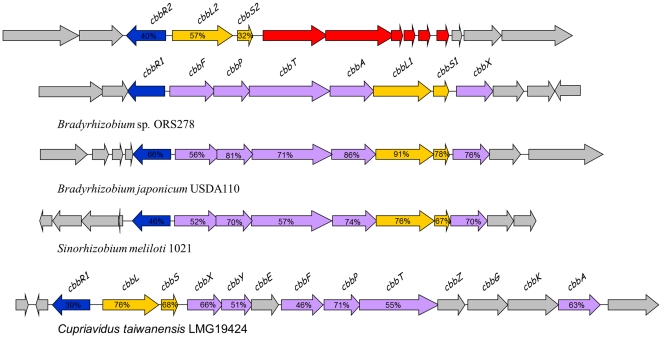
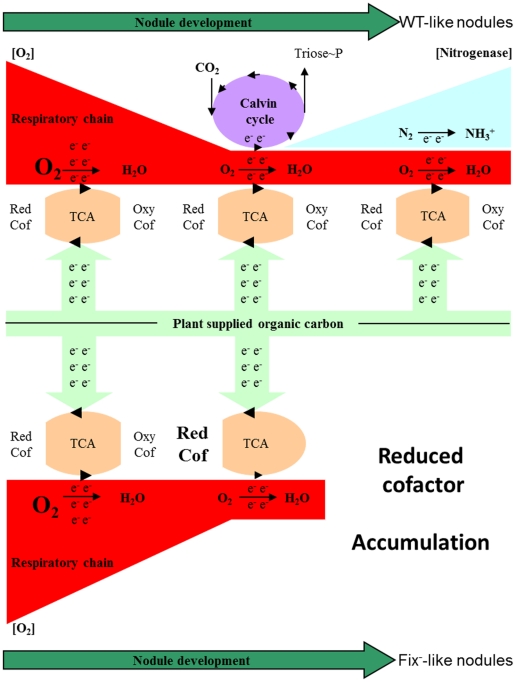
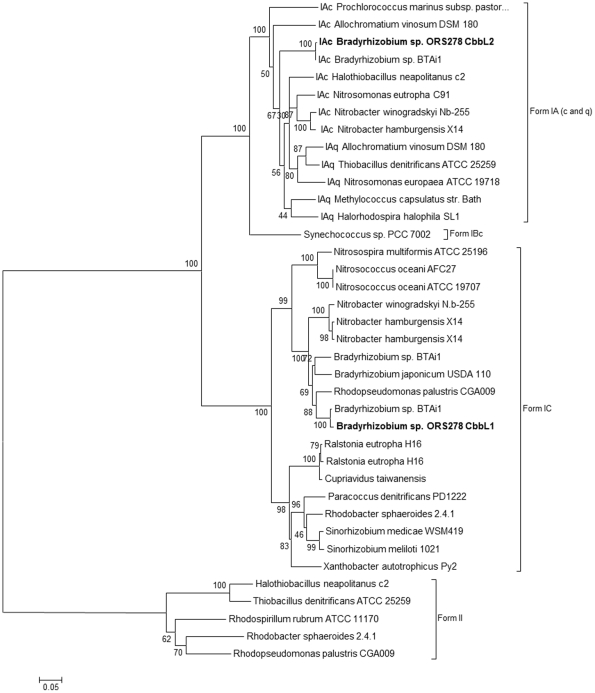
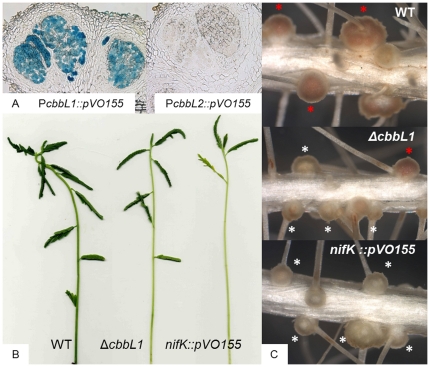
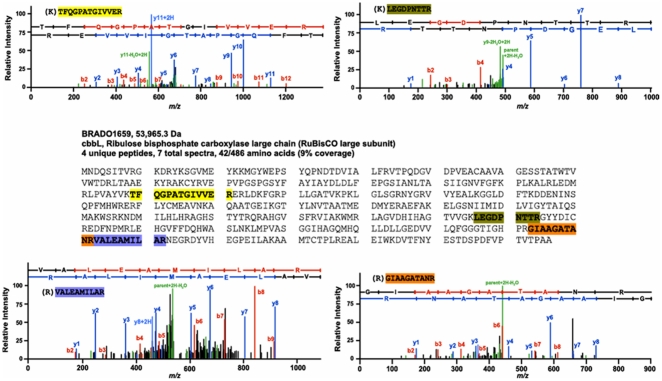
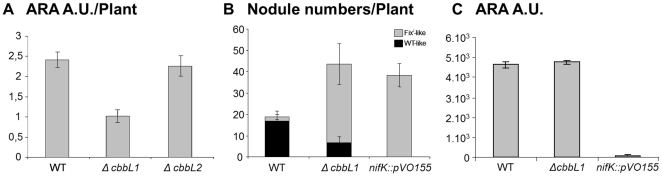
Rhizobia and legume plants establish symbiotic associations resulting in the formation of organs specialized in nitrogen fixation. In such organs, termed nodules, bacteria differentiate into bacteroids which convert atmospheric nitrogen and supply the plant with organic nitrogen. As a counterpart, bacteroids receive carbon substrates from the plant. This rather simple model of metabolite exchange underlies symbiosis but does not describe the complexity of bacteroids' central metabolism. A previous study using the tropical symbiotic model Aeschynomene indica/photosynthetic Bradyrhizobium sp. ORS278 suggested a role of the bacterial Calvin cycle during the symbiotic process. Herein we investigated the role of two RuBisCO gene clusters of Bradyrhizobium sp. ORS278 during symbiosis. Using gene reporter fusion strains, we showed that cbbL1 but not the paralogous cbbL2 is expressed during symbiosis. Congruently, CbbL1 was detected in bacteroids by proteome analysis. The importance of CbbL1 for symbiotic nitrogen fixation was proven by a reverse genetic approach. Interestingly, despite its symbiotic nitrogen fixation defect, the cbbL1 mutant was not affected in nitrogen fixation activity under free living state. This study demonstrates a critical role for bacterial RuBisCO during a rhizobia/legume symbiotic interaction.
根瘤菌和豆科植物建立共生关系,形成专门进行固氮的器官。在这些被称为根瘤的器官中,细菌分化为类菌体,将大气中的氮转化为有机氮,并供给植物。作为回报,类菌体从植物中获得碳底物。这种代谢物交换的简单模式是共生的基础,但并不能描述类菌体中心代谢的复杂性。先前使用热带共生模式 Aeschynomene indica/光合 Bradyrhizobium sp. ORS278 的研究表明,细菌卡尔文循环在共生过程中起作用。在此,我们研究了 Bradyrhizobium sp. ORS278 的两个 RuBisCO 基因簇在共生中的作用。使用基因报告融合菌株,我们表明 cbbL1 而不是其同源基因 cbbL2 在共生过程中表达。通过蛋白质组分析,在类菌体中检测到 CbbL1。通过反向遗传学方法证明了 CbbL1 对共生固氮的重要性。有趣的是,尽管 cbbL1 突变体在共生固氮过程中存在缺陷,但它在自由生活状态下的固氮活性不受影响。这项研究表明,细菌 RuBisCO 在根瘤菌/豆科植物共生互作中起着关键作用。