Wallace H. Coulter Department of Biomedical Engineering, Georgia Institute of Technology and Emory University, GA 30332, Atlanta, USA.
J Transl Med. 2011 Jul 14;9:109. doi: 10.1186/1479-5876-9-109.
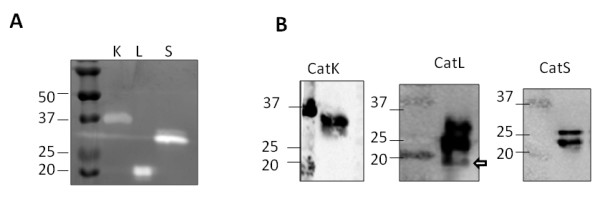
Cathepsins K, L, and S are cysteine proteases upregulated in cancer and proteolyze extracellular matrix to facilitate metastasis, but difficulty distinguishing specific cathepsin activity in complex tissue extracts confounds scientific studies and employing them for use in clinical diagnoses. Here, we have developed multiplex cathepsin zymography to profile cathepsins K, L, and S activity in 10 μg human breast, lung, and cervical tumors by exploiting unique electrophoretic mobility and renaturation properties.
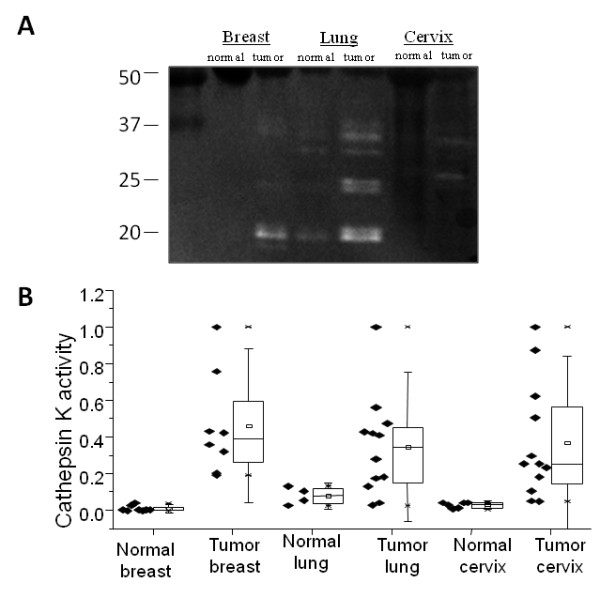
Frozen breast, lung, and cervix cancer tissue lysates and normal organ tissue lysates from the same human patients were obtained (28 breast tissues, 23 lung tissues, and 23 cervix tissues), minced and homogenized prior to loading for cathepsin gelatin zymography to determine enzymatic activity.
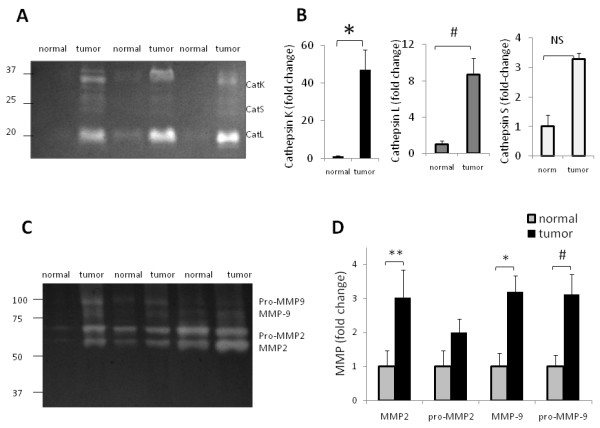
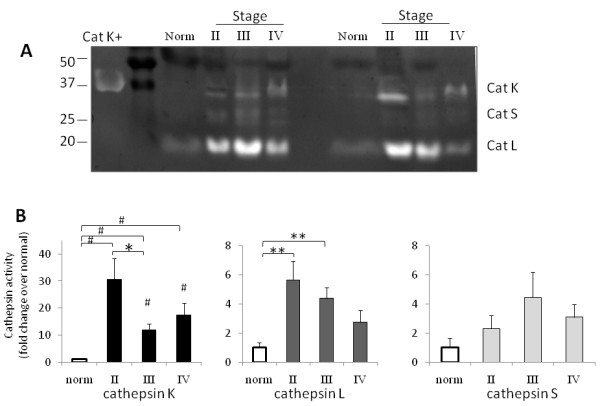
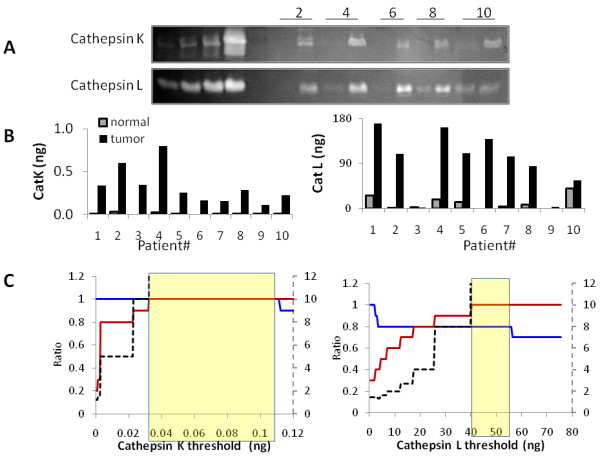
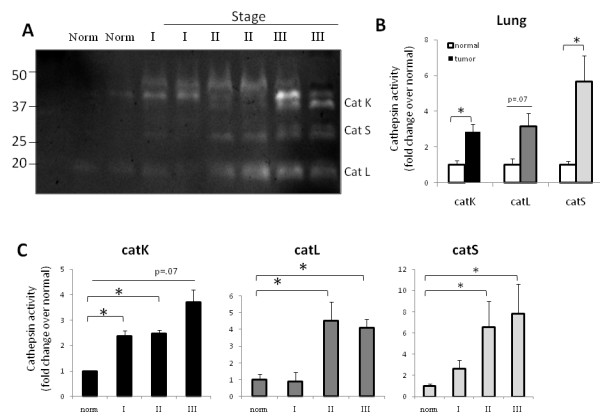
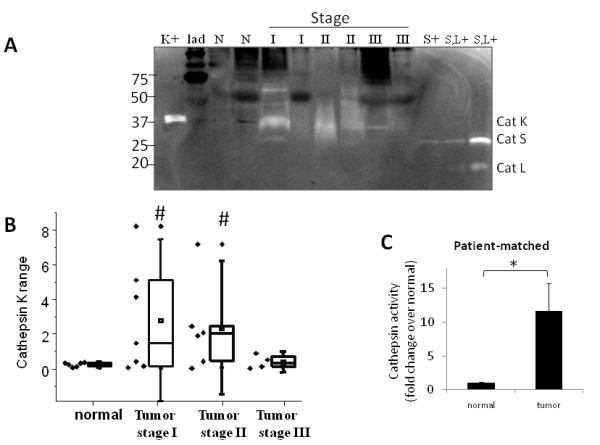
Cleared bands of cathepsin activity were identified and validated in tumor extracts and detected organ- and stage-specific differences in activity. Cathepsin K was unique compared to cathepsins L and S. It was significantly higher for all cancers even at the earliest stage tested (stage I for lung and cervix (n = 6, p < .05), and stage II for breast; n = 6, p < .0001). Interestingly, cervical and breast tumor cathepsin activity was highest at the earliest stage we tested, stages I and II, respectively, and then were significantly lower at the latest stages tested (III and IV, respectively) (n = 6, p < 0.01 and p < 0.05), but lung cathepsin activity increased from one stage to the next (n = 6, p < .05). Using cathepsin K as a diagnostic biomarker for breast cancer detected with multiplex zymography, yielded 100% sensitivity and specificity for 20 breast tissue samples tested (10 normal; 10 tumor) in part due to the consistent absence of cathepsin K in normal breast tissue across all patients.
To summarize, this sensitive assay provides quantitative outputs of cathepsins K, L, and S activities from mere micrograms of tissue and has potential use as a supplement to histological methods of clinical diagnoses of biopsied human tissue.
组织蛋白酶 K、L 和 S 是在癌症中上调的半胱氨酸蛋白酶,可降解细胞外基质以促进转移,但在复杂组织提取物中难以区分特定的组织蛋白酶活性,这给科学研究带来了困难,并阻碍了它们在临床诊断中的应用。在这里,我们开发了多重组织蛋白酶酶谱法,通过利用独特的电泳迁移率和复性特性,在 10μg 人乳腺、肺和宫颈肿瘤中对组织蛋白酶 K、L 和 S 的活性进行分析。
获取冷冻的乳腺、肺和宫颈癌组织和来自同一患者的正常器官组织的组织匀浆(28 份乳腺组织、23 份肺组织和 23 份宫颈组织),在加载用于组织蛋白酶明胶酶谱法以确定酶活性之前,将其切碎并均化。
在肿瘤提取物中鉴定和验证了清除的组织蛋白酶活性带,并检测到活性的器官和阶段特异性差异。组织蛋白酶 K 与组织蛋白酶 L 和 S 不同。即使在测试的最早阶段(肺和宫颈的 I 期(n=6,p<0.05)和乳腺的 II 期;n=6,p<0.0001),所有癌症的组织蛋白酶 K 水平均显著升高。有趣的是,在我们测试的最早阶段,宫颈和乳腺肿瘤的组织蛋白酶活性最高,分别为 I 期和 II 期,然后在测试的最新阶段(分别为 III 期和 IV 期)显著降低(n=6,p<0.01 和 p<0.05),但肺组织蛋白酶活性从一个阶段增加到下一个阶段(n=6,p<0.05)。使用多重酶谱法作为乳腺癌的诊断生物标志物,检测 20 个组织样本的结果显示 100%的敏感性和特异性(10 个正常;10 个肿瘤),部分原因是在所有患者中,正常乳腺组织中始终不存在组织蛋白酶 K。
总之,这种灵敏的检测方法可以从微量组织中定量输出组织蛋白酶 K、L 和 S 的活性,并有可能作为组织活检的临床诊断中组织学方法的补充。