University of Pittsburgh School of Medicine, Pittsburgh, PA 15213, USA.
Compr Psychiatry. 2012 May;53(4):323-32. doi: 10.1016/j.comppsych.2011.05.008. Epub 2011 Jul 14.
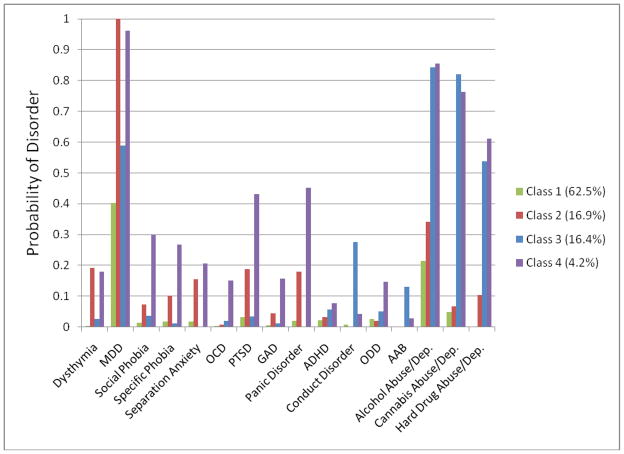
Several recent studies using factor analytic methods find that the structure of psychopathology reflects broad internalizing and externalizing dimensions, with the internalizing dimension being further divided into fear and distress disorders. Although these variable-centered studies have provided important insights into the structure of psychopathology, they provide limited information about the classification of individual cases. The present study examines patterns of lifetime internalizing and externalizing psychopathology in participants from the Oregon Adolescent Depression Project using latent class analysis that classifies individuals rather than variables. A 4-class solution best fits the data. The largest class (62.5%) included individuals with relatively little psychopathology; 1 class (16.4%) was largely characterized by internalizing disorders, 1 class (16.9%), largely characterized by externalizing disorders; and the final class (4.2%), characterized by both internalizing and externalizing disorders. The validity of the classes was further examined using data on psychiatric morbidity, temperament, and family aggregation of psychopathology. Classes differed on indices of positive, negative, and disinhibited temperament in ways that were consistent with theoretical predictions. Patterns of familial aggregation of psychopathology demonstrated relative specificity of transmission of different disorders. Overall, the findings support conclusions from studies of dimensional models of internalizing and externalizing disorders, and extend them to person-centered approaches to classification.
几项最近使用因子分析方法的研究发现,精神病理学的结构反映了广泛的内化和外化维度,内化维度进一步分为恐惧和痛苦障碍。虽然这些基于变量的研究为精神病理学的结构提供了重要的见解,但它们提供的关于个体病例分类的信息有限。本研究使用潜在类别分析检查了俄勒冈青少年抑郁项目参与者的终生内化和外化精神病理学模式,该分析将个体而不是变量进行分类。4 类解决方案最适合数据。最大的类别(62.5%)包括相对较少精神病理学的个体;1 个类别(16.4%)主要以内化障碍为特征,1 个类别(16.9%)主要以外化障碍为特征;最后一个类别(4.2%)以内化和外化障碍为特征。通过关于精神病理学的精神发病率、气质和家族聚集的数据进一步检查了类别的有效性。类别的阳性、阴性和去抑制气质指标存在差异,这与理论预测一致。精神病理学家族聚集模式显示出不同障碍传递的相对特异性。总体而言,这些发现支持了内化和外化障碍维度模型研究的结论,并将其扩展到以个体为中心的分类方法。