Biological and Experimental Psychology Group, School of Biological and Chemical Sciences, Queen Mary University of London, London, United Kingdom.
PLoS One. 2011;6(7):e21982. doi: 10.1371/journal.pone.0021982. Epub 2011 Jul 7.
Human sexual orientation is influenced by genetic and non-shared environmental factors as are two important psychological correlates--childhood gender typicality (CGT) and adult gender identity (AGI). However, researchers have been unable to resolve the genetic and non-genetic components that contribute to the covariation between these traits, particularly in women.
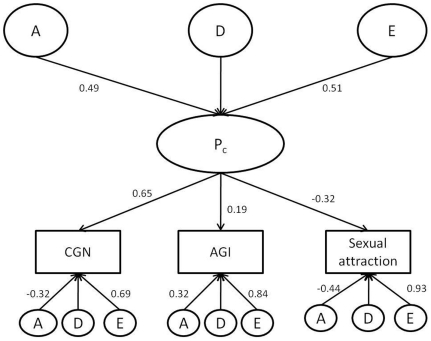
METHODOLOGY/PRINCIPAL FINDINGS: Here we performed a multivariate genetic analysis in a large sample of British female twins (N = 4,426) who completed a questionnaire assessing sexual attraction, CGT and AGI. Univariate genetic models indicated modest genetic influences on sexual attraction (25%), AGI (11%) and CGT (31%). For the multivariate analyses, a common pathway model best fitted the data.
CONCLUSIONS/SIGNIFICANCE: This indicated that a single latent variable influenced by a genetic component and common non-shared environmental component explained the association between the three traits but there was substantial measurement error. These findings highlight common developmental factors affecting differences in sexual orientation.
人类的性取向受到遗传和非共享环境因素的影响,而儿童期性别典型性(CGT)和成年性别认同(AGI)是两个重要的心理相关因素。然而,研究人员一直无法解决导致这些特征之间相互关联的遗传和非遗传成分,特别是在女性中。
方法/主要发现:在这里,我们对一大群完成了评估性吸引力、CGT 和 AGI 的问卷的英国女性双胞胎(N=4426)进行了多变量遗传分析。单变量遗传模型表明,性吸引力(25%)、AGI(11%)和 CGT(31%)受到遗传的适度影响。对于多变量分析,共同途径模型最适合数据。
结论/意义:这表明,一个受遗传成分和共同非共享环境成分影响的单一潜在变量解释了三个特征之间的关联,但存在大量测量误差。这些发现强调了影响性取向差异的共同发展因素。