Department of Medical Sciences, Psychiatry, Uppsala University, Uppsala, Sweden.
Norwegian Institute of Public Health, Oslo, Norway.
Sci Rep. 2022 Aug 4;12(1):13439. doi: 10.1038/s41598-022-17749-0.
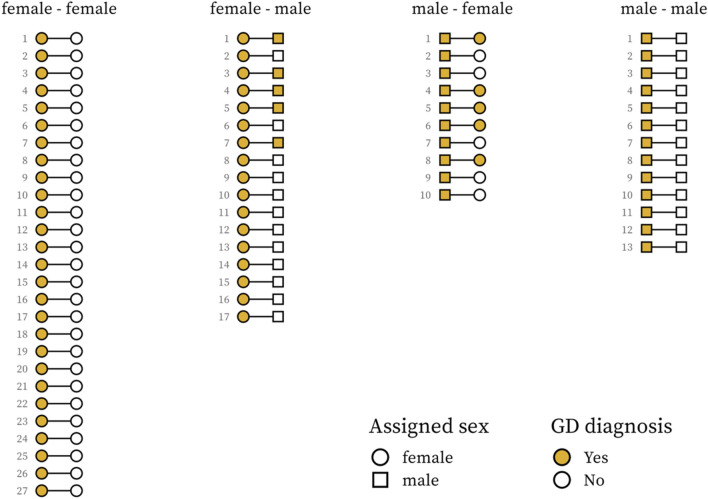
Both genetic and environmental influences have been proposed to contribute to the variance of gender identity and development of gender dysphoria (GD), but the magnitude of the effect of each component remains unclear. We aimed to examine the prevalence of GD among twins and non-twin siblings of individuals with GD, using data derived from a large register-based population in Sweden over the period 2001-2016. Register data was collected from the Statistics Sweden and the National Board of Health and Welfare. The outcome of interest was defined as at least four diagnoses of GD or at least one diagnosis followed by gender-affirming treatment. A total of 2592 full siblings to GD cases were registered, of which 67 were twins; age at first GD diagnosis for the probands ranged from 11.2 to 64.2 years. No same-sex twins that both presented with GD were identified during the study period. The proportion of different-sex twins both presenting with GD (37%) was higher than that in same-sex twins (0%, Fisher's exact test p-value < 0.001) and in non-twin sibling pairs (0.16%). The present findings suggest that familial factors, mainly confined to shared environmental influences during the intrauterine period, seem to contribute to the development of GD.
遗传和环境因素都被认为对性别认同的差异和性别焦虑症 (GD) 的发展有影响,但每个因素的影响程度仍不清楚。我们旨在利用瑞典 2001-2016 年期间基于大型登记人口的数据,研究 GD 患者的双胞胎和非双胞胎兄弟姐妹中的 GD 患病率。登记数据来自瑞典统计局和国家卫生和福利委员会。感兴趣的结果定义为至少四次 GD 诊断或至少一次诊断后进行性别肯定治疗。共登记了 2592 名 GD 病例的全同胞,其中 67 名为双胞胎;先证者首次 GD 诊断的年龄从 11.2 岁到 64.2 岁不等。在研究期间没有发现同时患有 GD 的同性别双胞胎。同时患有 GD 的不同性别双胞胎的比例(37%)高于同性别双胞胎(0%,Fisher 确切检验 p 值<0.001)和非双胞胎同胞对(0.16%)。本研究结果表明,家族因素主要局限于宫内的共同环境影响,似乎有助于 GD 的发展。