Neurometabolic Diseases Laboratory, Institut d'Investigació Biomèdica de Bellvitge (IDIBELL), L'Hospitalet de Llobregat, Barcelona, Spain.
PLoS One. 2011;6(7):e21989. doi: 10.1371/journal.pone.0021989. Epub 2011 Jul 7.
The origin of eukaryotes remains a fundamental question in evolutionary biology. Although it is clear that eukaryotic genomes are a chimeric combination of genes of eubacterial and archaebacterial ancestry, the specific ancestry of most eubacterial genes is still unknown. The growing availability of microbial genomes offers the possibility of analyzing the ancestry of eukaryotic genomes and testing previous hypotheses on their origins.
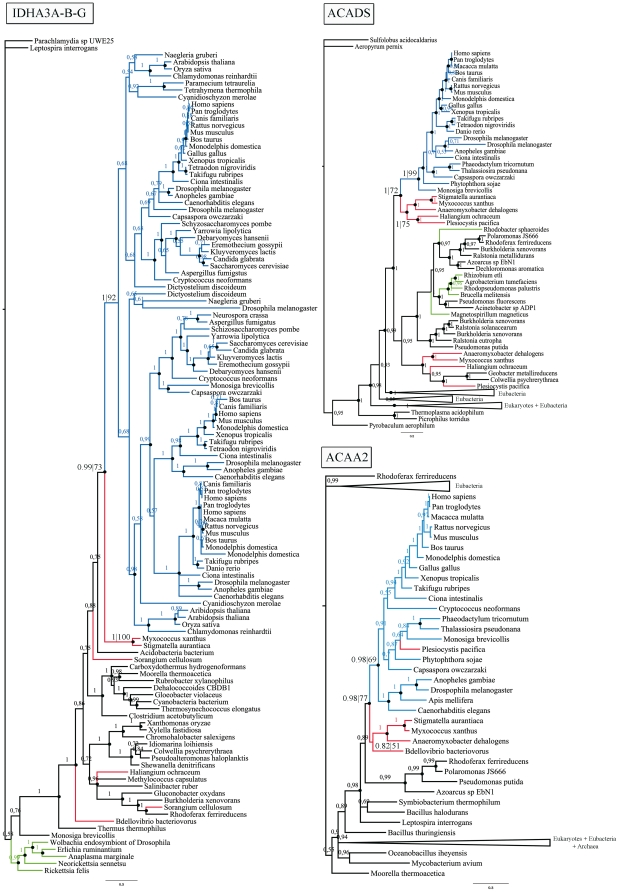
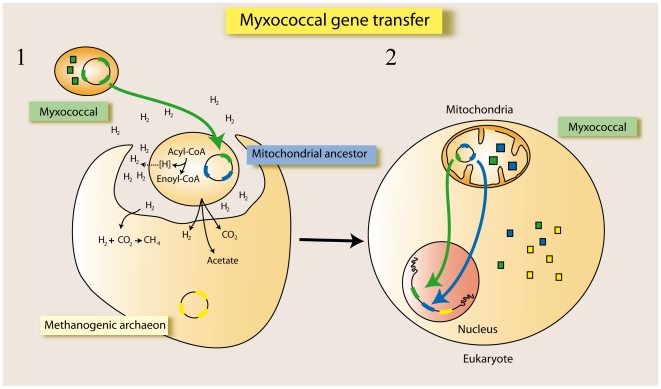
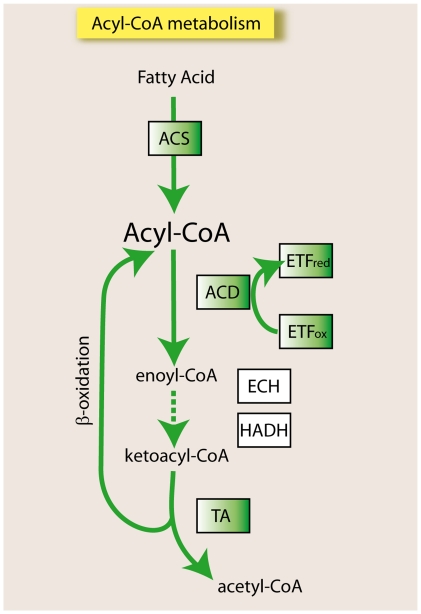
METHODOLOGY/PRINCIPAL FINDINGS: Here, we have applied a phylogenomic analysis to investigate a possible contribution of the Myxococcales to the first eukaryotes. We conducted a conservative pipeline with homologous sequence searches against a genomic sampling of 40 eukaryotic and 357 prokaryotic genomes. The phylogenetic reconstruction showed that several eukaryotic proteins traced to Myxococcales. Most of these proteins were associated with mitochondrial lipid intermediate pathways, particularly enzymes generating reducing equivalents with pivotal roles in fatty acid β-oxidation metabolism. Our data suggest that myxococcal species with the ability to oxidize fatty acids transferred several genes to eubacteria that eventually gave rise to the mitochondrial ancestor. Later, the eukaryotic nucleocytoplasmic lineage acquired those metabolic genes through endosymbiotic gene transfer.
CONCLUSIONS/SIGNIFICANCE: Our results support a prokaryotic origin, different from α-proteobacteria, for several mitochondrial genes. Our data reinforce a fluid prokaryotic chromosome model in which the mitochondrion appears to be an important entry point for myxococcal genes to enter eukaryotes.
真核生物的起源仍然是进化生物学中的一个基本问题。虽然很明显真核生物的基因组是古细菌和细菌基因的嵌合体组合,但大多数细菌基因的具体起源仍然未知。微生物基因组的日益普及为分析真核生物基因组的起源和检验其起源的先前假说提供了可能。
方法/主要发现:在这里,我们应用了系统基因组学分析来研究粘球菌目是否可能对最初的真核生物做出了贡献。我们对 40 个真核生物和 357 个原核生物基因组进行了同源序列搜索的保守性分析。系统发育重建表明,几种真核生物蛋白可以追溯到粘球菌目。这些蛋白中的大多数与线粒体脂质中间体途径有关,特别是在脂肪酸β-氧化代谢中具有关键作用的生成还原当量的酶。我们的数据表明,具有氧化脂肪酸能力的粘球菌种将几个基因转移到了细菌中,这些细菌最终成为线粒体的祖先。后来,真核生物核质系通过内共生基因转移获得了这些代谢基因。
结论/意义:我们的结果支持了几个线粒体基因的原核起源,不同于α-变形菌。我们的数据强化了一个流动的原核染色体模型,其中线粒体似乎是粘球菌基因进入真核生物的一个重要切入点。