Biol Direct. 2011 Oct 20;6:55. doi: 10.1186/1745-6150-6-55.
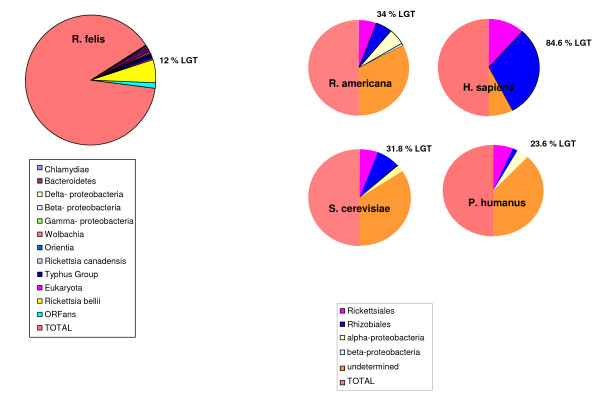
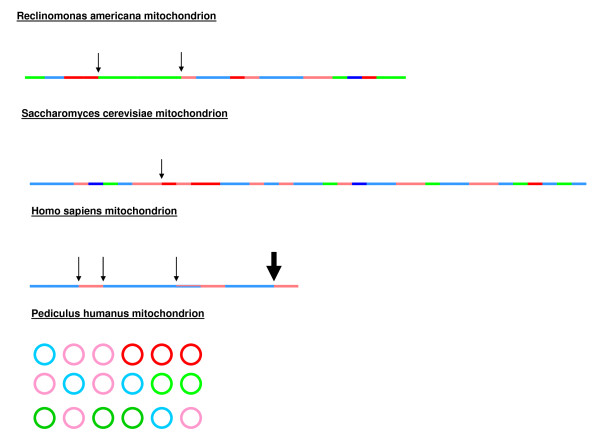
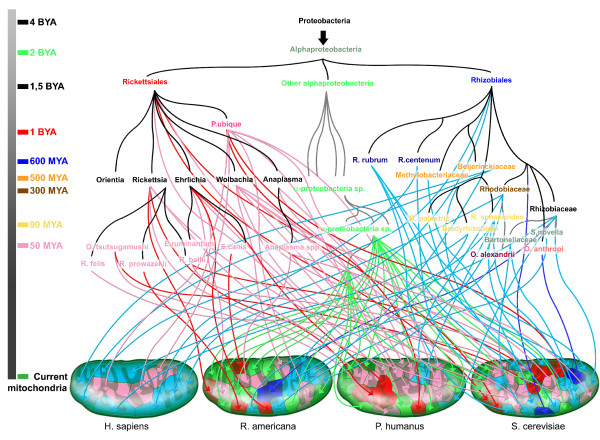
Mitochondria are thought to have evolved from eubacteria-like endosymbionts; however, the origin of the mitochondrion remains a subject of debate. In this study, we investigated the phenomenon of chimerism in mitochondria to shed light on the origin of these organelles by determining which species played a role in their formation. We used the mitochondria of four distinct organisms, Reclinomonas americana, Homo sapiens, Saccharomyces cerevisiae and multichromosome Pediculus humanus, and attempted to identify the origin of each mitochondrial gene.
Our results suggest that the origin of mitochondrial genes is not limited to the Rickettsiales and that the creation of these genes did not occur in a single event, but through multiple successive events. Some of these events are very old and were followed by events that are more recent and occurred through the addition of elements originating from current species. The points in time that the elements were added and the parental species of each gene in the mitochondrial genome are different to the individual species. These data constitute strong evidence that mitochondria do not have a single common ancestor but likely have numerous ancestors, including proto-Rickettsiales, proto-Rhizobiales and proto-Alphaproteobacteria, as well as current alphaproteobacterial species. The analysis of the multichromosome P. humanus mitochondrion supports this mechanism.
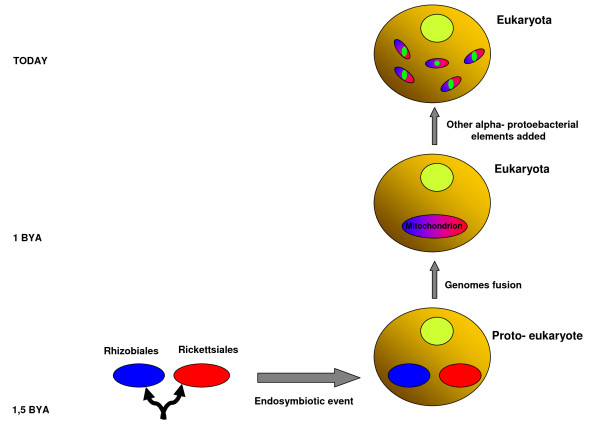
The most plausible scenario of the origin of the mitochondrion is that ancestors of Rickettsiales and Rhizobiales merged in a proto-eukaryotic cell approximately one billion years ago. The fusion of the Rickettsiales and Rhizobiales cells was followed by gene loss, genomic rearrangements and the addition of alphaproteobacterial elements through ancient and more recent recombination events. Each gene of each of the four studied mitochondria has a different origin, while in some cases, multichromosomes may allow for enhanced gene exchange. Therefore, the tree of life is not sufficient to explain the chimeric structure of current genomes, and the theory of a single common ancestor and a top-down tree does not reflect our current state of knowledge. Mitochondrial evolution constitutes a rhizome, and it should be represented as such.
线粒体被认为是由类似于真细菌的内共生体进化而来的;然而,线粒体的起源仍然是一个争论的话题。在这项研究中,我们通过确定哪些物种在其形成过程中发挥了作用,研究了线粒体嵌合体的现象,以揭示这些细胞器的起源。我们使用了四种不同的生物体的线粒体,即 Reclinomonas americana、智人、酿酒酵母和多染色体 Pediculus humanus,并试图确定每个线粒体基因的起源。
我们的结果表明,线粒体基因的起源并不仅限于立克次体目,而且这些基因的创造不是在一次事件中发生的,而是通过多次连续的事件发生的。其中一些事件非常古老,随后是更近的事件,这些事件通过添加来自当前物种的元素而发生。添加元素的时间点以及线粒体基因组中每个基因的亲代物种与个别物种不同。这些数据构成了强有力的证据,表明线粒体没有一个单一的共同祖先,而是可能有许多祖先,包括原立克次体目、原根瘤菌目和原α变形菌,以及当前的α变形菌物种。对多染色体 P. humanus 线粒体的分析支持了这一机制。
线粒体起源最合理的情景是,立克次体目和根瘤菌目的祖先在大约十亿年前融合在一个原真核细胞中。立克次体目和根瘤菌目细胞的融合后,发生了基因丢失、基因组重排以及通过古老和更近的重组事件添加α变形菌元素。所研究的四个线粒体中的每个基因都有不同的起源,而在某些情况下,多染色体可能允许增强基因交换。因此,生命之树不足以解释当前基因组的嵌合体结构,而单一共同祖先和自上而下的树理论并不反映我们当前的知识状态。线粒体进化构成了一个根茎,应该以这样的方式来表示。