Biomechanics and Imaging Group, Department of Orthopaedics, Leiden University Medical Center, PO Box 9600, J11-S, 2300 RC, Leiden, The Netherlands.
Knee Surg Sports Traumatol Arthrosc. 2012 Mar;20(3):559-64. doi: 10.1007/s00167-011-1605-y. Epub 2011 Jul 15.
The aim of this study was to compare a broad range of total knee prostheses with different design parameters to determine whether in vivo kinematics was consistently related to design. The hypothesis was that there are no clear recognizable differences in in vivo kinematics between different design parameters or prostheses.
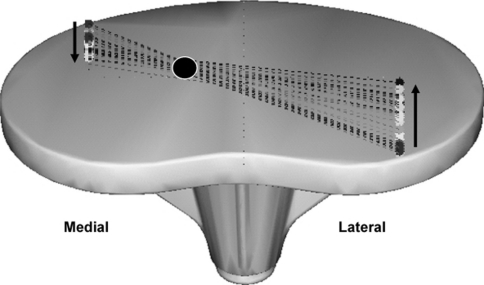
At two sites, data were collected by a single observer on 52 knees (49 subjects with rheumatoid arthritis or osteoarthritis). Six different total knee prostheses were used: multi-radius, single-radius, fixed-bearing, mobile-bearing, posterior-stabilized, cruciate retaining and cruciate sacrificing. Knee kinematics was recorded using fluoroscopy as the patients performed a step-up motion.
There was a significant effect of prosthetic design on all outcome parameters; however, post hoc tests showed that the NexGen group was responsible for 80% of the significant values. The range of knee flexion was much smaller in this group, resulting in smaller anterior-posterior translations and rotations.
Despite kinematics being generally consistent with the kinematics intended by their design, there were no clear recognizable differences in in vivo kinematics between different design parameters or prostheses. Hence, the differences in design parameters or prostheses are not distinct enough to have an effect on clinical outcome of patients.
Therapeutic study, Level III.
本研究旨在比较具有不同设计参数的广泛的全膝关节假体,以确定体内运动学是否与设计一致。假设是不同设计参数或假体之间不存在明显可识别的体内运动学差异。
在两个地点,由一名观察者对 52 个膝关节(49 名类风湿关节炎或骨关节炎患者)进行数据收集。使用了六种不同的全膝关节假体:多半径、单半径、固定轴承、活动轴承、后稳定、保留十字韧带和牺牲十字韧带。当患者进行上台阶运动时,使用透视法记录膝关节运动学。
假体设计对所有结果参数均有显著影响;然而,事后检验表明,NexGen 组负责 80%的显著值。该组的膝关节屈曲范围小得多,导致前后平移和旋转较小。
尽管运动学通常与设计预期的运动学一致,但不同设计参数或假体之间的体内运动学没有明显可识别的差异。因此,设计参数或假体的差异不够明显,不会对患者的临床结果产生影响。
治疗研究,III 级。