Department of Community Medicine, Faculty of Health Sciences, University of Tromsø, N-9037 Tromsø, Norway.
BMC Psychiatry. 2011 Jul 17;11:112. doi: 10.1186/1471-244X-11-112.
Little research has been done on the relationship between malnutrition and mental health in community living elderly individuals. In the present study, we aimed to assess the associations between mental health (particularly anxiety and depression) and both the risk of malnutrition and body mass index (BMI, kg/m(2)) in a large sample of elderly men and women from Tromsø, Norway.
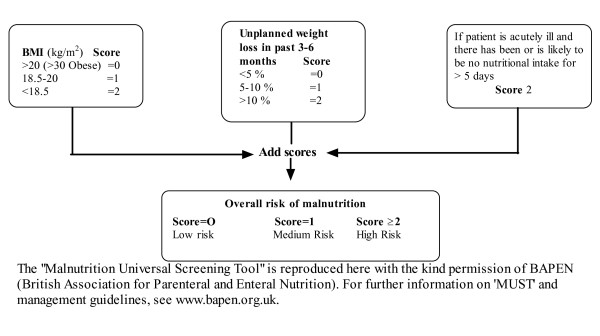
In a cross-sectional survey, with 1558 men and 1553 women aged 65 to 87 years, the risk of malnutrition was assessed by the Malnutrition Universal Screening Tool ('MUST'), and mental health was measured by the Symptoms Check List 10 (SCL-10). BMI was categorised into six groups (< 20.0, 20.0-22.4, 22.5-24.9, 25.0-27.4, 27.5-29.9, ≥ 30.0 kg/m(2)).
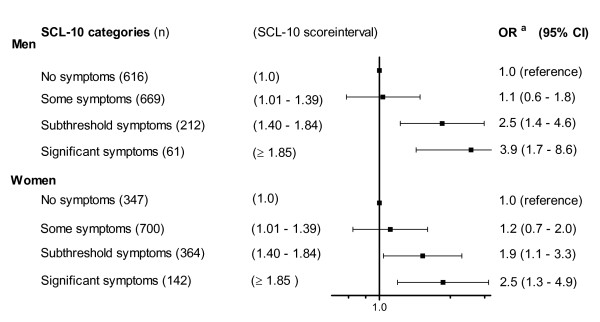
The risk of malnutrition (combining medium and high risk) was found in 5.6% of the men and 8.6% of the women. Significant mental health symptoms were reported by 3.9% of the men and 9.1% of the women. In a model adjusted for age, marital status, smoking and education, significant mental health symptoms (SCL-10 score ≥ 1.85) were positively associated with the risk of malnutrition (odds ratio 3.9 [95% CI 1.7-8.6] in men and 2.5 [95%CI 1.3-4.9] in women), the association was positive also for subthreshold mental health symptoms. For individuals with BMI < 20.0 the adjusted odds ratio for significant mental health symptoms was 2.0 [95% CI 1.0-4.0].
Impaired mental health was strongly associated with the risk of malnutrition in community living elderly men and women and this association was also significant for subthreshold mental health symptoms.
针对社区中生活的老年人营养不良与心理健康之间的关系,研究甚少。本研究旨在评估在挪威特罗姆瑟的一个大型男女老年人样本中,心理健康(特别是焦虑和抑郁)与营养不良风险和体重指数(BMI,kg/m(2))之间的关系。
在一项横断面调查中,纳入了 1558 名男性和 1553 名年龄在 65 至 87 岁的女性,采用营养不良通用筛查工具(MUST)评估营养不良风险,采用症状清单 10(SCL-10)评估心理健康。BMI 分为六组(< 20.0、20.0-22.4、22.5-24.9、25.0-27.4、27.5-29.9、≥ 30.0 kg/m(2))。
5.6%的男性和 8.6%的女性存在营养不良风险(中高危)。3.9%的男性和 9.1%的女性报告存在明显的心理健康症状。在调整年龄、婚姻状况、吸烟和教育因素的模型中,明显的心理健康症状(SCL-10 评分≥1.85)与营养不良风险呈正相关(男性比值比 3.9 [95%CI 1.7-8.6],女性比值比 2.5 [95%CI 1.3-4.9]),亚临床心理健康症状也存在这种相关性。对于 BMI<20.0 的个体,明显心理健康症状的调整比值比为 2.0 [95%CI 1.0-4.0]。
社区生活的老年男女中,受损的心理健康与营养不良风险密切相关,亚临床心理健康症状也存在这种相关性。