Public Health Science Division, Fred Hutchinson Cancer Research Center, Seattle, WA 98109-1024, USA.
Cancer Epidemiol Biomarkers Prev. 2011 Sep;20(9):1822-30. doi: 10.1158/1055-9965.EPI-11-0364. Epub 2011 Jul 15.
Selenium may prevent colorectal cancer. However, several previous studies are small and few investigated the association between selenium and colorectal cancer among women whose selenium metabolism may differ from men. Furthermore, genetic variants in selenoenzymes may be associated with colorectal cancer risk.
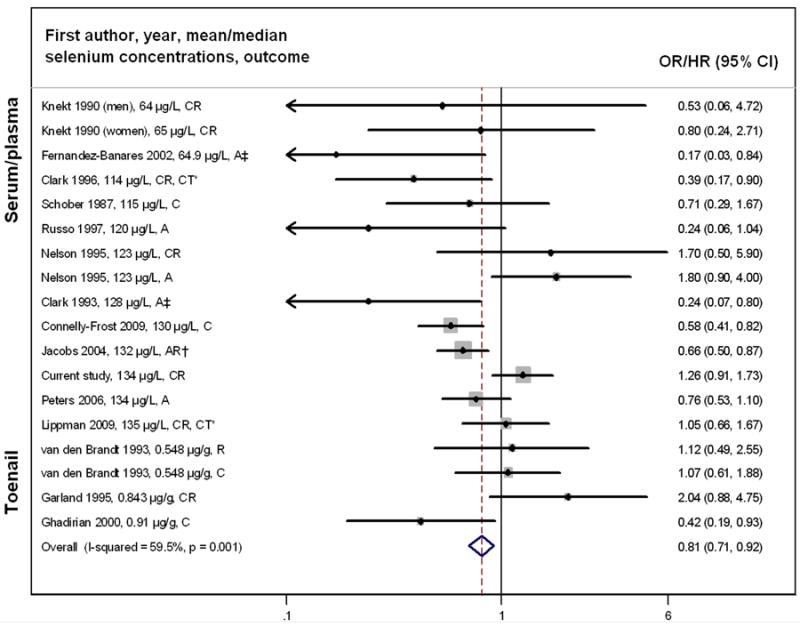
This nested case-control study investigated whether serum selenium concentration and genetic variants in five selenoenzymes (glutathione peroxidase 1-4 and selenoprotein P) were associated with colorectal cancer risk in 804 colorectal cancer cases and 805 matched controls from the Women's Health Initiative (WHI) Observational Study. A meta-analysis was conducted to compare the WHI result with previous studies including 12 observational studies and two clinical trials on selenium.
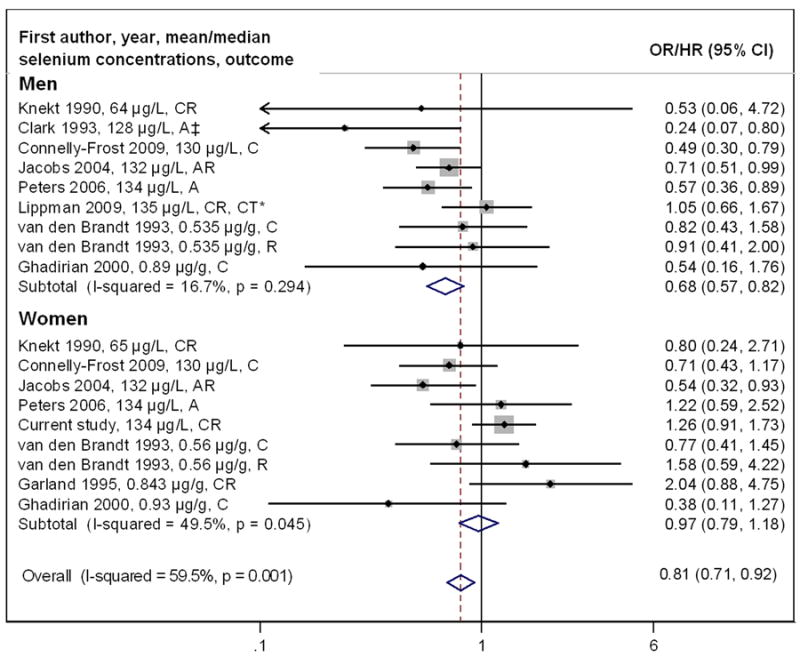
Within the WHI, selenium concentrations were relatively high (mean = 135.6 μg/L) and were not associated with colorectal cancer risk (P(trend) = 0.10); the adjusted OR comparing the fifth with first quintile was 1.26 (95% CI, 0.91-1.73). Moreover, genetic variants in selenoenzymes were not significantly associated with colorectal cancer risk. Consistent with the finding in WHI, our meta-analysis showed no association between selenium and colorectal tumor risk in women (OR = 0.97; 95% CI, 0.79-1.18) comparing the highest quantile with the lowest); however, in men, there was a significant inverse association (OR = 0.68; 95% CI, 0.57-0.82) (P = 0.01).
Consistent with previous studies, we observed no protective effect of selenium on colorectal cancer among women.
Our analyses suggest that a population with relatively high selenium concentrations, especially women, would not benefit from increasing selenium intake.
硒可能预防结直肠癌。然而,之前的几项研究规模较小,且很少有研究调查硒代谢可能不同于男性的女性的硒与结直肠癌之间的关系。此外,硒酶的遗传变异可能与结直肠癌风险相关。
这项巢式病例对照研究调查了在妇女健康倡议(WHI)观察研究中的 804 例结直肠癌病例和 805 例匹配对照中,血清硒浓度和五种硒酶(谷胱甘肽过氧化物酶 1-4 和硒蛋白 P)中的遗传变异是否与结直肠癌风险相关。进行了一项荟萃分析,以比较 WHI 结果与之前包括 12 项观察性研究和两项硒临床试验的研究。
在 WHI 中,硒浓度相对较高(平均值=135.6μg/L),与结直肠癌风险无关(P(趋势)=0.10);与五分位第一分位相比,第五分位的调整 OR 为 1.26(95%CI,0.91-1.73)。此外,硒酶的遗传变异与结直肠癌风险无显著相关性。与 WHI 中的发现一致,我们的荟萃分析显示,在女性中,硒与结直肠肿瘤风险之间没有关联(OR=0.97;95%CI,0.79-1.18)(比较最高分位数与最低分位数);然而,在男性中,存在显著的反比关系(OR=0.68;95%CI,0.57-0.82)(P=0.01)。
与之前的研究一致,我们观察到硒对女性结直肠癌没有保护作用。
我们的分析表明,人群中硒浓度相对较高,特别是女性,增加硒摄入不会带来益处。