Rizzo Milena, Evangelista Monica, Simili Marcella, Mariani Laura, Pitto Letizia, Rainaldi Giuseppe
Laboratory of Gene and Molecular Therapy, Institute of Clinical Physiology, CNR, Pisa, Italy.
Aging (Albany NY). 2011 Jul;3(7):665-71. doi: 10.18632/aging.100353.
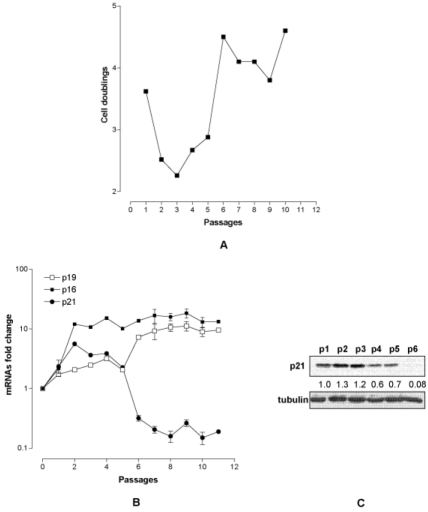
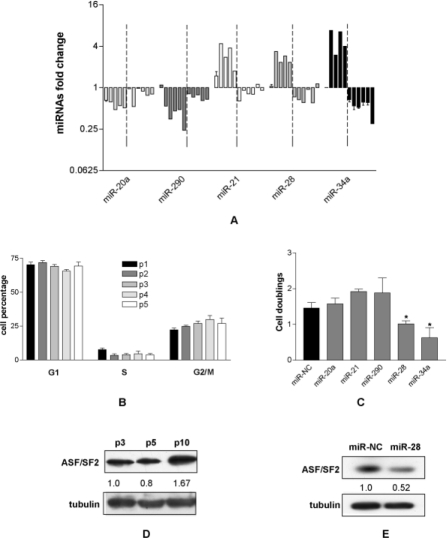
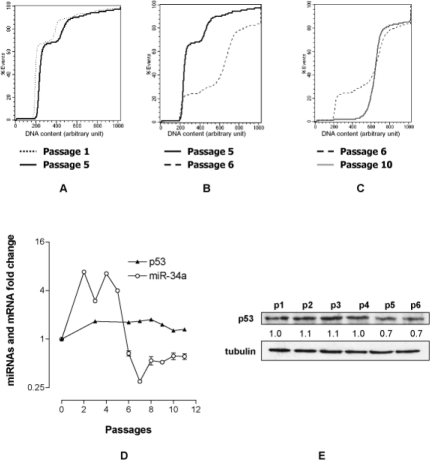
The life span (Hayflick limit) of primary mouse embryo fibroblasts (MEF) in culture is variable but it is still unclear if the escape of the Hayflick limit is also variable. To address this point MEF were expanded every fifteen days (6T15) instead of every three days (6T3) until they became immortal. With this protocol MEF lifespan was extended and immortalization accordingly delayed. By testing a panel of genes (p19ARF, p16, p21) and miRNAs (miR-20a, miR-21, miR-28, miR-290) related to primary MEF senescence, a switch of p21 from up to down regulation, the down regulation of specific miRNAs as well as a massive shift from diploidy to hyperdiploidy were observed in coincidence with the resumption of cell proliferation. Collectively, these data indicate that the inactivation of genes and miRNAs, important in controlling cell proliferation, might be determinant for the escape from the Hayflick limit. In support of this hypothesis was the finding that some of the down regulated miRNAs transfected in immortalized MEF inhibited cell proliferation thus displaying a tumor suppressor-like activity.
原代小鼠胚胎成纤维细胞(MEF)在培养中的寿命(海弗利克极限)是可变的,但海弗利克极限的突破是否也具有可变性仍不清楚。为了解决这一问题,MEF每15天传代一次(6T15),而不是每3天传代一次(6T3),直到它们永生化。通过该方案,MEF的寿命得以延长,永生化相应延迟。通过检测一组与原代MEF衰老相关的基因(p19ARF、p16、p21)和miRNA(miR-20a、miR-21、miR-28、miR-290),观察到随着细胞增殖的恢复,p21表达从上调转变为下调、特定miRNA下调以及从二倍体到超二倍体的大量转变。总体而言,这些数据表明,在控制细胞增殖中起重要作用的基因和miRNA的失活可能是突破海弗利克极限的决定因素。支持这一假设的是以下发现:在永生化MEF中转染一些下调的miRNA会抑制细胞增殖,从而表现出类似肿瘤抑制因子的活性。