Jeyapalan Jessie C, Sedivy John M
Department of Molecular Biology, Cell Biology and Biochemistry, Brown University, Providence, RI 02912, USA.
Aging (Albany NY). 2013 Feb;5(2):120-9. doi: 10.18632/aging.100536.
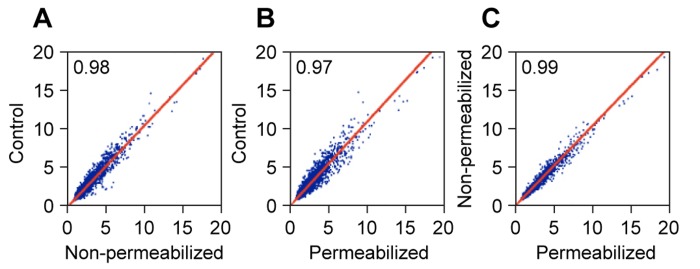
Here we describe a carefully optimized method for the preparation of high quality RNA by flow sorting of formaldehyde fixed senescent cells immunostained for any intracellular antigen. Replicative cellular senescence is a phenomenon of irreversible growth arrest triggered by the accumulation of a discrete number of cell divisions. The underlying cause of senescence due to replicative exhaustion is telomere shortening. We document here a spontaneous and apparently stochastic process that continuously generates senescent cells in cultures fully immortalized with telomerase. In the course of studying this phenomenon we developed a preparative fluorescence activated flow sorting method based on immunofluorescent staining of intracellular antigens that can also deliver RNA suitable for quantitative analysis of global gene expression. The protocols were developed using normal human diploid fibroblasts (HDF) and up to 5x10⁷ cells could be conveniently processed in a single experiment. The methodology is based on formaldehyde crosslinking of cells, followed by permeabilization, antibody staining, flow sorting, reversal of the crosslinks, and recovery of the RNA. We explored key parameters such as crosslink reversal that affect the fragmentation of RNA. The recovered RNA is of high quality for downstream molecular applications based on short range sequence analysis, such qPCR, hybridization microarrays, and next generation sequencing. The RNA was analyzed by Affymetrix Gene Chip expression profiling and compared to RNA prepared by the direct lysis of cells. The correlation between the data sets was very high, indicating that the procedure does not introduce systematic changes in the mRNA transcriptome. The methods presented in this communication should be of interest to many investigators working in diverse model systems.
在此,我们描述了一种经过精心优化的方法,用于通过对针对任何细胞内抗原进行免疫染色的甲醛固定衰老细胞进行流式分选来制备高质量RNA。复制性细胞衰老乃是由一定数量的细胞分裂积累所引发的不可逆生长停滞现象。因复制性耗竭导致衰老的根本原因是端粒缩短。我们在此记录了一个自发且明显随机的过程,该过程在经端粒酶完全永生化的培养物中持续产生衰老细胞。在研究此现象的过程中,我们开发了一种基于细胞内抗原免疫荧光染色的制备性荧光激活流式分选方法,该方法还能提供适用于全局基因表达定量分析的RNA。这些方案是使用正常人二倍体成纤维细胞(HDF)制定的,在单个实验中可方便地处理多达5×10⁷个细胞。该方法基于细胞的甲醛交联,随后进行通透处理、抗体染色、流式分选、交联逆转以及RNA回收。我们探究了诸如交联逆转等影响RNA片段化的关键参数。回收的RNA质量很高,可用于基于短程序列分析的下游分子应用,如定量聚合酶链反应(qPCR)、杂交微阵列和下一代测序。通过Affymetrix基因芯片表达谱分析对RNA进行了分析,并与通过细胞直接裂解制备的RNA进行了比较。数据集之间的相关性非常高,表明该程序不会在mRNA转录组中引入系统性变化。本通讯中介绍的方法应该会引起许多在不同模型系统中工作的研究人员的兴趣。