Stephens Nathan A, Skipworth Richard J E, Macdonald Alisdair J, Greig Carolyn A, Ross James A, Fearon Kenneth C H
Department of Clinical and Surgical Sciences (Surgery), School of Clinical Sciences and Community Health, University of Edinburgh, Royal Infirmary, 51 Little France Crescent, Edinburgh, EH16 4SA UK.
J Cachexia Sarcopenia Muscle. 2011 Jun;2(2):111-117. doi: 10.1007/s13539-011-0030-x. Epub 2011 May 31.
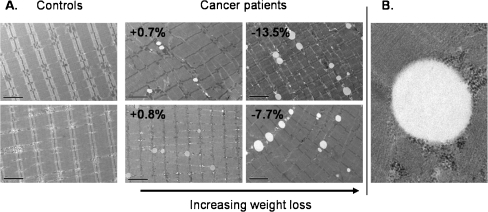
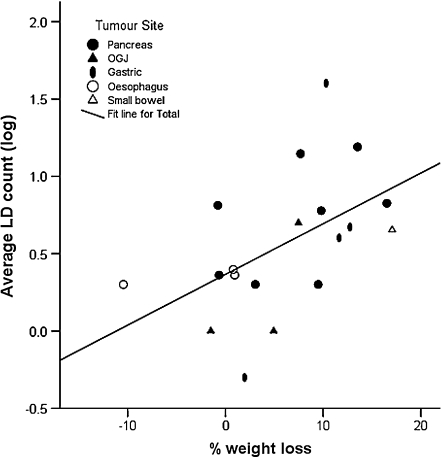
Intramyocellular lipids are an important source of fuel for mitochondrial fat oxidation and play an important role in intramuscular lipid homeostasis. We hypothesised that due to the phenotype associated with cancer cachexia, there would exist an association between increasing weight loss and the number/size of intramyocellular lipid droplets. METHODS: Nineteen cancer patients and 6 controls undergoing surgery were recruited. A rectus abdominis biopsy was performed and processed for transmission electron microscopy (TEM). The number of intramyocellular lipid droplets and lipid droplet diameter were calculated from the TEM images. CT scans, performed as part of patients' routine care, were analysed to determine amount of adipose (intermuscular, visceral and subcutaneous) and muscle tissue. RESULTS: Compared with controls, cancer patients had increased numbers of lipid droplets (mean (SD) 1.8 (1.9) vs. 6.4 (9.1) per ×2,650 field, respectively, p = 0.036). Mean (SD) lipid droplet diameter was also higher in cancer patients compared with controls (0.42 (0.13) vs. 0.24 (0.21) μm, p = 0.015). Mean lipid droplet count correlated positively with the severity of weight loss (R = 0.51, p = 0.025) and negatively with CT-derived measures of intermuscular fat (R = -0.53, p = 0.022) and visceral fat (R = -0.51, p = 0.029). CONCLUSIONS: This study suggests that the number and size of intramyocellular lipid droplets is increased in the presence of cancer and increases further with weight loss/loss of adipose mass in other body compartments.
肌内脂质是线粒体脂肪氧化的重要燃料来源,在肌内脂质稳态中发挥重要作用。我们推测,由于与癌症恶病质相关的表型,体重减轻增加与肌内脂质滴数量/大小之间存在关联。方法:招募了19名癌症患者和6名接受手术的对照者。进行腹直肌活检并处理用于透射电子显微镜(TEM)检查。从TEM图像计算肌内脂质滴数量和脂质滴直径。作为患者常规护理一部分进行的CT扫描被分析以确定脂肪(肌间、内脏和皮下)和肌肉组织的量。结果:与对照组相比,癌症患者的脂质滴数量增加(分别为每×2,650视野平均(标准差)1.8(1.9)个与6.4(9.1)个,p = 0.036)。与对照组相比,癌症患者的平均(标准差)脂质滴直径也更高(0.42(0.13)μm与0.24(0.21)μm,p = 0.015)。平均脂质滴计数与体重减轻的严重程度呈正相关(R = 0.51,p = 0.025),与CT衍生的肌间脂肪测量值呈负相关(R = -0.53,p = 0.022),与内脏脂肪呈负相关(R = -0.51,p = 0.029)。结论:本研究表明,癌症患者存在时肌内脂质滴的数量和大小增加,并且随着体重减轻/身体其他部位脂肪量的减少而进一步增加。