Research ServiceSt. Louis Veterans Affairs Medical Center, St. Louis, Missouri, USA.
J Addict Med. 2008 Jun;2(2):85-95. doi: 10.1097/ADM.0b013e31816d699f.
: This study was designed to empirically derive latent classes based on PG criteria and to assess the association between nongambling psychiatric disorders and specific classes.
: A total of 8138 community-based middle-aged men were surveyed, and 2720 were assessed for Diagnostic Interview Schedule, Version 3, Revised (DIS-III-R) pathologic gambling (PG). Latent class analysis (LCA) was applied to Diagnostic and Statistical Manual Version 3, Revised (DSM-III-R) criteria to identify gambling classes. χ and logistic regression models evaluated the association between gambling classes and lifetime psychiatric disorders.
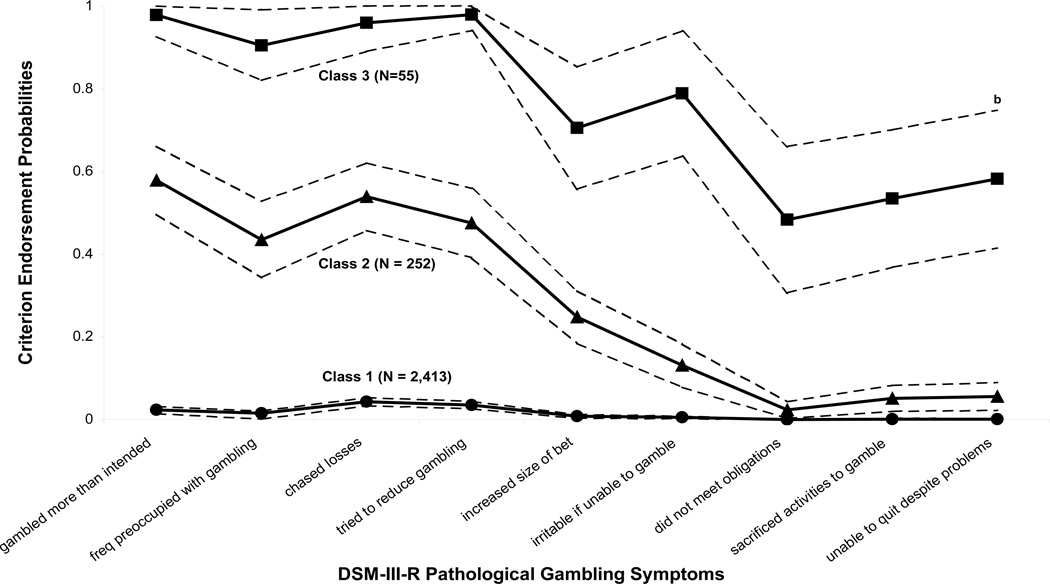
: The final model included 4 classes: class 0 (ie, 5418 individuals who never gambled 25 or more times per year) and classes 1-3 (identified by the LCA and comprising 2720 respondents assessed for PG). For the 9 individual criteria of PG, endorsement percentages ranged from 2%-6%, 4%-58%, and 53%-100% for classes 1-3, respectively. Nongambling psychiatric disorders were differentially associated with the 4 gambling classes, and psychopathology was more common in groups more frequently acknowledging PG criteria.
: Empirical support is provided for distinct classes of gambling behaviors demonstrating differential associations with individual PG criteria and nongambling psychiatric disorders. The data-driven categorization of gambling behaviors provides direction for research on defining, preventing, and treating syndromal and subsyndromal PG.
本研究旨在根据 PG 标准对潜在类别进行实证推导,并评估非赌博性精神障碍与特定类别之间的关系。
对 8138 名社区中年男性进行了调查,其中 2720 人接受了诊断访谈表,第三版修订版(DIS-III-R)病理性赌博(PG)评估。应用潜在类别分析(LCA)对诊断和统计手册,第三版修订版(DSM-III-R)标准进行分析,以确定赌博类别。χ 和逻辑回归模型评估了赌博类别的终生精神障碍之间的关联。
最终模型包括 4 个类别:类别 0(即从未每年赌博 25 次或以上的 5418 个人)和类别 1-3(通过 LCA 确定,由 2720 名接受 PG 评估的受访者组成)。对于 PG 的 9 个个体标准,类别的认可百分比分别为 2%-6%、4%-58%和 53%-100%。非赌博性精神障碍与 4 个赌博类别有不同的关联,而精神病理学在更多地承认 PG 标准的群体中更为常见。
为具有不同关联的赌博行为提供了实证支持个体 PG 标准和非赌博性精神障碍。赌博行为的基于数据的分类为定义、预防和治疗综合征和亚综合征 PG 提供了方向。