BMC Med. 2011 Jul 19;9:88. doi: 10.1186/1741-7015-9-88.
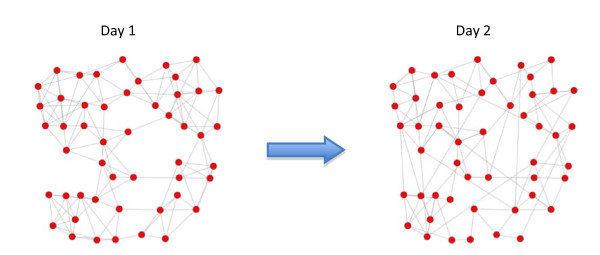
Mathematical models are useful tools for understanding and predicting epidemics. A recent innovative modeling study by Stehle and colleagues addressed the issue of how complex models need to be to ensure accuracy. The authors collected data on face-to-face contacts during a two-day conference. They then constructed a series of dynamic social contact networks, each of which was used to model an epidemic generated by a fast-spreading airborne pathogen. Intriguingly, Stehle and colleagues found that increasing model complexity did not always increase accuracy. Specifically, the most detailed contact network and a simplified version of this network generated very similar results. These results are extremely interesting and require further exploration to determine their generalizability.
数学模型是理解和预测传染病的有用工具。Stehle 及其同事最近进行了一项创新性的建模研究,探讨了复杂模型需要达到何种精确程度的问题。作者收集了在为期两天的会议期间面对面接触的数据。然后,他们构建了一系列动态社会接触网络,每个网络都用于模拟由快速传播的空气传播病原体引起的传染病。有趣的是,Stehle 及其同事发现增加模型复杂性并不总是能提高准确性。具体来说,最详细的接触网络和该网络的简化版本产生了非常相似的结果。这些结果非常有趣,需要进一步研究以确定其普遍性。