Department of Chemistry, University of Wisconsin-Madison, Madison, WI, USA.
Mol Syst Biol. 2011 Jul 19;7:514. doi: 10.1038/msb.2011.48.
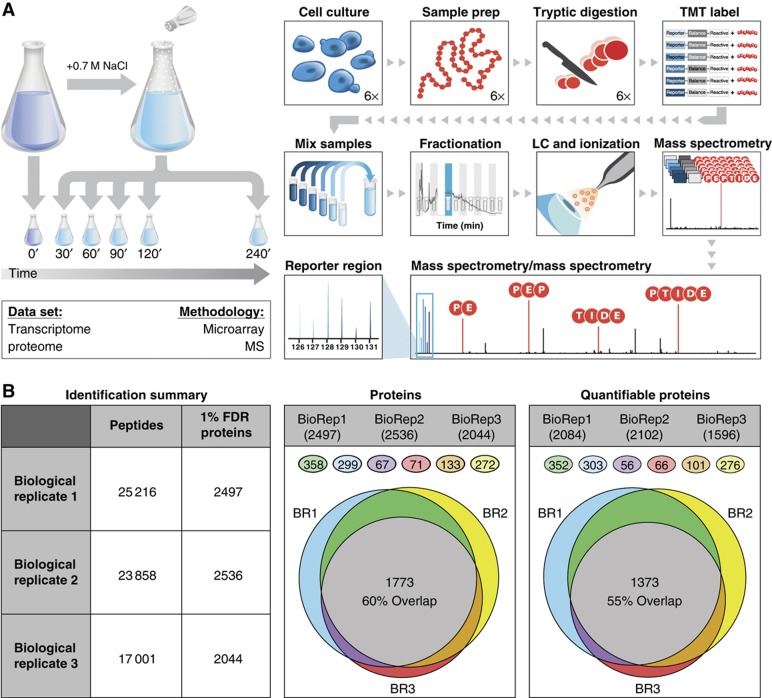
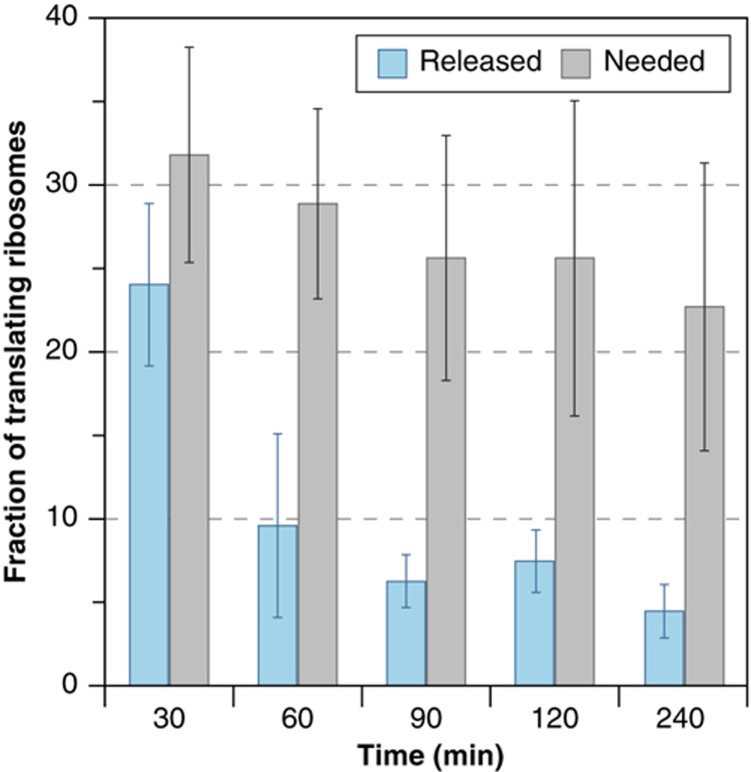
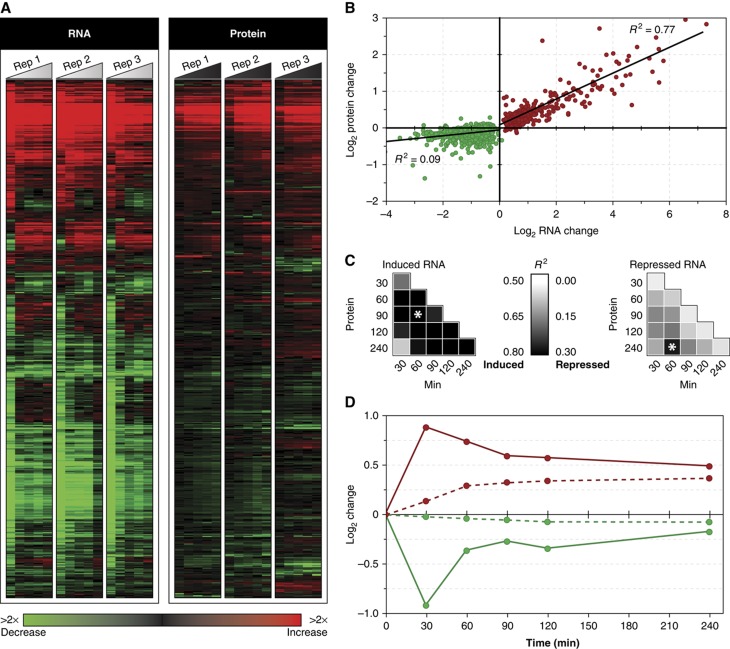
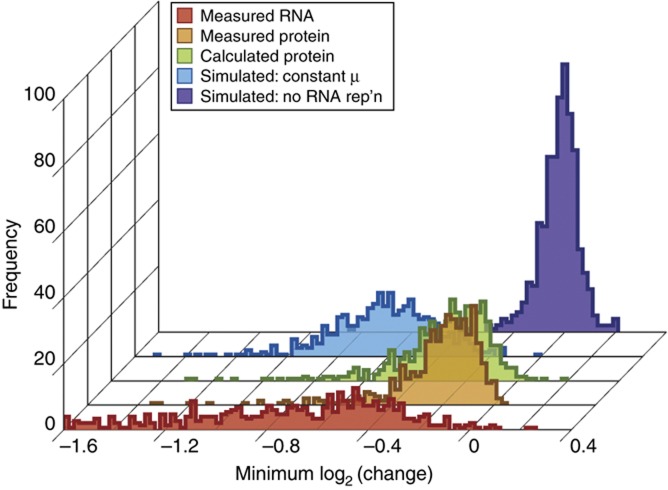
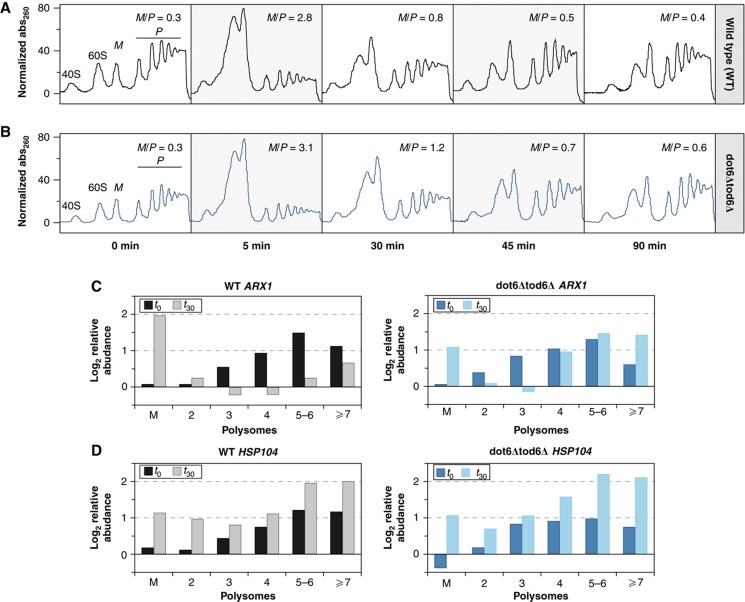
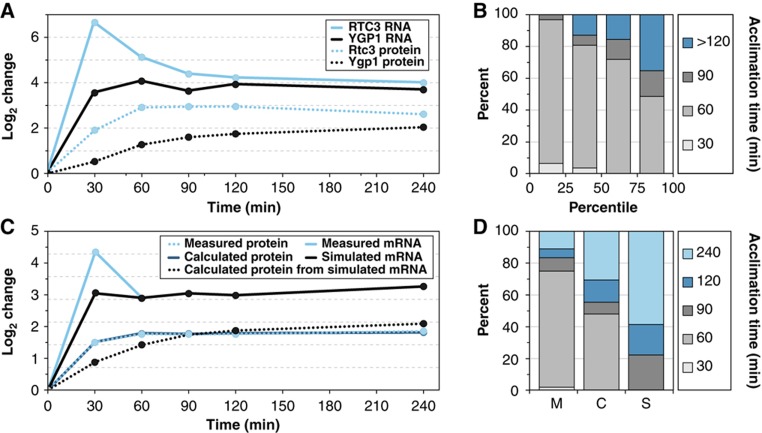
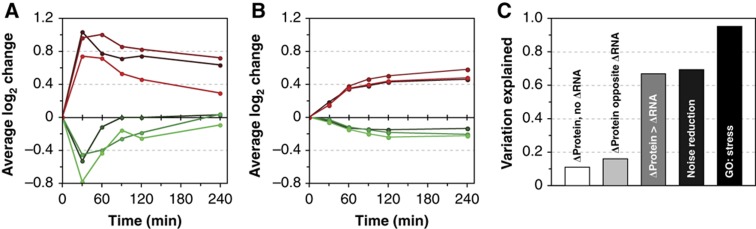
The transcriptome and proteome change dynamically as cells respond to environmental stress; however, prior proteomic studies reported poor correlation between mRNA and protein, rendering their relationships unclear. To address this, we combined high mass accuracy mass spectrometry with isobaric tagging to quantify dynamic changes in ~2500 Saccharomyces cerevisiae proteins, in biological triplicate and with paired mRNA samples, as cells acclimated to high osmolarity. Surprisingly, while transcript induction correlated extremely well with protein increase, transcript reduction produced little to no change in the corresponding proteins. We constructed a mathematical model of dynamic protein changes and propose that the lack of protein reduction is explained by cell-division arrest, while transcript reduction supports redistribution of translational machinery. Furthermore, the transient 'burst' of mRNA induction after stress serves to accelerate change in the corresponding protein levels. We identified several classes of post-transcriptional regulation, but show that most of the variance in protein changes is explained by mRNA. Our results present a picture of the coordinated physiological responses at the levels of mRNA, protein, protein-synthetic capacity, and cellular growth.
当细胞响应环境压力时,转录组和蛋白质组会动态变化;然而,之前的蛋白质组学研究报告称 mRNA 和蛋白质之间的相关性较差,使得它们的关系不明确。为了解决这个问题,我们将高质量精度质谱与同位素标记相结合,定量分析了约 2500 个酿酒酵母蛋白在高渗透压条件下适应过程中的动态变化,在生物学重复三次并与配对的 mRNA 样本进行了分析。令人惊讶的是,尽管转录物的诱导与蛋白质的增加高度相关,但转录物的减少几乎没有导致相应蛋白质的变化。我们构建了一个动态蛋白质变化的数学模型,并提出缺乏蛋白质减少的原因是细胞分裂停滞,而转录物的减少则支持翻译机制的重新分配。此外,应激后 mRNA 诱导的短暂“爆发”有助于加速相应蛋白质水平的变化。我们确定了几类转录后调控,但表明大多数蛋白质变化的方差都可以用 mRNA 来解释。我们的研究结果展示了在 mRNA、蛋白质、蛋白质合成能力和细胞生长水平上协调的生理反应的全貌。