Deakin University, Melbourne, Victoria, Australia.
Cortex. 2012 Oct;48(9):1138-54. doi: 10.1016/j.cortex.2011.06.001. Epub 2011 Jun 12.
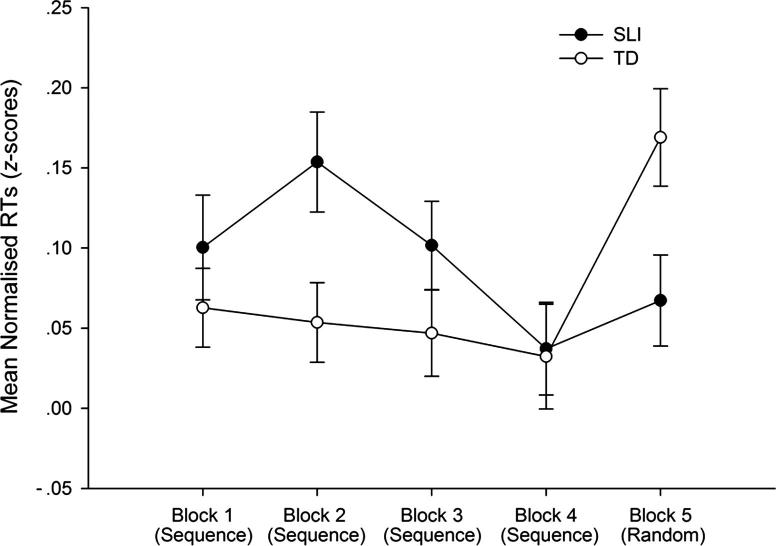
According to the Procedural Deficit Hypothesis (PDH), abnormalities of brain structures underlying procedural memory largely explain the language deficits in children with specific language impairment (SLI). These abnormalities are posited to result in core deficits of procedural memory, which in turn explain the grammar problems in the disorder. The abnormalities are also likely to lead to problems with other, non-procedural functions, such as working memory, that rely at least partly on the affected brain structures. In contrast, declarative memory is expected to remain largely intact, and should play an important compensatory role for grammar. These claims were tested by examining measures of working, declarative and procedural memory in 51 children with SLI and 51 matched typically-developing (TD) children (mean age 10). Working memory was assessed with the Working Memory Test Battery for Children, declarative memory with the Children's Memory Scale, and procedural memory with a visuo-spatial Serial Reaction Time task. As compared to the TD children, the children with SLI were impaired at procedural memory, even when holding working memory constant. In contrast, they were spared at declarative memory for visual information, and at declarative memory in the verbal domain after controlling for working memory and language. Visuo-spatial short-term memory was intact, whereas verbal working memory was impaired, even when language deficits were held constant. Correlation analyses showed neither visuo-spatial nor verbal working memory was associated with either lexical or grammatical abilities in either the SLI or TD children. Declarative memory correlated with lexical abilities in both groups of children. Finally, grammatical abilities were associated with procedural memory in the TD children, but with declarative memory in the children with SLI. These findings replicate and extend previous studies of working, declarative and procedural memory in SLI. Overall, we suggest that the evidence largely supports the predictions of the PDH.
根据程序缺陷假说(PDH),程序性记忆的大脑结构异常在很大程度上解释了特定语言障碍(SLI)儿童的语言缺陷。这些异常被认为导致了程序性记忆的核心缺陷,进而解释了该障碍中的语法问题。这些异常也可能导致其他非程序性功能(如工作记忆)出现问题,而这些功能至少部分依赖于受影响的大脑结构。相比之下,陈述性记忆预计基本保持完整,并应为语法提供重要的补偿作用。通过检查 51 名 SLI 儿童和 51 名匹配的典型发育(TD)儿童(平均年龄 10 岁)的工作、陈述性和程序性记忆的测量来检验这些说法。工作记忆使用儿童工作记忆测试电池进行评估,陈述性记忆使用儿童记忆量表进行评估,程序性记忆使用视觉空间序列反应时间任务进行评估。与 TD 儿童相比,即使在保持工作记忆不变的情况下,SLI 儿童在程序性记忆方面也存在障碍。相比之下,他们在视觉信息的陈述性记忆和控制工作记忆和语言后的言语领域的陈述性记忆方面未受影响。视觉空间短期记忆完好无损,而言语工作记忆受损,即使在保持语言缺陷不变的情况下也是如此。相关分析表明,无论是在 SLI 儿童还是 TD 儿童中,视觉空间或言语工作记忆均与词汇或语法能力无关。在两组儿童中,陈述性记忆均与词汇能力相关。最后,在 TD 儿童中,语法能力与程序性记忆相关,而在 SLI 儿童中与陈述性记忆相关。这些发现复制并扩展了 SLI 中工作、陈述性和程序性记忆的先前研究。总体而言,我们认为证据在很大程度上支持 PDH 的预测。