Department of Metabolism/Diabetes and Clinical Nutrition, Nagasaki University Hospital, Nagasaki, Japan.
Diabetes Care. 2011 Sep;34(9):2084-9. doi: 10.2337/dc10-2274. Epub 2011 Jul 20.
Interferon therapy can trigger induction of several autoimmune diseases, including type 1 diabetes. To assess the clinical, immunologic, and genetic characteristics of type 1 diabetes induced by interferon therapy, we conducted a nationwide cross-sectional survey.
Clinical characteristics, anti-islet autoantibodies, and HLA-DR typing were examined in 91 patients for whom type 1 diabetes developed during or shortly after interferon therapy.
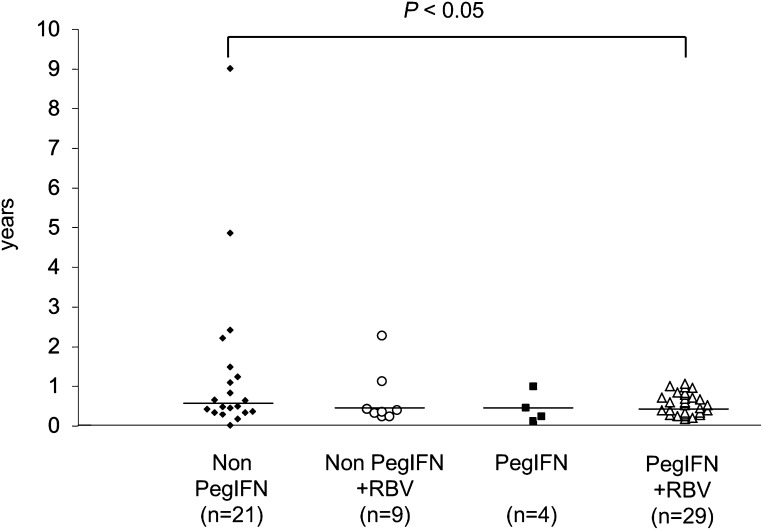
Median age at the onset of type 1 diabetes was 56 (interquartile range 48-63) years and mean ± SD BMI was 20.8 ± 2.7 kg/m(2). The time period from the initiation of interferon therapy to type 1 diabetes onset in patients receiving pegylated interferon and ribavirin was significantly shorter than that in patients with nonpegylated interferon single therapy (P < 0.05). Anti-islet autoantibodies were detected in 94.5% of patients at diabetes onset. Type 1 diabetes susceptibility HLA-DRs in the Japanese population, DR4 and DR9, were also associated with interferon treatment-related type 1 diabetes. Furthermore, the prevalence of HLA-DR13 was significantly higher in interferon treatment-related type 1 diabetes than in healthy control subjects (odds ratio 3.80 [95% CI 2.20-7.55]; P < 0.0001) and classical type 1 diabetes (2.15 [1.17-3.93]; P < 0.05).
Anti-islet autoantibodies should be investigated before and during interferon therapy to identify subjects at high risk of type 1 diabetes. Stronger antiviral treatment may induce earlier development of type 1 diabetes. Furthermore, patients who develop interferon-induced type 1 diabetes are genetically susceptible.
干扰素治疗可引发多种自身免疫性疾病,包括 1 型糖尿病。为评估干扰素治疗诱导的 1 型糖尿病的临床、免疫和遗传特征,我们进行了一项全国性的横断面研究。
对 91 例在干扰素治疗期间或之后不久发生 1 型糖尿病的患者,检测了其临床特征、抗胰岛自身抗体和 HLA-DR 分型。
1 型糖尿病发病的中位年龄为 56(四分位间距 48-63)岁,平均 BMI 为 20.8 ± 2.7 kg/m²。接受聚乙二醇干扰素和利巴韦林治疗的患者从开始干扰素治疗到发生 1 型糖尿病的时间明显短于接受非聚乙二醇干扰素单一治疗的患者(P < 0.05)。94.5%的患者在糖尿病发病时检测到抗胰岛自身抗体。日本人群中与 1 型糖尿病易感性相关的 HLA-DR 也与干扰素治疗相关的 1 型糖尿病有关,即 DR4 和 DR9。此外,干扰素治疗相关的 1 型糖尿病患者中 HLA-DR13 的患病率明显高于健康对照组(比值比 3.80 [95%CI 2.20-7.55];P < 0.0001)和经典 1 型糖尿病(2.15 [1.17-3.93];P < 0.05)。
在开始干扰素治疗前和治疗期间应检测抗胰岛自身抗体,以识别发生 1 型糖尿病风险较高的患者。更强的抗病毒治疗可能会导致 1 型糖尿病更早发生。此外,发生干扰素诱导的 1 型糖尿病的患者在遗传上易感。