Louis Elan D, Factor-Litvak Pam, Gerbin Marina, Jiang Wendy, Zheng Wei
GH Sergievsky Center, College of Physicians and Surgeons, Columbia University, Unit 198, Neurological Institute, 710 West 168th Street, New York, NY 10032-2699, USA.
J Toxicol. 2011;2011:628151. doi: 10.1155/2011/628151. Epub 2011 May 16.
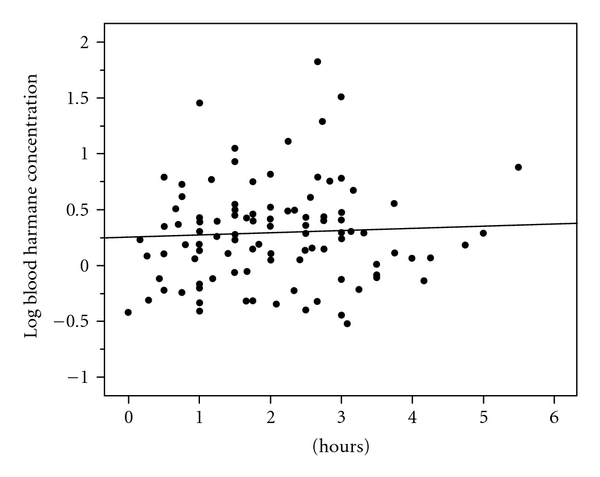
Harmane, a potent neurotoxin linked with several neurological disorders, is present in many foods, coffee, and cigarettes. We assessed whether morning food/coffee consumption and smoking were reflected in blood harmane concentrations (BHCs) we obtained in an epidemiologic sample (n = 497). Participants who smoked on the morning of phlebotomy had similar logBHCs to those who had not smoked (P = .57); there was no correlation between logBHCs and number of cigarettes (P = .59). Among the coffee drinkers, there was no correlation between number of cups and logBHCs (P = .98). Participants who had eaten on the morning of phlebotomy had similar logBHCs to those who had not (P = .49); logBHCs did not correlate with the time latency between last food consumption and phlebotomy (P = .74). BHCs in this sample of ~500 individuals did not covary with recent smoking, coffee, or food consumption, suggesting that our inability to withhold these exposures on the morning of phlebotomy was not reflected in the BHCs we measured.
哈尔满是一种与多种神经疾病相关的强效神经毒素,存在于许多食物、咖啡和香烟中。我们评估了在一次流行病学样本(n = 497)中,早餐食用食物/咖啡以及吸烟情况是否反映在我们所测得的血液哈尔满浓度(BHCs)中。在采血当天早晨吸烟的参与者与未吸烟的参与者的对数BHCs相似(P = 0.57);对数BHCs与吸烟数量之间无相关性(P = 0.59)。在喝咖啡的人群中,咖啡杯数与对数BHCs之间无相关性(P = 0.98)。在采血当天早晨进食的参与者与未进食的参与者的对数BHCs相似(P = 0.49);对数BHCs与最后一次进食至采血之间的时间间隔无相关性(P = 0.74)。在这个约500人的样本中,BHCs与近期吸烟、喝咖啡或进食情况无关,这表明我们未能在采血当天早晨避免这些暴露情况,并未反映在所测得的BHCs中。