Atherosclerosis Unit, Department of Internal Medicine and Allied Medical Specialities, Sapienza University of Rome, Rome, Italy.
Diabetes Metab Syndr Obes. 2011;4:155-66. doi: 10.2147/DMSO.S11244. Epub 2011 Apr 28.
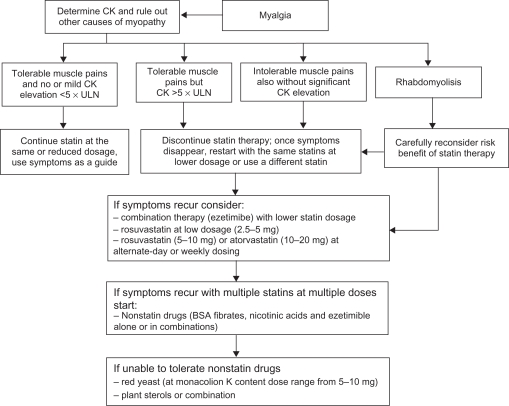
Statins are effective in reducing cardiovascular events and are safe for almost all patients. Nevertheless, intolerance to statins is frequently faced in clinical practice. This is mostly due to muscular symptoms (myalgia with or without increase of plasma creatinine kinase) and/or elevation of hepatic aminotransferases, which overall constitutes approximately two-thirds of reported adverse events during statin therapy. These side effects raise concerns in patients as well as in doctors and are likely to reduce patients' adherence and, as a consequence, the cardiovascular benefit. Therefore, it is mandatory that clinicians improve their knowledge on the clinical aspects of muscular and hepatic side effects of statin therapy as well as their ability to manage patients with statin intolerance. Besides briefly examining the clinical aspects and the mechanisms that are proposed to be responsible for the most common statin-associated side effects, the main purpose of this article is to review the available approaches to manage statin-intolerant patients. The first step is to determine whether the adverse events are indeed related to statin therapy. If so, lowering the dosage or changing statin, alternate dosing options, or the use of nonstatin compounds may be practical strategies. The cholesterol-lowering potency as well as the usefulness of these different approaches in treating statin-intolerant patients will be examined based on currently available data. However, the cardiovascular benefit of these strategies has not been well established, so their use has to be guided by a careful clinical assessment of each patient.
他汀类药物在降低心血管事件方面非常有效,且几乎对所有患者都安全。然而,在临床实践中经常会遇到他汀类药物不耐受的情况。这主要是由于肌肉症状(肌痛伴或不伴血浆肌酸激酶升高)和/或肝转氨酶升高,这些不良反应总体构成了他汀类药物治疗期间报告的不良事件的大约三分之二。这些副作用不仅引起患者和医生的关注,还可能降低患者的依从性,从而降低心血管获益。因此,临床医生必须提高他们对他汀类药物肌肉和肝脏副作用的临床方面以及管理他汀类药物不耐受患者的能力的认识。除了简要检查他汀类药物相关副作用最常见的临床方面和提出的机制外,本文的主要目的是综述管理他汀类药物不耐受患者的现有方法。第一步是确定不良事件是否确实与他汀类药物治疗有关。如果是这样,可以降低剂量或更换他汀类药物、改变他汀类药物的给药方案、或使用非他汀类化合物可能是实用的策略。将根据现有数据检查这些不同方法在治疗他汀类药物不耐受患者中的降脂效果和有效性。然而,这些策略的心血管获益尚未得到充分证实,因此必须根据每位患者的仔细临床评估来指导其使用。