DKFZ, Heidelberg, Germany.
PLoS Pathog. 2011 Jul;7(7):e1002125. doi: 10.1371/journal.ppat.1002125. Epub 2011 Jul 14.
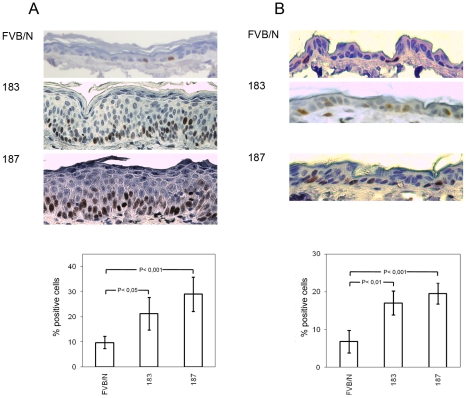
Cutaneous beta human papillomavirus (HPV) types appear to be involved in the development of non-melanoma skin cancer (NMSC); however, it is not entirely clear whether they play a direct role. We have previously shown that E6 and E7 oncoproteins from the beta HPV type 38 display transforming activities in several experimental models. To evaluate the possible contribution of HPV38 in a proliferative tissue compartment during carcinogenesis, we generated a new transgenic mouse model (Tg) where HPV38 E6 and E7 are expressed in the undifferentiated basal layer of epithelia under the control of the Keratin 14 (K14) promoter. Viral oncogene expression led to increased cellular proliferation in the epidermis of the Tg animals in comparison to the wild-type littermates. Although no spontaneous formation of tumours was observed during the lifespan of the K14 HPV38 E6/E7-Tg mice, they were highly susceptible to 7,12-dimethylbenz(a)anthracene (DMBA)/12-0-tetradecanoylphorbol-13-acetate (TPA) two-stage chemical carcinogenesis. In addition, when animals were exposed to ultraviolet light (UV) irradiation, we observed that accumulation of p21(WAF1) and cell-cycle arrest were significantly alleviated in the skin of Tg mice as compared to wild-type controls. Most importantly, chronic UV irradiation of Tg mice induced the development of actinic keratosis-like lesions, which are considered in humans as precursors of squamous cell carcinomas (SCC), and subsequently of SCC in a significant proportion of the animals. In contrast, wild-type animals subjected to identical treatments did not develop any type of skin lesions. Thus, the oncoproteins E6 and E7 from beta HPV38 significantly contribute to SCC development in the skin rendering keratinocytes more susceptible to UV-induced carcinogenesis.
皮肤β型人乳头瘤病毒(HPV)似乎与非黑色素瘤皮肤癌(NMSC)的发展有关;然而,目前尚不清楚它们是否发挥直接作用。我们之前已经表明,β HPV 38 型的 E6 和 E7 癌蛋白在几种实验模型中具有转化活性。为了评估 HPV38 在致癌过程中增殖组织区室中的可能作用,我们生成了一种新的转基因小鼠模型(Tg),其中 HPV38 E6 和 E7 在角蛋白 14(K14)启动子的控制下在未分化的上皮基底层中表达。与野生型同窝仔相比,病毒癌基因的表达导致 Tg 动物的表皮细胞增殖增加。尽管在 K14 HPV38 E6/E7-Tg 小鼠的寿命期间未观察到自发形成肿瘤,但它们对 7,12-二甲基苯并(a)蒽(DMBA)/12-O-十四烷酰佛波醇-13-乙酸酯(TPA)两步化学致癌作用非常敏感。此外,当动物暴露于紫外线(UV)辐射下时,我们观察到与野生型对照相比,Tg 小鼠皮肤中 p21(WAF1)的积累和细胞周期停滞明显减轻。最重要的是,慢性 UV 照射 Tg 小鼠诱导了光化性角化病样病变的发展,这些病变在人类中被认为是鳞状细胞癌(SCC)的前体,并且随后在很大一部分动物中发展为 SCC。相比之下,接受相同处理的野生型动物没有发展出任何类型的皮肤病变。因此,β HPV38 的癌蛋白 E6 和 E7 显著促进了皮肤 SCC 的发展,使角质形成细胞更容易受到 UV 诱导的致癌作用的影响。