Department of Neurology, Bucheon St. Mary's Hospital, The Catholic University of Korea College of Medicine, Bucheon, Korea.
J Clin Neurol. 2011 Jun;7(2):60-8. doi: 10.3988/jcn.2011.7.2.60. Epub 2011 Jun 28.
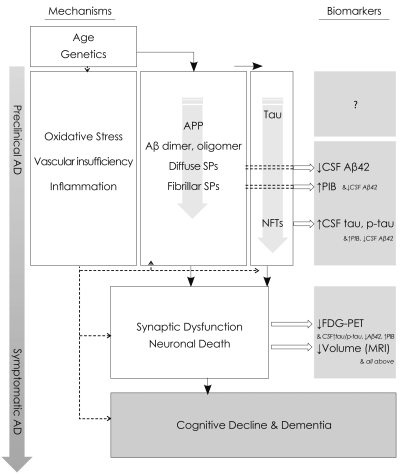
The pathophysiologic process of Alzheimer's disease (AD) begins years before the diagnosis of clinical dementia. This concept of preclinical AD has arisen from the observation of AD pathologic findings such as senile plaques and neurofibrillary tangles in the brains of people who at the time of death had normal cognitive function. Recent advances in biomarker studies now provide the ability to detect the pathologic changes of AD, which are antecedent to symptoms of the illness, in cognitively normal individuals. Functional and structural brain alterations that begin with amyloid-β accumulation already show the patterns of abnormality seen in individuals with dementia due to AD. The presence of preclinical AD provides a critical opportunity for potential interventions with disease-modifying therapy. This review focuses on the studies of antecedent biomarkers for preclinical AD.
阿尔茨海默病(AD)的病理生理过程早在临床痴呆症诊断之前就已经开始了。这种临床前 AD 的概念源于 AD 病理发现的观察,例如在死亡时认知功能正常的人的大脑中的老年斑和神经纤维缠结。生物标志物研究的最新进展现在提供了在认知正常个体中检测 AD 病理变化的能力,这些变化发生在疾病症状之前。与 AD 导致的痴呆症个体相比,从淀粉样蛋白-β 积累开始的功能性和结构性脑改变已经显示出异常模式。临床前 AD 的存在为潜在的疾病修饰治疗干预提供了关键机会。本综述重点介绍了临床前 AD 相关生物标志物的研究。