Department of Oral Biology, University of Florida, 1395 Center Drive, Gainesville, FL 32610-0424, USA.
Arthritis Res Ther. 2011 Jul 22;13(4):R119. doi: 10.1186/ar3422.
Anti-RNA polymerase III (RNAP III) antibodies are highly specific markers of scleroderma (systemic sclerosis, SSc) and associated with a rapidly progressing subset of SSc. The clinical presentation of anti-RNAP III positive patients, onset of Raynaud's phenomenon (RP) and SSc in unselected patients in a rheumatology clinic were evaluated.
Autoantibodies in sera from 1,966 unselected patients (including 434 systemic lupus erythematosus (SLE), 119 SSc, 85 polymyositis/dermatomyositis (PM/DM)) in a rheumatology clinic were screened by radioimmunoprecipitation. Anti-RNAP III positive sera were also tested by immunofluorescence antinuclear antibodies and anti-RNAP III ELISA. Medical records of anti-RNAP III positive patients were reviewed.
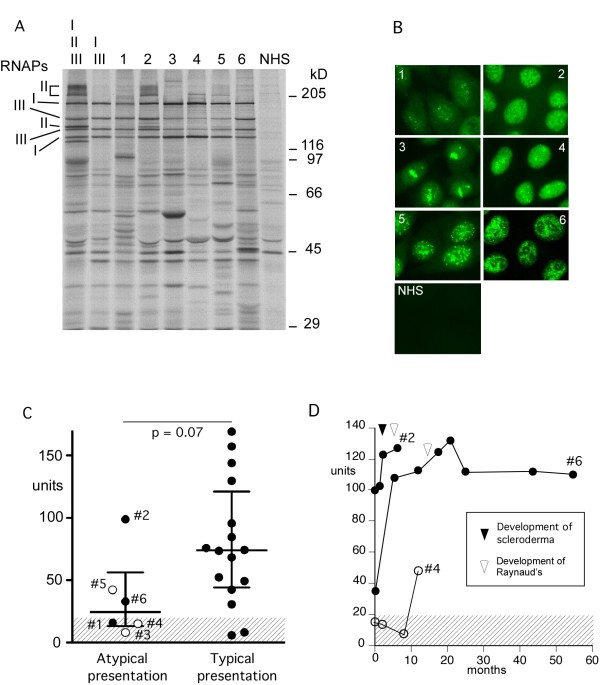
Among 21 anti-RNAP III positive patients, 16 met the American College of Rheumatology (ACR) SSc criteria at the initial visit but 5 did not; diagnoses were vasculitis, early polyarthritis, renal failure with RP, interstitial lung disease, and Sjögren's syndrome. The first two patients developed rapidly progressive diffuse SSc. An additional case presented with diffuse scleroderma without RP and RP developed two years later. Anti-RNAP III antibodies in these 6 cases of atypical clinical presentation were compared with those in 15 cases of typical (SSc with RP) cases. Anti-RNAP III levels by ELISA were lower in the former group (P = 0.04 by Mann-Whitney test) and 3 of 6 were negative versus only 1 of 15 negative in the latter (P < 0.05 by Fisher's exact test). Three cases of non-SSc anti-RNAP III positive patients had predominant reactivity with RNAP I with weak RNAP III reactivity and had a strong nucleolar staining. Three anti-RNAP III patients, who did not have RP at the initial visit, developed RP months later. Scleroderma developed prior to RP in 5 out of 16 (31%) in the anti-RNAP III group, but this was rare in patients with other autoantibodies. The interval between the onset of RP to scleroderma was short in anti-RNAP III positive patients.
Anti-RNAP III antibodies are highly specific for SSc; however, a subset of anti-RNAP III positive patients do not present as typical SSc. The interval between RP and scleroderma in this group is short, and 31% of patients developed scleroderma prior to RP in this group. Anti-RNAP III positive patients may not present as typical SSc and detecting anti-RNAP III may have predictive value.
抗 RNA 聚合酶 III(RNAP III)抗体是硬皮病(系统性硬化症,SSc)的高度特异性标志物,与 SSc 的一个快速进展亚群相关。评估了风湿科诊所中未选择的患者的抗-RNAP III 阳性患者的临床表现、雷诺现象(RP)和 SSc 的发病时间。
通过放射免疫沉淀法筛选风湿科诊所 1966 例未选择患者(包括 434 例系统性红斑狼疮(SLE)、119 例 SSc、85 例多发性肌炎/皮肌炎(PM/DM))血清中的自身抗体。抗-RNAP III 阳性血清也通过免疫荧光抗核抗体和抗-RNAP III ELISA 进行检测。回顾抗-RNAP III 阳性患者的病历。
在 21 例抗-RNAP III 阳性患者中,16 例在初次就诊时符合美国风湿病学会(ACR)SSc 标准,但 5 例不符合;诊断为血管炎、早期多关节炎、伴有 RP 的肾功能衰竭、间质性肺病和干燥综合征。前两名患者迅速发展为弥漫性 SSc。另一名患者表现为无 RP 的弥漫性硬皮病,两年后出现 RP。比较这 6 例非典型临床表现的病例与 15 例典型(有 RP 的 SSc)病例的抗-RNAP III 抗体。ELISA 法检测到前者组的抗-RNAP III 水平较低(Mann-Whitney 检验 P = 0.04),6 例中有 3 例为阴性,而后者组仅有 1 例为阴性(Fisher 确切检验 P < 0.05)。3 例非 SSc 抗-RNAP III 阳性患者主要与 RNAP I 反应,与 RNAP III 反应较弱,具有强烈的核仁染色。3 例初次就诊时无 RP 的抗-RNAP III 患者在数月后出现 RP。在抗-RNAP III 组中,有 5 例(31%)患者在 RP 之前出现硬皮病,但在其他自身抗体阳性患者中这种情况很少见。在抗-RNAP III 阳性患者中,RP 与硬皮病之间的间隔较短。
抗-RNAP III 抗体是 SSc 的高度特异性标志物;然而,亚组抗-RNAP III 阳性患者并不表现为典型的 SSc。该组中 RP 和硬皮病之间的间隔较短,该组中有 31%的患者在 RP 之前出现硬皮病。抗-RNAP III 阳性患者可能不表现为典型的 SSc,检测抗-RNAP III 可能具有预测价值。