Ross Kenneth Andrew
Department of Computer Science, Columbia University, New York, New York, United States of America.
PLoS One. 2014 Jul 2;9(7):e101093. doi: 10.1371/journal.pone.0101093. eCollection 2014.
Many aspects of autoimmune disease are not well understood, including the specificities of autoimmune targets, and patterns of co-morbidity and cross-heritability across diseases. Prior work has provided evidence that somatic mutation caused by gene conversion and deletion at segmentally duplicated loci is relevant to several diseases. Simple tandem repeat (STR) sequence is highly mutable, both somatically and in the germ-line, and somatic STR mutations are observed under inflammation.
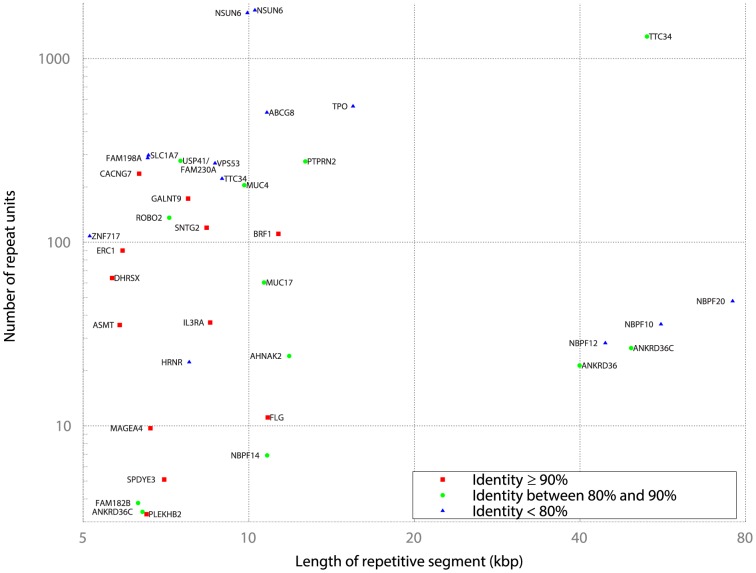
Protein-coding genes spanning STRs having markers of mutability, including germ-line variability, high total length, repeat count and/or repeat similarity, are evaluated in the context of autoimmunity. For the initiation of autoimmune disease, antigens whose autoantibodies are the first observed in a disease, termed primary autoantigens, are informative. Three primary autoantigens, thyroid peroxidase (TPO), phogrin (PTPRN2) and filaggrin (FLG), include STRs that are among the eleven longest STRs spanned by protein-coding genes. This association of primary autoantigens with long STR sequence is highly significant (p<3.0x10(-7)). Long STRs occur within twenty genes that are associated with sixteen common autoimmune diseases and atherosclerosis. The repeat within the TTC34 gene is an outlier in terms of length and a link with systemic lupus erythematosus is proposed.
The results support the hypothesis that many autoimmune diseases are triggered by immune responses to proteins whose DNA sequence mutates somatically in a coherent, consistent fashion. Other autoimmune diseases may be caused by coherent somatic mutations in immune cells. The coherent somatic mutation hypothesis has the potential to be a comprehensive explanation for the initiation of many autoimmune diseases.
自身免疫性疾病的许多方面尚未得到充分理解,包括自身免疫靶点的特异性以及疾病之间的共病模式和交叉遗传率。先前的研究已经提供证据表明,由基因转换和节段性重复位点的缺失引起的体细胞突变与多种疾病相关。简单串联重复序列(STR)在体细胞和生殖系中都具有高度可变性,并且在炎症条件下可观察到体细胞STR突变。
在自身免疫的背景下,对跨越具有可变性标记的STR的蛋白质编码基因进行了评估,这些标记包括生殖系变异性、总长度高、重复次数和/或重复相似性。对于自身免疫性疾病的起始,其自身抗体在疾病中首先被观察到的抗原,即所谓的原发性自身抗原,具有重要意义。三种原发性自身抗原,甲状腺过氧化物酶(TPO)、phogrin(PTPRN2)和丝聚合蛋白(FLG),包含的STR是蛋白质编码基因跨越的11个最长STR之一。原发性自身抗原与长STR序列的这种关联非常显著(p<3.0×10⁻⁷)。长STR出现在与16种常见自身免疫性疾病和动脉粥样硬化相关的20个基因中。就长度而言,TTC34基因内的重复是一个异常值,并提出了它与系统性红斑狼疮的联系。
结果支持这样一种假设,即许多自身免疫性疾病是由对其DNA序列以连贯、一致方式体细胞突变的蛋白质的免疫反应引发的。其他自身免疫性疾病可能由免疫细胞中的连贯体细胞突变引起。连贯体细胞突变假说有可能成为许多自身免疫性疾病起始的全面解释。