Social Development Research Group, University of Washington, Seattle, WA 98115, USA.
J Adolesc Health. 2011 Aug;49(2):180-6. doi: 10.1016/j.jadohealth.2010.11.244. Epub 2011 Feb 11.
To examine positive childhood experiences as predictors of positive adult functioning, including civic involvement, productivity and responsibility, interpersonal connection, and physical exercise; and to examine adolescent substance use as a mediator of prosocial continuity.
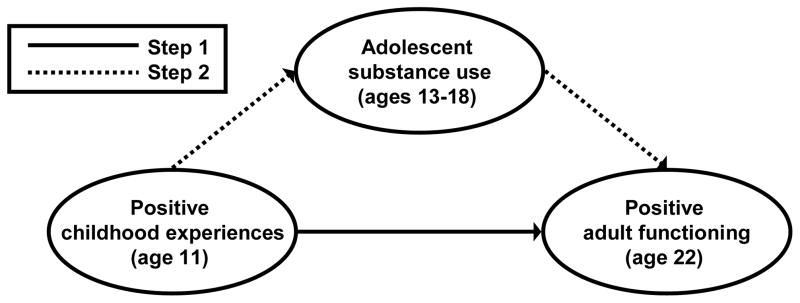
A total of 429 rural participants were interviewed across seven waves from age 11 to 22 years. Structural equation models examined the relationship between positive childhood experiences and adult functioning, with adolescent substance use added to each model as a possible mediating mechanism.
Positive childhood experiences predicted significantly better adult functioning for each model, even after accounting for adolescent substance use. Positive childhood experiences also consistently predicted significantly less adolescent substance use. In turn, adolescent substance use predicted significantly less civic involvement and less productivity and responsibility, but was not associated with interpersonal connection or physical exercise when accounting for childhood experiences. Results were largely consistent across gender and levels of family income.
Findings show the enduring importance of positive childhood experiences in predicting positive functioning in early adulthood. Although adolescent substance use increased risk for poorer functioning in important domains of adult life, results suggest that positive experiences in late childhood continued to have a significant prosocial effect into young adulthood. The study also highlights the late elementary grades as a time when parents, teachers, and others can potentially have a large influence in proactively providing prosocial opportunities for children.
探讨积极的童年经历对积极的成年功能的预测作用,包括公民参与、生产力和责任感、人际关系和体育锻炼;并探讨青少年物质使用作为亲社会连续性的中介。
共有 429 名农村参与者在 11 至 22 岁期间接受了七轮访谈。结构方程模型检验了积极的童年经历与成年功能之间的关系,在每个模型中都加入了青少年物质使用,作为一种可能的中介机制。
即使考虑到青少年物质使用,积极的童年经历也显著预测了更好的成年功能。积极的童年经历也持续地预测了青少年物质使用的减少。反过来,青少年物质使用显著预测了更少的公民参与和更少的生产力和责任感,但在考虑童年经历时,与人际关系或体育锻炼无关。结果在性别和家庭收入水平上基本一致。
研究结果表明,积极的童年经历对预测成年早期的积极功能具有持久的重要性。尽管青少年物质使用增加了成年生活重要领域功能较差的风险,但研究结果表明,儿童后期的积极经历仍然对成年早期具有显著的亲社会影响。该研究还强调了小学后期是父母、教师和其他人可以潜在地对为儿童提供亲社会机会产生重大影响的时期。