University of Groningen, University Medical Center Groningen, Department of Psychiatry,Interdisciplinary Center Psychopathology and Emotion Regulation (ICPE),Groningen,The Netherlands.
University of Groningen, University Medical Center Groningen,Department of Health Sciences,Groningen,The Netherlands.
Psychol Med. 2019 Jul;49(9):1459-1469. doi: 10.1017/S0033291718001976. Epub 2018 Sep 19.
Various childhood social experiences have been reported to predict adult outcomes. However, it is unclear how different social contexts may influence each other's effects in the long run. This study examined the joint contribution of adolescent family and peer experiences to young adult wellbeing and functioning.
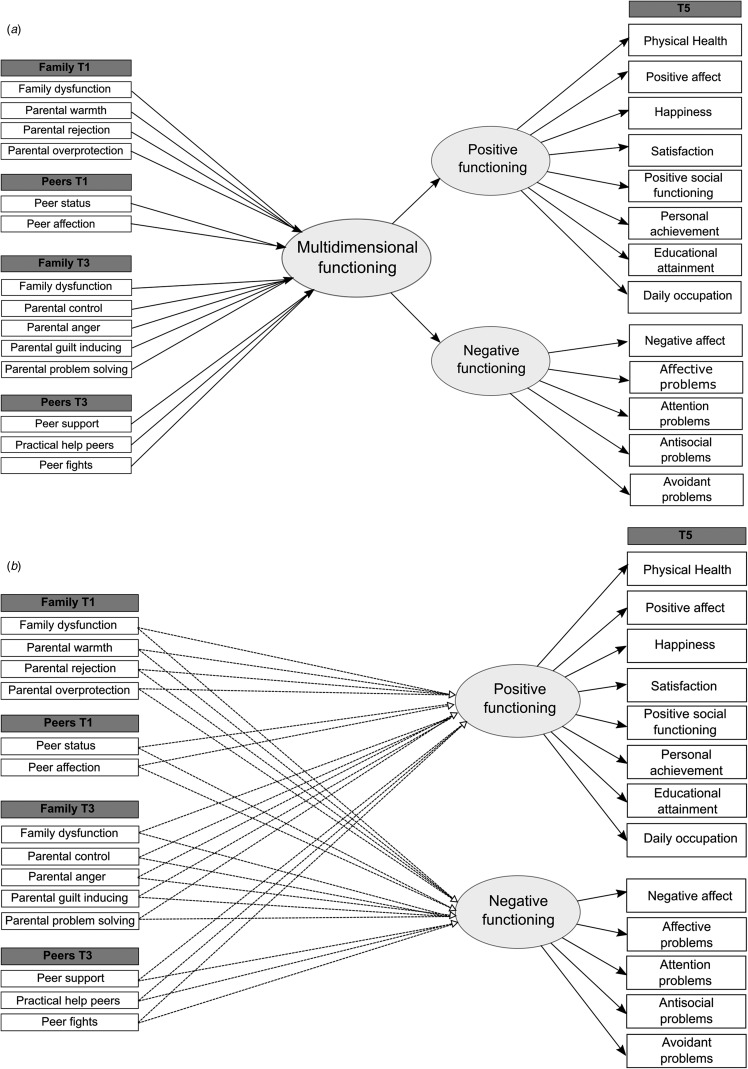
Participants came from the TRacking Adolescents' Individual Lives Survey (TRAILS) study (n = 2230). We measured family and peer relations at ages 11 and 16 (i.e. family functioning, perceived parenting, peer status, peer relationship quality), and functioning as the combination of subjective wellbeing, physical and mental health, and socio-academic functioning at age 22. Using structural equation modelling, overall functioning was indicated by two latent variables for positive and negative functioning. Positive, negative and overall functioning at young adulthood were regressed on adolescent family experiences, peer experiences and interactions between the two.
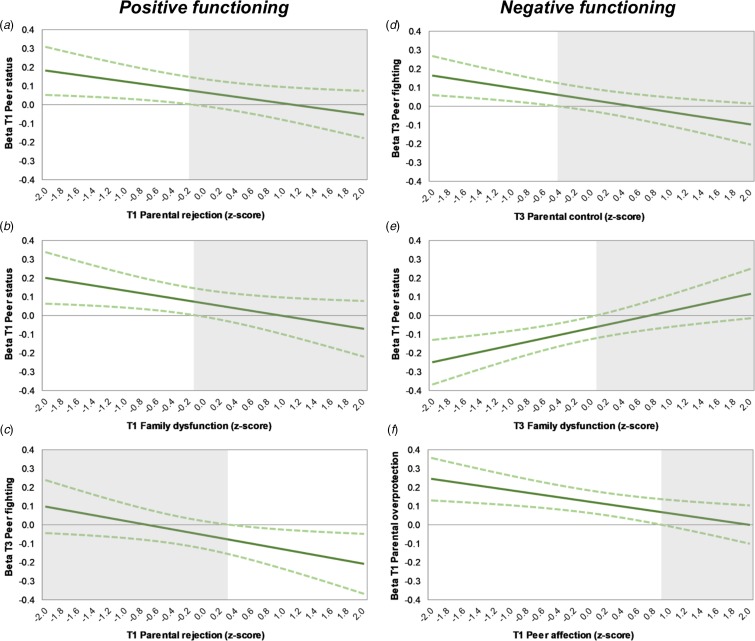
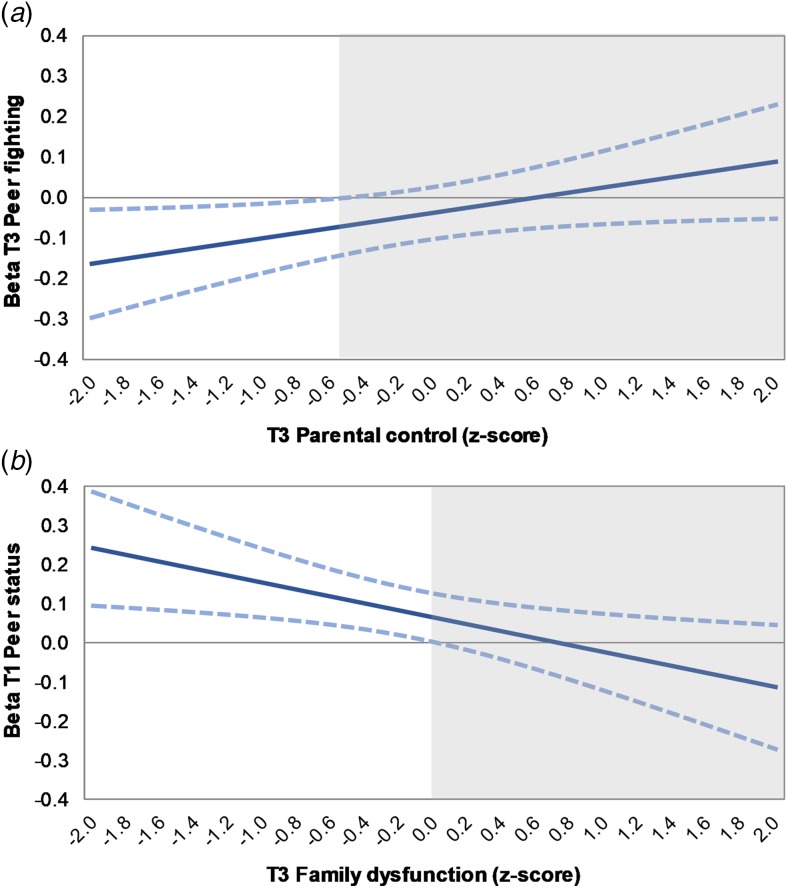
Family experiences during early and mid-adolescence were most predictive for later functioning; peer experiences did not independently predict functioning. Interactions between family and peer experiences showed that both protective and risk factors can have context-dependent effects, being exacerbated or overshadowed by negative experiences or buffered by positive experiences in other contexts. Overall the effect sizes were modest at best.
Adolescent family relations as well as the interplay with peer experiences predict young adult functioning. This emphasizes the importance of considering the relative effects of one context in relation to the other.
各种儿童时期的社会经历都被报道与成年后的结果有关。然而,目前尚不清楚不同的社会环境如何在长期内相互影响。本研究考察了青少年时期家庭和同伴经历对年轻成人幸福感和功能的共同贡献。
参与者来自青少年个体生活轨迹研究(TRAILS)(n=2230)。我们在 11 岁和 16 岁时测量了家庭和同伴关系(即家庭功能、感知父母教养、同伴地位、同伴关系质量),并在 22 岁时测量了主观幸福感、身心健康和社会学术功能的综合。使用结构方程模型,将积极和消极功能的两个潜在变量表示为整体功能。将年轻成人的积极、消极和整体功能回归到青少年时期的家庭经历、同伴经历以及两者之间的相互作用。
青少年早期和中期的家庭经历对以后的功能最具预测性;同伴经历并不能独立预测功能。家庭和同伴经历之间的相互作用表明,保护和风险因素都可能具有情境依赖性效应,被其他情境中的负面经历加剧或掩盖,或被其他情境中的积极经历缓冲。总的来说,效应大小充其量只是适度的。
青少年时期的家庭关系以及与同伴经历的相互作用预测了年轻成人的功能。这强调了考虑一个环境相对于另一个环境的相对影响的重要性。