Life Sciences Division, Lawrence Berkeley National Laboratory, Berkeley, CA, USA.
Oncogene. 2012 Mar 1;31(9):1176-80. doi: 10.1038/onc.2011.306. Epub 2011 Jul 25.
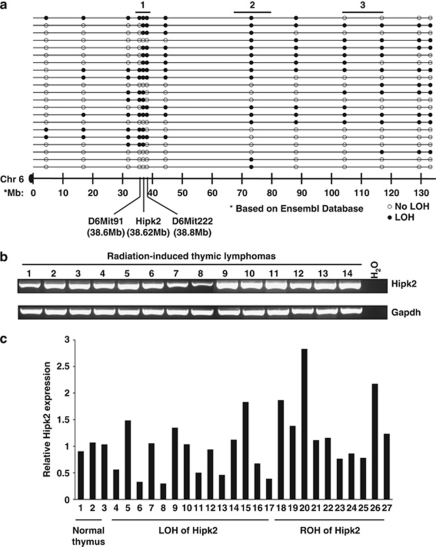
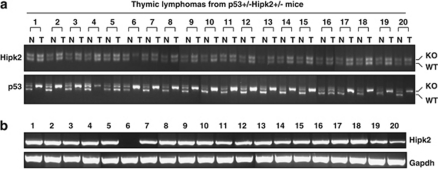
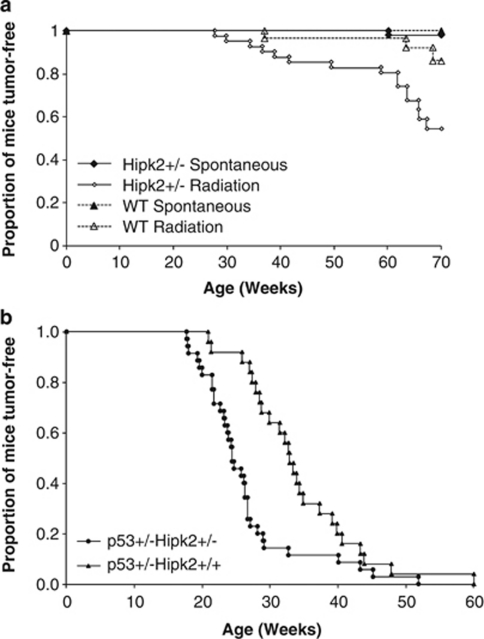
A genome-wide screen for genetic alterations in radiation-induced thymic lymphomas generated from p53+/- and p53-/- mice showed frequent loss of heterozygosity (LOH) on chromosome 6. Fine mapping of these LOH regions revealed three non-overlapping regions, one of which was refined to a 0.2 Mb interval that contained only the gene encoding homeobox-interacting protein kinase 2 (Hipk2). More than 30% of radiation-induced tumors from both p53+/- and p53-/- mice showed heterozygous loss of one Hipk2 allele. Mice carrying a single inactive allele of Hipk2 in the germline were susceptible to induction of tumors by γ-radiation, but most tumors retained and expressed the wild-type allele, suggesting that Hipk2 is a haploinsufficient tumor suppressor gene for mouse lymphoma development. Heterozygous loss of both Hipk2 and p53 confers strong sensitization to radiation-induced lymphoma. We conclude that Hipk2 is a haploinsufficient lymphoma suppressor gene.
一项针对 p53+/-(+)和 p53-/-(-)小鼠辐射诱导胸腺淋巴瘤中遗传改变的全基因组筛查显示,6 号染色体上经常发生杂合性丢失(LOH)。对这些 LOH 区域的精细定位揭示了三个非重叠区域,其中一个区域细化到仅包含编码同源盒相互作用蛋白激酶 2(Hipk2)的基因的 0.2 Mb 间隔。p53+/-(+)和 p53-/-(-)小鼠中超过 30%的辐射诱导肿瘤显示出 Hipk2 等位基因的杂合性缺失。携带 Hipk2 单一失活等位基因的种系小鼠易受 γ 射线诱导肿瘤,但大多数肿瘤保留并表达野生型等位基因,表明 Hipk2 是小鼠淋巴瘤发生的杂合不足肿瘤抑制基因。Hipk2 杂合性缺失和 p53 缺失均使辐射诱导的淋巴瘤易感性增强。我们得出结论,Hipk2 是一个杂合不足的淋巴瘤抑制基因。