Molecular Therapy Laboratory, Paik Memorial Institute for Clinical Research, Busan, Korea.
Diabetes Metab J. 2011 Jun;35(3):226-35. doi: 10.4093/dmj.2011.35.3.226. Epub 2011 Jun 30.
To accelerate the healing of diabetic wounds, various kinds of growth factors have been employed. It is the short half-life of administered growth factors in hostile wound beds that have limited wide-spread clinical usage. To overcome this limitation, growth factor gene therapy could be an attractive alternative rather than direct application of factors onto the wound beds. We administered two growth factor DNAs, epidermal growth factor (EGF) and vascular endothelial growth factor (VEGF) into a cutaneous wound on diabetic mice. We compared the different characteristics of the healing wounds.
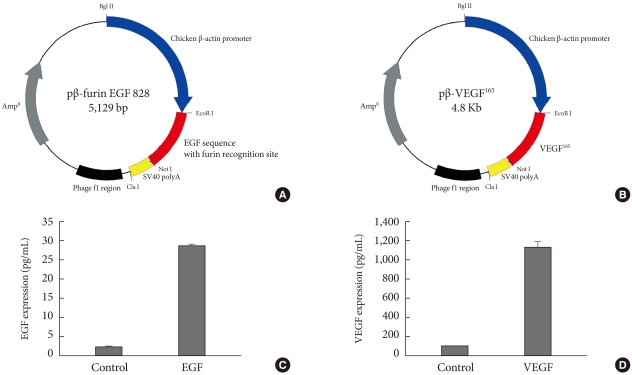
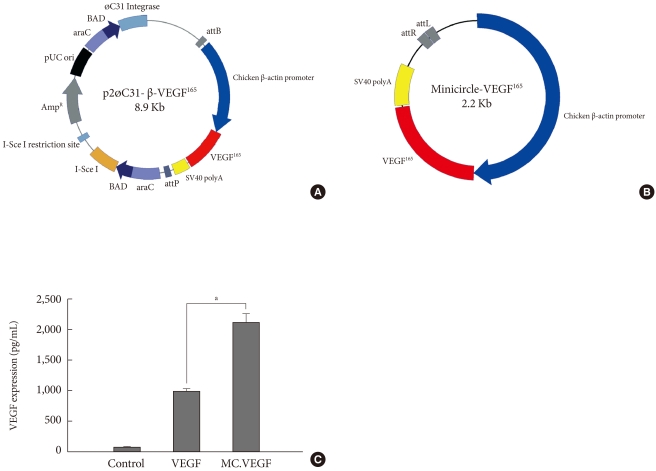
Streptozotocin was injected intraperitoneally to induce diabetes into C57BL/6J mice. The ultrasound micro-bubble destruction method with SonoVue as a bubbling agent was used for non-viral gene delivery of EGF(828) and VEGF(165) DNAs. Each gene was modified for increasing efficacy as FRM-EGF(828) or minicircle VEGF(165). The degree of neoangiogenesis was assessed using qualitative laser Doppler flowmetry. We compared wound size and histological findings of the skin wounds in each group.
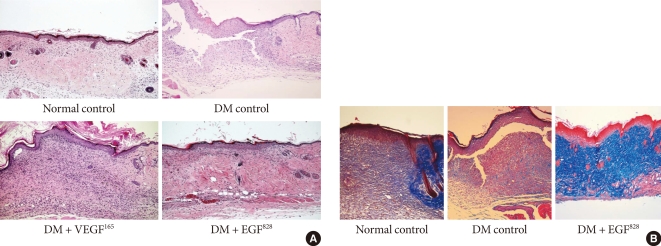
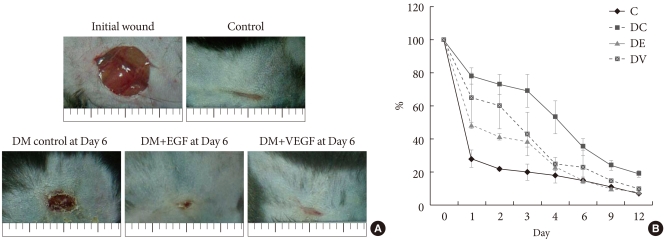
In both groups, accelerated wound closure was observed in the mice receiving gene therapy compared with non treated diabetic control mice. Blood flow detected by laser doppler flowmetry was better in the VEGF group than in the EGF group. Wound healing rates and histological findings were more accelerated in the EGF gene therapy group than the VEGF group, but were not statistically significant.
Both non-viral EGF and VEGF gene therapy administrations could improve the speed and quality of skin wound healing. However, the detailed histological characteristics of the healing wounds were different.
为了加速糖尿病伤口的愈合,各种生长因子被应用于临床。但由于在恶劣的伤口床中给予的生长因子半衰期短,限制了其广泛的临床应用。为了克服这一限制,生长因子基因治疗可能是一种有吸引力的替代方法,而不是直接将因子应用于伤口床。我们将两种生长因子 DNA,表皮生长因子(EGF)和血管内皮生长因子(VEGF)导入糖尿病小鼠的皮肤伤口中。我们比较了不同愈合伤口的特征。
链脲佐菌素(streptozotocin)经腹腔注射诱导 C57BL/6J 小鼠发生糖尿病。采用 SonoVue 作为发泡剂的超声微泡破坏方法进行 EGF(828)和 VEGF(165)DNA 的非病毒基因转导。每种基因都经过修饰以提高 FRM-EGF(828)或微环 VEGF(165)的功效。通过定性激光多普勒血流计评估新生血管形成的程度。我们比较了每组皮肤伤口的伤口大小和组织学发现。
在接受基因治疗的两组小鼠中,与未接受治疗的糖尿病对照组相比,伤口闭合速度加快。激光多普勒血流计检测到的血流量在 VEGF 组优于 EGF 组。EGF 基因治疗组的伤口愈合率和组织学发现比 VEGF 组更快,但无统计学意义。
非病毒 EGF 和 VEGF 基因治疗均可提高皮肤伤口愈合的速度和质量。然而,愈合伤口的详细组织学特征不同。