Section of Epidemiology and Biostatistics, Leeds Cancer Research UK.
Br J Dermatol. 2011 Nov;165(5):1011-21. doi: 10.1111/j.1365-2133.2011.10536.x.
Skin ageing is said to be caused by multiple factors. The relationship with sun exposure is of particular interest because the detrimental cutaneous effects of the sun may be a strong motivator to sun protection. We report a study of skin ageing in participants of an epidemiological study of melanoma.
To determine the predictors of periorbital cutaneous ageing and whether it could be used as an objective marker of sun exposure.
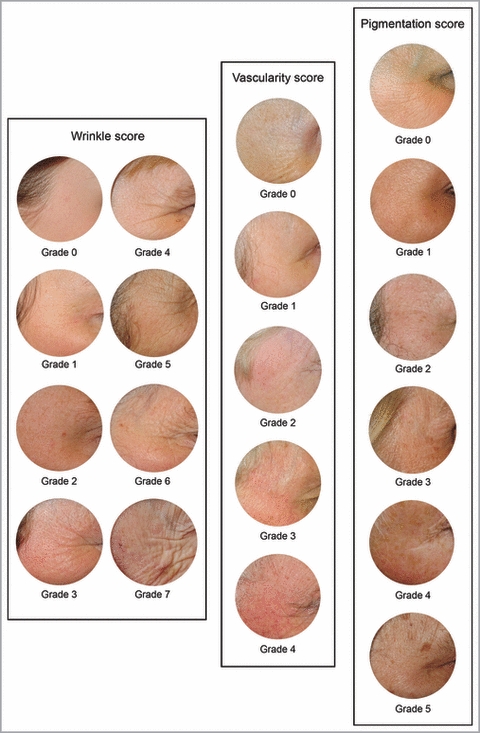
Photographs of the periorbital skin in 1341 participants were graded for wrinkles, degree of vascularity and blotchy pigmentation and the resultant data assessed in relation to reported sun exposure, sunscreen use, body mass index (BMI), smoking and the melanocortin 1 receptor (MC1R) gene status. Data were analysed using proportional odds regression.
Wrinkling was associated with age and heavy smoking. Use of higher sun-protection factor sunscreen was protective (P = 0·01). Age, male sex, MC1R variants ('r', P=0·01; 'R', P=0·02), higher reported daily sun exposure (P=0·02), increased BMI (P=0·01) and smoking (P=0·02) were risk factors for hypervascularity. Blotchy pigmentation was associated with age, male sex, higher education and higher weekday sun exposure (P=0·03). More frequent sunscreen use (P=0·02) and MC1R variants ('r', P=0·03; 'R', P=0·001) were protective.
Periorbital wrinkling is a poor biomarker of reported sun exposure. Vascularity is a better biomarker as is blotchy pigmentation, the latter in darker-skinned individuals. In summary, male sex, sun exposure, smoking, obesity and MC1R variants were associated with measures of cutaneous ageing. Sunscreen use showed some evidence of being protective.
皮肤老化据称是由多种因素引起的。与阳光暴露的关系尤其受到关注,因为阳光对皮肤的有害影响可能是防晒的强大动力。我们报告了一项对黑色素瘤流行病学研究参与者的皮肤老化研究。
确定眶周皮肤老化的预测因素,以及它是否可以作为阳光暴露的客观标志物。
对 1341 名参与者的眶周皮肤进行拍照,评估皱纹、血管程度和斑驳色素沉着程度,并根据报告的阳光暴露、防晒霜使用、体重指数 (BMI)、吸烟和黑素皮质素 1 受体 (MC1R) 基因状态评估所得数据。使用比例优势回归进行数据分析。
皱纹与年龄和大量吸烟有关。使用更高防晒因子的防晒霜具有保护作用 (P = 0·01)。年龄、男性、MC1R 变体 ('r',P=0·01;'R',P=0·02)、报告的每日阳光暴露量增加 (P=0·02)、BMI 增加 (P=0·01) 和吸烟 (P=0·02) 是血管增多的危险因素。斑驳色素沉着与年龄、男性、更高的教育程度和更高的工作日阳光暴露有关 (P=0·03)。更频繁地使用防晒霜 (P=0·02) 和 MC1R 变体 ('r',P=0·03;'R',P=0·001) 具有保护作用。
眶周皱纹是报告的阳光暴露的不良生物标志物。血管增多是更好的生物标志物,斑驳色素沉着也是如此,后者在肤色较深的人群中更为明显。总之,男性、阳光暴露、吸烟、肥胖和 MC1R 变体与皮肤老化的测量值有关。防晒霜的使用有一定的保护作用。