Departamento de Biologia Estrutural, Molecular e Genética, Universidade Estadual de Ponta Grossa, Av. Carlos Cavalcanti, 4748, Ponta Grossa-PR, 84030-900, Brazil.
BMC Genet. 2011 Jul 25;12:65. doi: 10.1186/1471-2156-12-65.
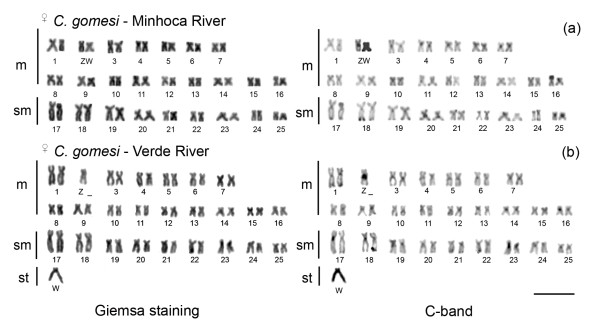
The Characidium (a Neotropical fish group) have a conserved diploid number (2n = 50), but show remarkable differences among species and populations in relation to sex chromosome systems and location of nucleolus organizer regions (NOR). In this study, we isolated a W-specific probe for the Characidium and characterized six Characidium species/populations using cytogenetic procedures. We analyzed the origin and differentiation of sex and NOR-bearing chromosomes by chromosome painting in populations of Characidium to reveal their evolution, phylogeny, and biogeography.
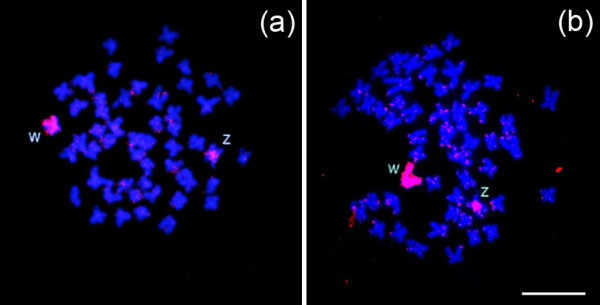
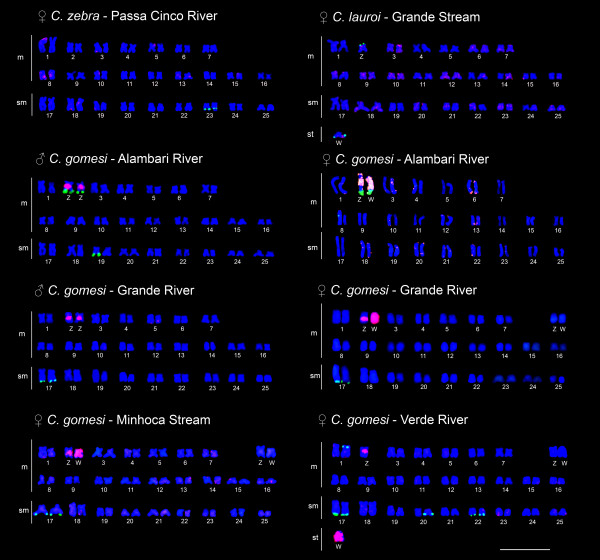
A W-specific probe for efficient chromosome painting was isolated by microdissection and degenerate oligonucleotide primed-polymerase chain reaction (DOP-PCR) amplification of W chromosomes from C. gomesi. The W probe generated weak signals dispersed on the proto sex chromosomes in C. zebra, dispersed signals in both W and Z chromosomes in C. lauroi and, in C. gomesi populations revealed a proximal site on the long arms of the Z chromosome and the entire W chromosome. All populations showed small terminal W probe sites in some autosomes. The 18S rDNA revealed distinctive patterns for each analyzed species/population with regard to proto sex chromosome, sex chromosome pair, and autosome location.
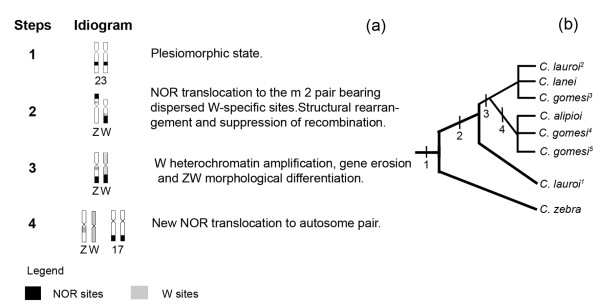
The results from dual-color fluorescence in situ hybridization (dual-color FISH) using W and 18S rDNA probes allowed us to infer the putative evolutionary pathways for the differentiation of sex chromosomes and NORs, from structural rearrangements in a sex proto-chromosome, followed by gene erosion and heterochromatin amplification, morphological differentiation of the sex chromosomal pair, and NOR transposition, giving rise to the distinctive patterns observed among species/populations of Characidium. Biogeographic isolation and differentiation of sex chromosomes seem to have played a major role in the speciation process in this group of fish.
Characidium(一个新热带鱼群)具有保守的二倍体数(2n=50),但在性染色体系统和核仁组织区(NOR)的位置方面,物种和种群之间存在显著差异。在这项研究中,我们分离了Characidium 的 W 特异性探针,并使用细胞遗传学程序对六种 Characidium 物种/种群进行了特征分析。我们通过对 Characidium 种群的染色体进行染色体涂染,分析了性染色体和 NOR 携带染色体的起源和分化,以揭示它们的进化、系统发育和生物地理学。
通过从 C. gomesi 的 W 染色体进行微切割和简并寡核苷酸引物聚合酶链反应(DOP-PCR)扩增,分离出了用于有效染色体涂染的 W 特异性探针。W 探针在 C. zebra 的原始性染色体上产生了分散的弱信号,在 C. lauroi 的 W 和 Z 染色体上产生了分散的信号,而在 C. gomesi 种群中则揭示了 Z 染色体长臂和整个 W 染色体上的近端位点。所有种群在一些常染色体上都显示出较小的末端 W 探针位点。18S rDNA 显示出每个分析的物种/种群在原始性染色体、性染色体对和常染色体位置方面的独特模式。
使用 W 和 18S rDNA 探针的双色荧光原位杂交(dual-color FISH)的结果使我们能够推断出性染色体和 NOR 分化的假定进化途径,从性原染色体的结构重排开始,接着是基因侵蚀和异染色质扩增、性染色体对的形态分化以及 NOR 的转位,导致了在 Characidium 的物种/种群中观察到的独特模式。性染色体的生物地理隔离和分化似乎在该鱼类群体的物种形成过程中发挥了主要作用。