Cocca Ennio, Petraccioli Agnese, Morescalchi Maria Alessandra, Odierna Gaetano, Capriglione Teresa
Istituto di Bioscienze e Biorisorse, CNR, via P. Castellino 111, 80131 Napoli, Italy.
Dipartimento di Biologia, Università di Napoli Federico II, Complesso Universitario Monte S. Angelo, via Cinthia, 80126 Napoli, Italy.
Comp Cytogenet. 2015 Feb 5;9(1):1-15. doi: 10.3897/CompCytogen.v9i1.8731. eCollection 2015.
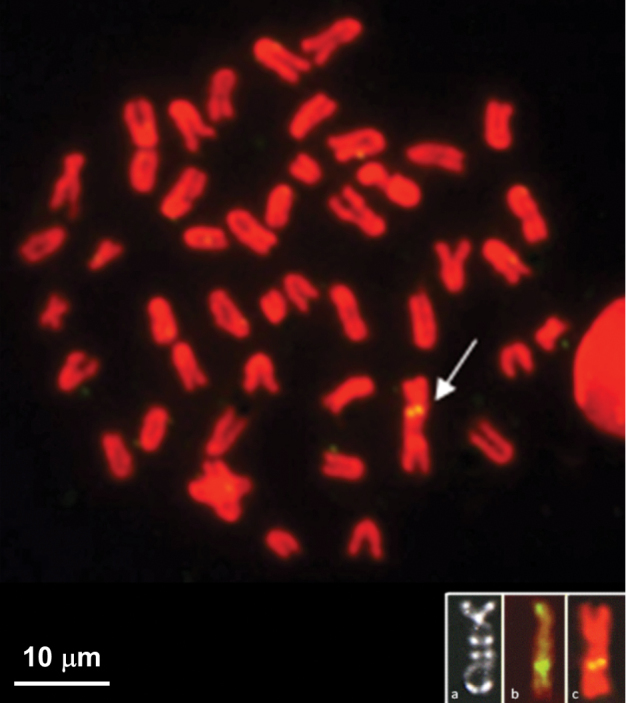
Microdissection, DOP-PCR amplification and microcloning were used to study the large Y chromosome of Chionodracohamatus, an Antarctic fish belonging to the Notothenioidei, the dominant component of the Southern Ocean fauna. The species has evolved a multiple sex chromosome system with digametic males showing an X1YX2 karyotype and females an X1X1X2X2 karyotype. Fluorescence in situ hybridization, performed with a painting probe made from microdissected Y chromosomes, allowed a deeper insight on the chromosomal rearrangement, which underpinned the fusion event that generated the Y. Then, we used a DNA library established by microdissection and microcloning of the whole Y chromosome of Chionodracohamatus for searching sex-linked sequences. One clone provided preliminary information on the presence on the Y chromosome of the CHD1 gene homologue, which is sex-linked in birds but in no other vertebrates. Several clones from the Y-chromosome mini-library contained microsatellites and transposable elements, one of which mapped to the q arm putative fusion region of the Y chromosome. The findings confirm that interspersed repetitive sequences might have fostered chromosome rearrangements and the emergence of the Y chromosome in Chionodracohamatus. Detection of the CHD1 gene in the Y sex-determining region could be a classical example of convergent evolution in action.
采用显微切割、DOP-PCR扩增和微克隆技术,对南极鱼类南极龙(Chionodraco hamatus)的大Y染色体进行了研究。南极龙属于南极鱼亚目(Notothenioidei),是南大洋动物群的主要组成部分。该物种进化出了一种多性染色体系统,异配型雄性的核型为X1YX2,雌性为X1X1X2X2。用显微切割得到的Y染色体制作的涂染探针进行荧光原位杂交,有助于更深入地了解染色体重排,这种重排是产生Y染色体的融合事件的基础。然后,我们利用通过对南极龙整个Y染色体进行显微切割和微克隆建立的DNA文库来搜索性连锁序列。一个克隆提供了初步信息,表明Y染色体上存在CHD1基因的同源物,该基因在鸟类中是性连锁的,但在其他脊椎动物中并非如此。Y染色体微型文库中的几个克隆包含微卫星和转座元件,其中一个定位到Y染色体的q臂假定融合区域。这些发现证实,散布的重复序列可能促进了南极龙染色体重排和Y染色体的出现。在Y性别决定区域检测到CHD1基因可能是趋同进化的一个典型例子。