Department of Twin Research and Genetic Epidemiology, King's College London, UK.
Calcif Tissue Int. 2011 Oct;89(4):295-302. doi: 10.1007/s00223-011-9518-9. Epub 2011 Jul 26.
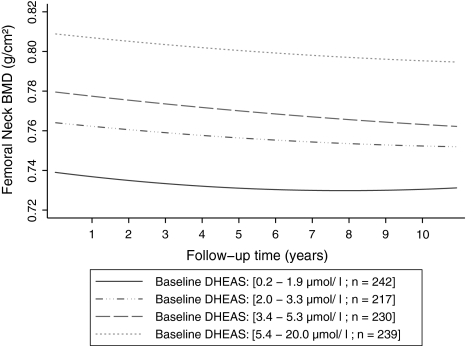
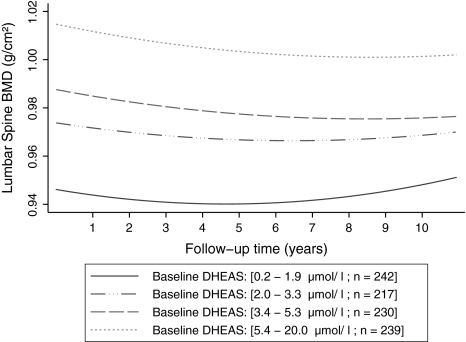
Our aim was to examine the association between serum dehydroepiandrosterone sulfate (DHEAS) at baseline and BMD change at the femoral neck (FN) and lumbar spine (LS) in postmenopausal women during a 15-year follow-up. All participants were from the Chingford Study. BMD at the FN and LS were measured eight times during the 15-year follow-up by dual-energy X-ray absorptiometry. DHEAS at baseline was measured using radioimmunoassay. Data on height, weight, and hormone-replacement therapy (HRT) status were obtained at each visit. Multilevel linear regression modeling was used to examine the association between longitudinal BMD change at the FN and LS and DHEAS at baseline. Postmenopausal women (n = 1,003) aged 45-68 years (mean 54.7) at baseline were included in the study. After adjustment for baseline age, estradiol, HRT, and BMI, BMD at the FN decreased on average 0.49% (95% CI 0.31-0.71%) per year; and the decline was slowed down by 0.028% per squared year. Increase of DHEAS (each micromole per liter) was associated with 0.49% less bone loss at the FN (95% CI 0.21-0.71%, P = 0.001). However, this strong association became slightly weaker over time. Similar but weaker results were obtained for LS BMD. Our data suggest that high serum DHEAS at baseline is associated with less bone loss at both FN and LS and this association diminishes over time. The nature of the association is unclear, but such an association implies that, in managing BMD loss, women might benefit from maintaining a high level of DHEAS.
我们的目的是研究绝经后妇女在 15 年随访期间,基线时血清硫酸脱氢表雄酮(DHEAS)与股骨颈(FN)和腰椎(LS)骨密度(BMD)变化之间的关系。所有参与者均来自 Chingford 研究。在 15 年的随访期间,通过双能 X 射线吸收法测量 FN 和 LS 的 BMD 共 8 次。基线时 DHEAS 采用放射免疫法测定。每次就诊时均记录身高、体重和激素替代疗法(HRT)状况的数据。使用多级线性回归模型来检查 FN 和 LS 的纵向 BMD 变化与基线时 DHEAS 之间的关系。本研究纳入了基线年龄为 45-68 岁(平均 54.7 岁)的 1003 名绝经后妇女。在调整基线年龄、雌二醇、HRT 和 BMI 后,FN 的 BMD 每年平均下降 0.49%(95%CI 0.31-0.71%);每年平方增加 0.028%,则下降速度减缓 0.028%。DHEAS 每增加 1 微摩尔/升(每微摩尔/升),FN 的骨丢失减少 0.49%(95%CI 0.21-0.71%,P=0.001)。然而,这种强关联随着时间的推移而变得稍微减弱。对于 LS BMD,也得到了类似但较弱的结果。我们的数据表明,基线时血清 DHEAS 水平较高与 FN 和 LS 的骨丢失减少有关,并且这种关联随着时间的推移而减弱。这种关联的性质尚不清楚,但这种关联意味着,在管理 BMD 丢失时,女性可能受益于维持较高水平的 DHEAS。