Division of Gastroenterology, Department of Medicine, Duke University Medical Center, Durham, NC 27710, USA.
Hepatology. 2011 Nov;54(5):1580-90. doi: 10.1002/hep.24576.
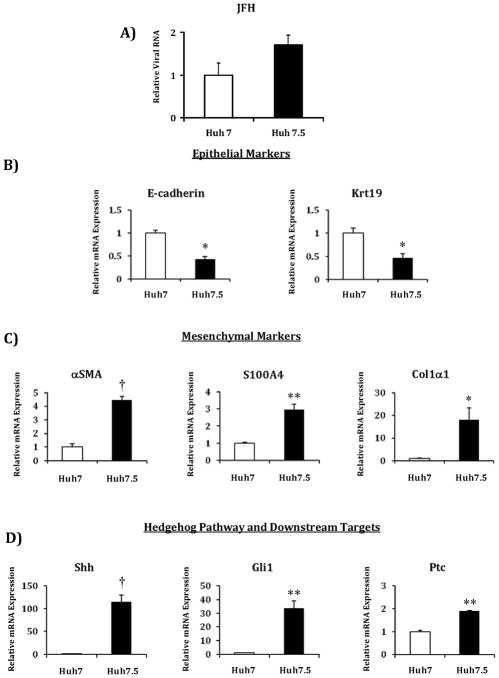
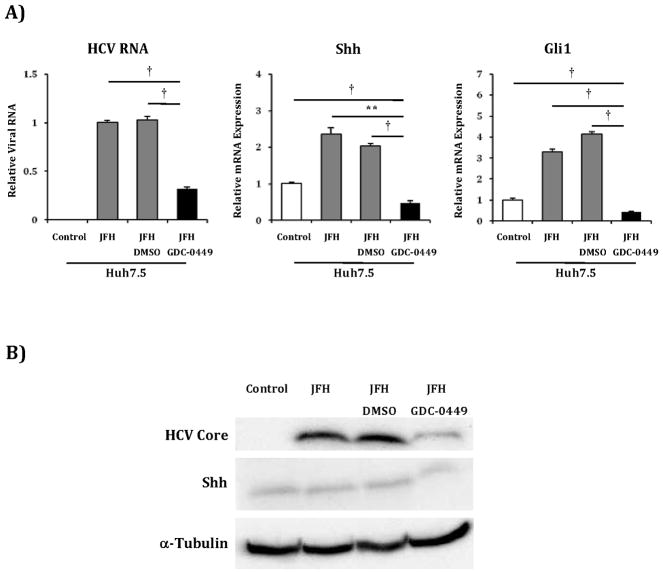
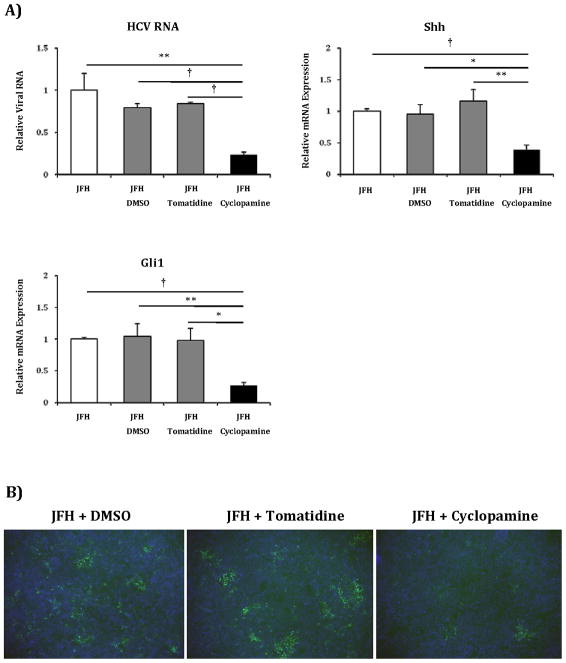
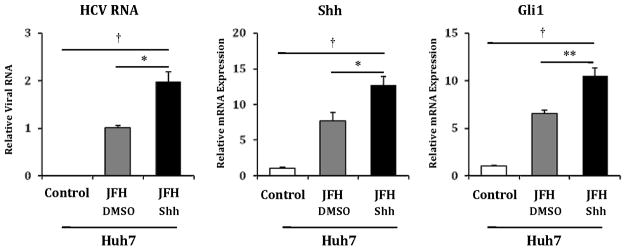
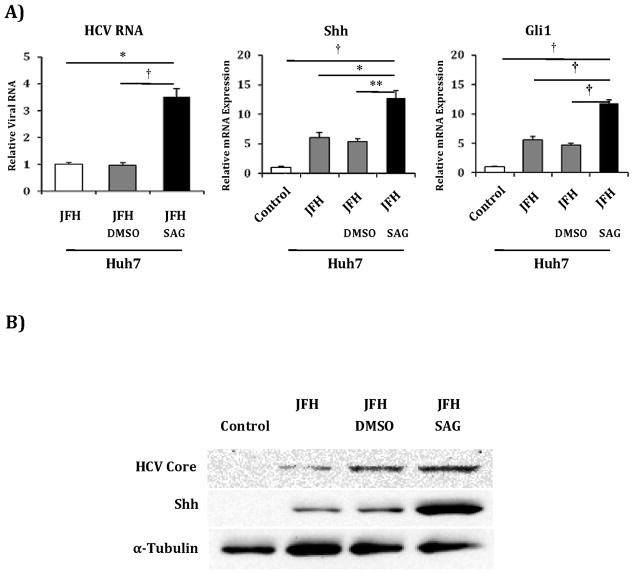
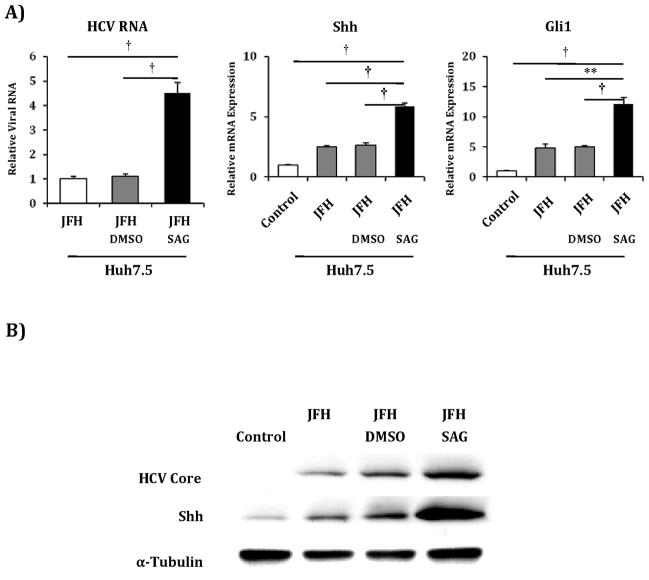
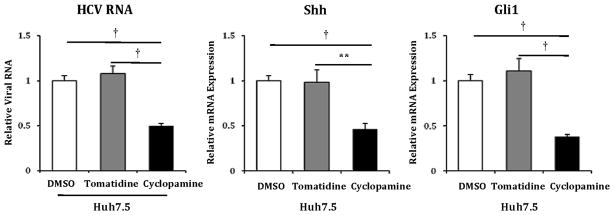
Studies of the hepatitis C virus (HCV) life-cycle rely heavily on Huh7.5 cells, but the reasons why these cells are exceptionally permissive for HCV replication are not clear. Based on recent clinical observations, we hypothesized that the Hedgehog (Hh) pathway, which has not been previously associated with HCV replication, may be involved in the Huh7.5 phenotype of increased permissiveness. We tested this hypothesis by comparing levels of a variety of Hh-related cellular markers in Huh7.5 cells with the parental Huh7 cells, which are far less permissive. Here we demonstrate that Huh7.5 cells, when compared with Huh7 cells, have substantially decreased expression of epithelial markers, increased levels of mesenchymal markers, and markedly up-regulated Hh pathway activity: Shh, >100-fold, Gli1, >30-fold, Ptc, 2-fold. In Huh7.5 cells, we found that cyclopamine, an Hh pathway antagonist, reduced HCV RNA levels by 50% compared with vehicle and inactive isomer controls. Moreover, in Huh7 cells treatment with recombinant Shh ligand and SAG, both Hh pathway agonists, stimulated HCV replication by 2-fold and 4-fold, respectively. These effects were observed with both viral infections and a subgenomic replicon. Finally, we demonstrated that GDC-0449 decreased HCV RNA levels in a dose-response manner.
We have identified a relationship between HCV and Hh signaling where up-regulated pathway activity during infection promotes an environment conducive to replication. Given that Hh activity is very low in most hepatocytes, these findings may serve to further shift the model of HCV liver infection from modest widespread replication in hepatocytes to one where a subset of cells support high-level replication. These findings also introduce Hh pathway inhibitors as potential anti-HCV therapeutics.
丙型肝炎病毒(HCV)生命周期的研究严重依赖 Huh7.5 细胞,但这些细胞对 HCV 复制具有异常易感性的原因尚不清楚。基于最近的临床观察,我们假设 Hedgehog(Hh)通路以前与 HCV 复制无关,可能与 Huh7.5 细胞增加的易感性表型有关。我们通过比较 Huh7.5 细胞与亲本 Huh7 细胞(其对 HCV 复制的易感性低得多)中各种 Hh 相关细胞标志物的水平来检验这一假说。在这里,我们证明与 Huh7 细胞相比,Huh7.5 细胞的上皮标志物表达显著降低,间充质标志物水平升高,Hh 通路活性明显上调:Shh 上调 100 倍,Gli1 上调 30 倍,Ptc 上调 2 倍。在 Huh7.5 细胞中,我们发现 Hh 通路拮抗剂 cyclopamine 与载体和无活性异构体对照相比,可使 HCV RNA 水平降低 50%。此外,在 Huh7 细胞中,重组 Shh 配体和 SAG(均为 Hh 通路激动剂)分别使 HCV 复制增加 2 倍和 4 倍。这些作用在病毒感染和亚基因组复制子中均有观察到。最后,我们证明 GDC-0449 以剂量反应方式降低 HCV RNA 水平。
我们已经确定了 HCV 与 Hh 信号之间的关系,即在感染过程中上调的通路活性促进了有利于复制的环境。鉴于大多数肝细胞中的 Hh 活性非常低,这些发现可能有助于进一步将 HCV 肝感染模型从肝细胞中适度广泛复制转变为某些细胞支持高水平复制的模型。这些发现还将 Hh 通路抑制剂引入作为潜在的抗 HCV 治疗药物。