Swinburne Autism Bio-Research Initiative (SABRI), Brain and Psychological Sciences Research Centre, Swinburne University of Technology, Hawthorn, Victoria, Australia.
J Toxicol Environ Health A. 2011;74(18):1185-94. doi: 10.1080/15287394.2011.590097.
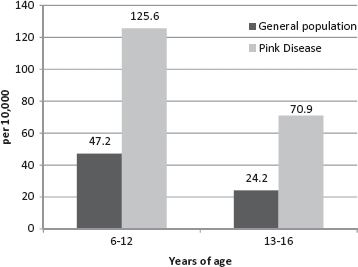
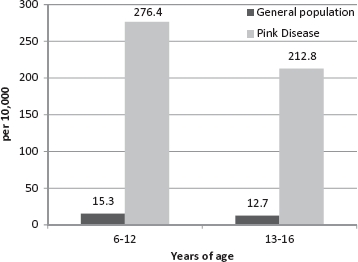
Pink disease (infantile acrodynia) was especially prevalent in the first half of the 20th century. Primarily attributed to exposure to mercury (Hg) commonly found in teething powders, the condition was developed by approximately 1 in 500 exposed children. The differential risk factor was identified as an idiosyncratic sensitivity to Hg. Autism spectrum disorders (ASD) have also been postulated to be produced by Hg. Analogous to the pink disease experience, Hg exposure is widespread yet only a fraction of exposed children develop an ASD, suggesting sensitivity to Hg may also be present in children with an ASD. The objective of this study was to test the hypothesis that individuals with a known hypersensitivity to Hg (pink disease survivors) may be more likely to have descendants with an ASD. Five hundred and twenty-two participants who had previously been diagnosed with pink disease completed a survey on the health outcomes of their descendants. The prevalence rates of ASD and a variety of other clinical conditions diagnosed in childhood (attention deficit hyperactivity disorder, epilepsy, Fragile X syndrome, and Down syndrome) were compared to well-established general population prevalence rates. The results showed the prevalence rate of ASD among the grandchildren of pink disease survivors (1 in 22) to be significantly higher than the comparable general population prevalence rate (1 in 160). The results support the hypothesis that Hg sensitivity may be a heritable/genetic risk factor for ASD.
“粉红病”(婴儿肢端痛症)在 20 世纪上半叶尤为普遍。这种疾病主要归因于接触到普遍存在于牙粉中的汞(Hg),大约每 500 名接触过汞的儿童中就有 1 名会发病。有差异的风险因素被确定为对汞的特异性敏感性。自闭症谱系障碍(ASD)也被认为是由汞引起的。类似于“粉红病”的经历,汞暴露很普遍,但只有一小部分接触过汞的儿童会发展成 ASD,这表明对汞的敏感性也可能存在于患有 ASD 的儿童中。本研究的目的是检验以下假设,即已知对汞过敏(“粉红病”幸存者)的个体可能更有可能有 ASD 后代。522 名先前被诊断患有“粉红病”的参与者完成了一项关于其后代健康结果的调查。将 ASD 的流行率以及在儿童时期诊断出的各种其他临床病症(注意力缺陷多动障碍、癫痫、脆性 X 综合征和唐氏综合征)的流行率与既定的一般人群流行率进行了比较。结果显示,“粉红病”幸存者的孙辈中 ASD 的流行率(1/22)明显高于可比的一般人群流行率(1/160)。结果支持了以下假设,即汞敏感性可能是 ASD 的遗传/基因风险因素。