Department of Epidemiology and Population Health, Albert Einstein College of Medicine, Bronx, New York, USA.
Obesity (Silver Spring). 2012 Mar;20(3):651-9. doi: 10.1038/oby.2011.243. Epub 2011 Jul 28.
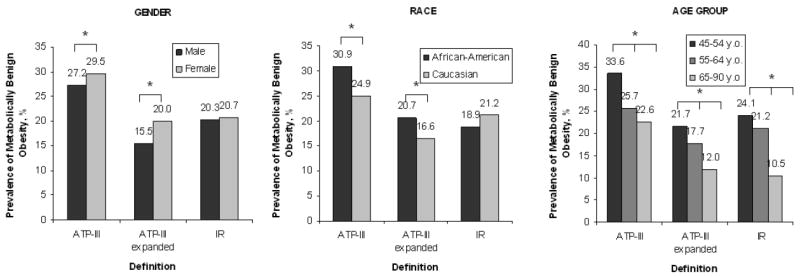
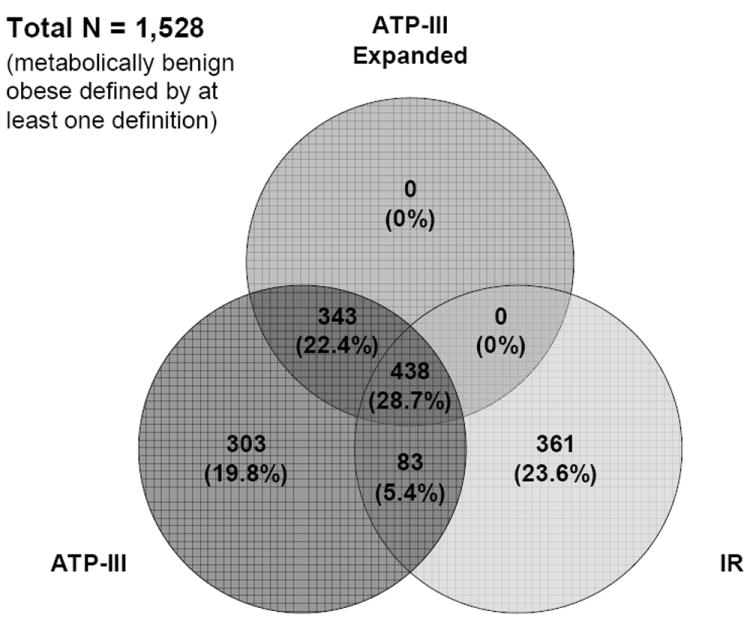
Nearly one-third of obese individuals are classified as metabolically benign; however whether this subgroup is at a lower risk of cardiovascular disease (CVD) is unclear. Using pooled data from the Atherosclerosis Risk in Communities and Cardiovascular Health Studies, we assessed incident CVD (coronary heart disease and stroke) using three definitions of the metabolically benign phenotype: (i) the ATP-III metabolic syndrome definition (≤2 of the ATP-III components, excluding abdominal obesity (ii) the expanded ATP-III definition (≤1 of: any ATP-III components, insulin resistance (IR), or systemic inflammation), and (iii) the IR-based definition (sex-specific lowest quartile of the HOMA(IR) distribution). The sample included 6,106 normal weight, 7,115 overweight, and 4,323 obese participants. Among obese, 27.0%, 18.1%, and 20.4% were metabolically benign by the three definitions, respectively. The CVD incidence rates (mean follow-up 11.8 years) were 7.1, 5.8, and 8.4 per 1,000 person-years in metabolically benign obese via the three definitions, respectively, compared to 14.3, 13.8, and 13.3 in at-risk obese, and 7.5, 6.7, and 8.2 in metabolically benign normal weight participants. Multivariable-adjusted hazard ratios of incident CVD in metabolically benign obese compared to their at-risk obese counterparts were 0.59 (95% CI 0.47-0.73), 0.52 (0.39-0.68), and 0.71 (0.57-0.90), respectively; and 1.24 (0.99-1.57), 1.16 (0.86-1.56), and 1.28 (1.01-1.62) compared to metabolically benign normal weight individuals. Only 28.7% of obese participants classified as metabolically benign by at least one definition were "metabolically benign" by all three definitions. Despite similar CVD risk estimates, the three definitions identified different subgroups of the obese population, perhaps suggesting distinct etiologies.
近三分之一的肥胖个体被归类为代谢良性;然而,这个亚组患心血管疾病 (CVD) 的风险是否较低尚不清楚。使用社区动脉粥样硬化风险 (ARIC) 和心血管健康研究 (CVD) 的汇总数据,我们使用代谢良性表型的三种定义评估了 CVD 事件 (冠心病和中风):(i) ATP-III 代谢综合征定义 (≤2 项 ATP-III 成分,不包括腹部肥胖症)、(ii) 扩展的 ATP-III 定义 (≤1 项:任何 ATP-III 成分、胰岛素抵抗 (IR) 或全身炎症) 和 (iii) IR 为基础的定义 (按性别划分的 HOMA(IR) 分布的最低四分位数)。样本包括 6106 名正常体重、7115 名超重和 4323 名肥胖参与者。在肥胖者中,分别有 27.0%、18.1%和 20.4% 符合三种定义的代谢良性。通过三种定义,代谢良性肥胖者的 CVD 发病率 (平均随访 11.8 年) 分别为每 1000 人年 7.1、5.8 和 8.4 例,而高危肥胖者为 14.3、13.8 和 13.3 例,代谢良性正常体重参与者为 7.5、6.7 和 8.2 例。与高危肥胖者相比,代谢良性肥胖者的 CVD 事件多变量调整后的风险比分别为 0.59 (95%CI 0.47-0.73)、0.52 (0.39-0.68) 和 0.71 (0.57-0.90);与代谢良性正常体重者相比,分别为 1.24 (0.99-1.57)、1.16 (0.86-1.56) 和 1.28 (1.01-1.62)。只有 28.7% 的肥胖参与者至少有一种定义被归类为代谢良性,而在所有三种定义中都是"代谢良性"。尽管 CVD 风险估计相似,但三种定义确定了肥胖人群的不同亚组,这也许表明存在不同的病因。