Biomaterials and Advanced Drug Delivery Laboratory, Stanford University, Stanford, California, United States of America.
PLoS One. 2011;6(7):e21776. doi: 10.1371/journal.pone.0021776. Epub 2011 Jul 22.
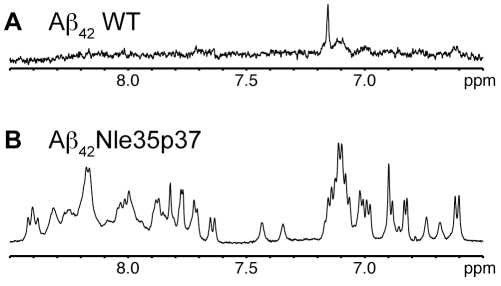
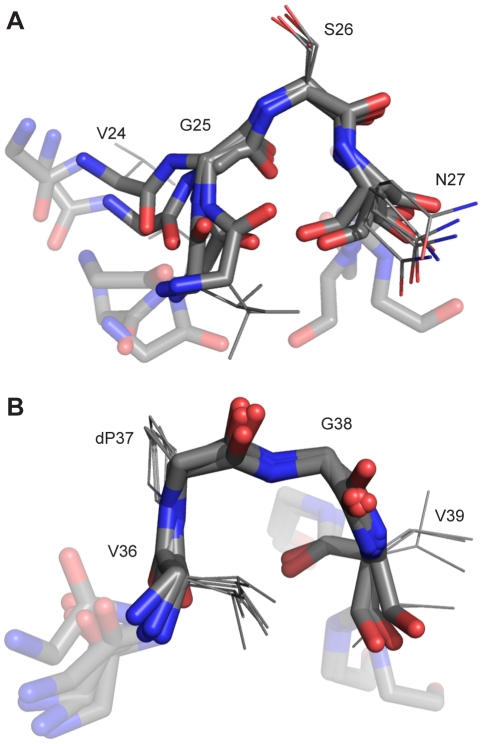
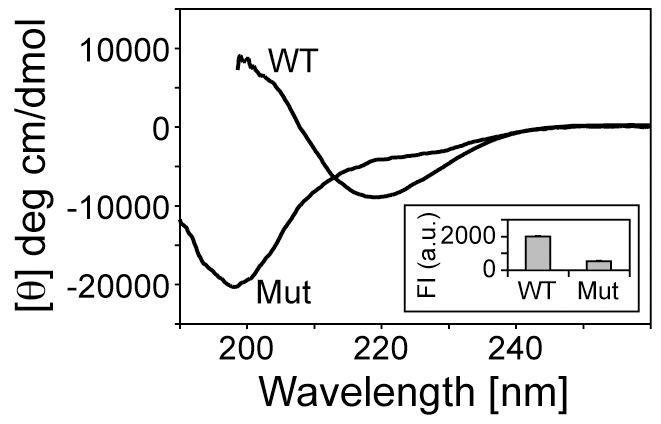
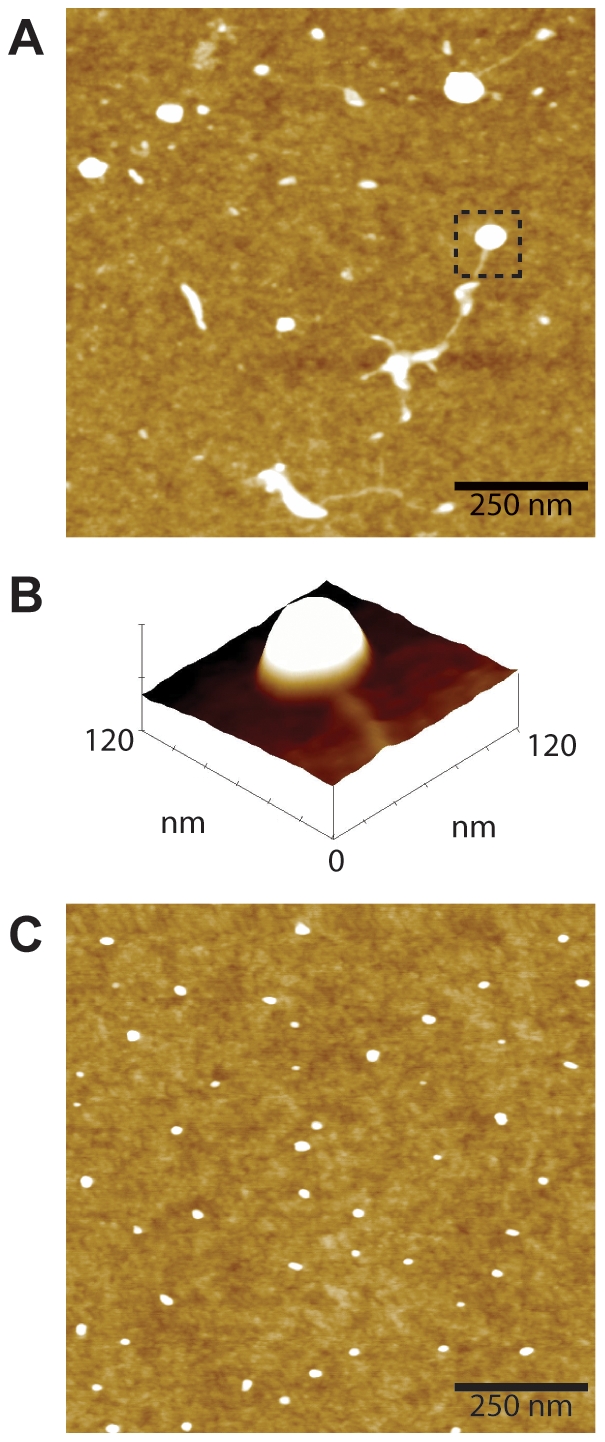
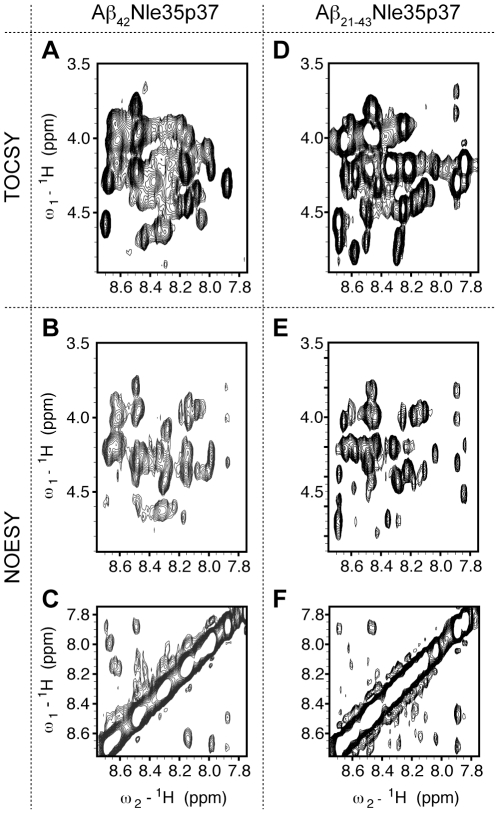
Enhanced production of a 42-residue beta amyloid peptide (Aβ(42)) in affected parts of the brain has been suggested to be the main causative factor for the development of Alzheimer's Disease (AD). The severity of the disease depends not only on the amount of the peptide but also its conformational transition leading to the formation of oligomeric amyloid-derived diffusible ligands (ADDLs) in the brain of AD patients. Despite being significant to the understanding of AD mechanism, no atomic-resolution structures are available for these species due to the evanescent nature of ADDLs that hinders most structural biophysical investigations. Based on our molecular modeling and computational studies, we have designed Met35Nle and G37p mutations in the Aβ(42) peptide (Aβ(42)Nle35p37) that appear to organize Aβ(42) into stable oligomers. 2D NMR on the Aβ(42)Nle35p37 peptide revealed the occurrence of two β-turns in the V24-N27 and V36-V39 stretches that could be the possible cause for the oligomer stability. We did not observe corresponding NOEs for the V24-N27 turn in the Aβ(21-43)Nle35p37 fragment suggesting the need for the longer length amyloid peptide to form the stable oligomer promoting conformation. Because of the presence of two turns in the mutant peptide which were absent in solid state NMR structures for the fibrils, we propose, fibril formation might be hindered. The biophysical information obtained in this work could aid in the development of structural models for toxic oligomer formation that could facilitate the development of therapeutic approaches to AD.
在受影响的大脑区域中,β 淀粉样蛋白(Aβ(42))的产量增加被认为是阿尔茨海默病(AD)发展的主要原因。疾病的严重程度不仅取决于肽的含量,还取决于其构象转变,这导致 AD 患者大脑中寡聚淀粉样衍生可扩散配体(ADDL)的形成。尽管这些 ADDLs 对理解 AD 机制具有重要意义,但由于 ADDLs 的瞬态性质阻碍了大多数结构生物物理研究,因此这些物质没有原子分辨率的结构。基于我们的分子建模和计算研究,我们在 Aβ(42)肽(Aβ(42)Nle35p37)中设计了 Met35Nle 和 G37p 突变,这些突变似乎使 Aβ(42)组织成稳定的寡聚体。对 Aβ(42)Nle35p37 肽的 2D NMR 研究揭示了 V24-N27 和 V36-V39 伸展部位的两个 β-转角的发生,这可能是寡聚物稳定性的原因。我们没有观察到 Aβ(21-43)Nle35p37 片段中 V24-N27 转角的相应 NOE,这表明需要更长的淀粉样肽形成稳定的寡聚体促进构象。由于突变肽中存在两个转角,而在纤维的固态 NMR 结构中不存在这些转角,因此我们提出纤维形成可能受阻。这项工作中获得的生物物理信息可以帮助构建毒性质子寡聚物形成的结构模型,从而有助于开发治疗 AD 的方法。