State Key Laboratory of Digital Manufacturing Equipments and Technology, Huazhong University of Science and Technology, Wuhan, People's Republic of China.
PLoS One. 2011;6(7):e22123. doi: 10.1371/journal.pone.0022123. Epub 2011 Jul 20.
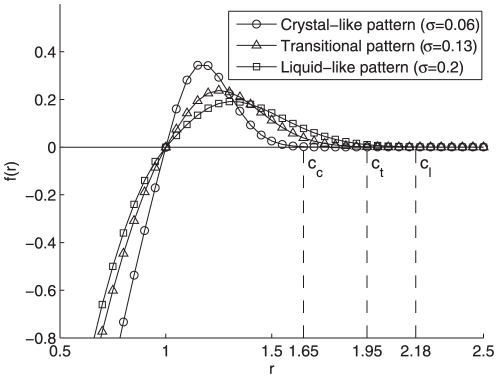
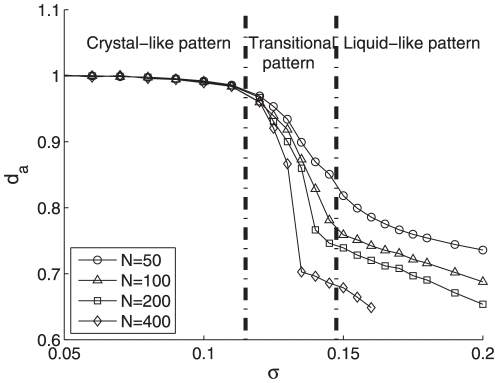
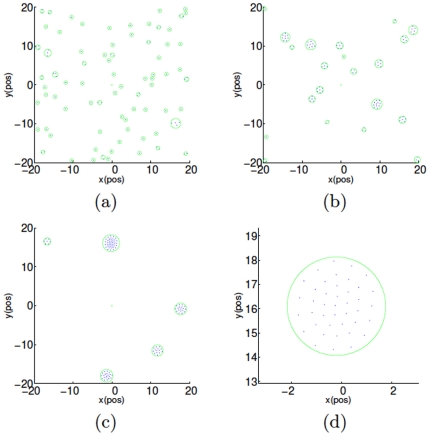
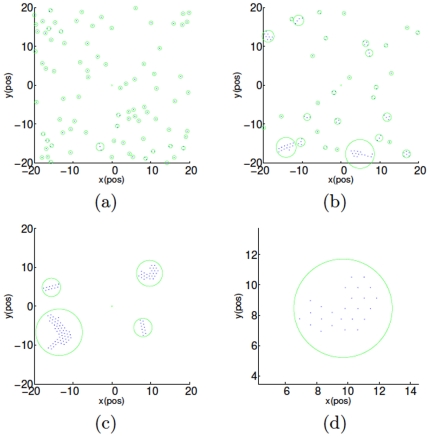
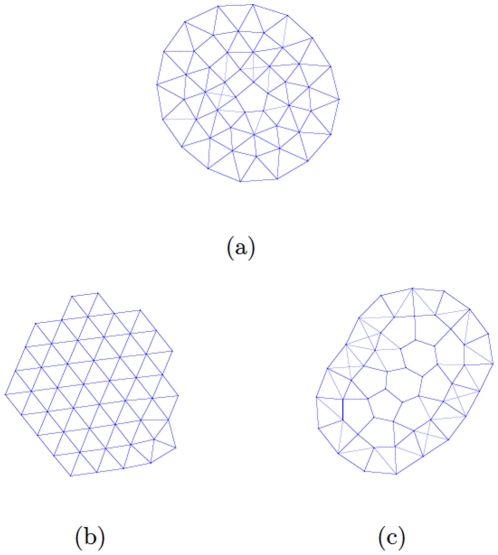
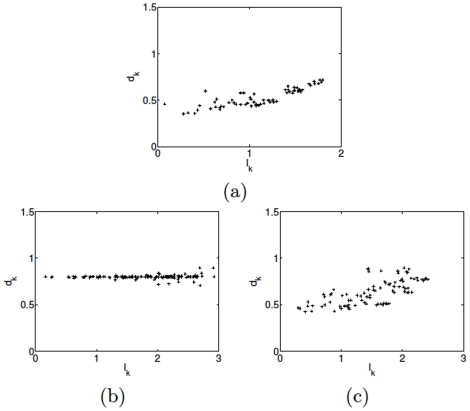
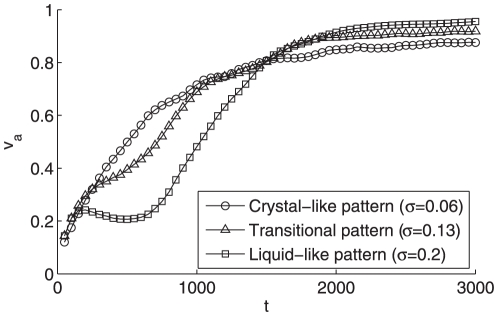
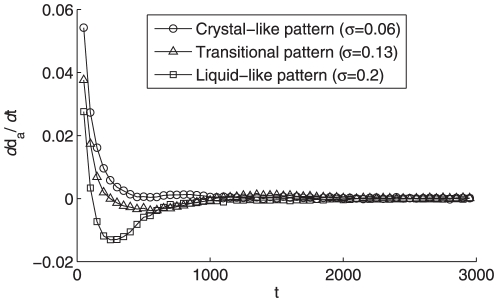
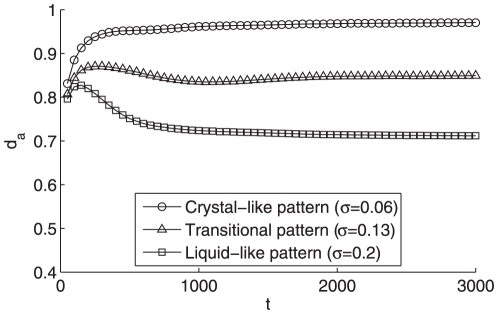
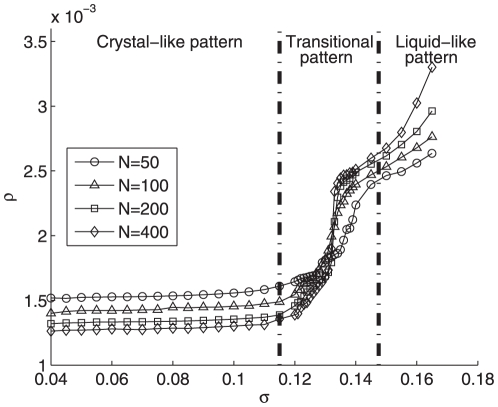
Among collective behaviors of biological swarms and flocks, the attractive/repulsive (A/R) functional links between particles play an important role. By slightly changing the cutoff distance of the A/R function, a drastic transition between two distinct aggregation patterns is observed. More precisely, a large cutoff distance yields a liquid-like aggregation pattern where the particle density decreases monotonously from the inside to the outwards within each aggregated cluster. Conversely, a small cutoff distance produces a crystal-like aggregation pattern where the distance between each pair of neighboring particles remains constant. Significantly, there is an obvious spinodal in the variance curve of the inter-particle distances along the increasing cutoff distances, implying a legible transition pattern between the liquid-like and crystal-like aggregations. This work bridges the aggregation phenomena of physical particles and swarming of organisms in nature upon revealing some common mechanism behind them by slightly varying their inter-individual attractive/repulsive functions, and may find its potential engineering applications, for example, in the formation design of multi-robot systems and unmanned aerial vehicles (UAVs).
在生物群体和群集的集体行为中,粒子之间的吸引/排斥(A/R)功能链接起着重要作用。通过稍微改变 A/R 函数的截止距离,可以观察到两种截然不同的聚集模式之间的剧烈转变。更准确地说,较大的截止距离会产生类似液体的聚集模式,其中每个聚集簇内的粒子密度从内到外单调下降。相反,较小的截止距离会产生类似晶体的聚集模式,其中每对相邻粒子之间的距离保持不变。重要的是,沿增加的截止距离,粒子间距离的方差曲线有一个明显的旋节线,表明在类似液体和类似晶体的聚集之间存在明显的转变模式。这项工作通过稍微改变个体之间的吸引/排斥功能,揭示了物理粒子聚集和自然界中生物群体聚集的一些共同机制,从而架起了两者之间的桥梁,这可能为多机器人系统和无人机(UAV)的形成设计等领域找到潜在的工程应用。