Department of Internal Medicine-Section of Geriatric Medicine, Erasmus MC, University Medical Center Rotterdam, Rotterdam, The Netherlands.
PLoS One. 2011;6(7):e22227. doi: 10.1371/journal.pone.0022227. Epub 2011 Jul 25.
Hip fractures are a public health problem, leading to hospitalization, long-term rehabilitation, reduced quality of life, large healthcare expenses, and a high 1-year mortality. Especially older adults are at greater risk of fractures than the general population, due to the combination of an increased fall risk and osteoporosis. The aim of this study was to determine time trends in numbers and incidence rates of hip fracture-related hospitalizations and admission duration in the older Dutch population.
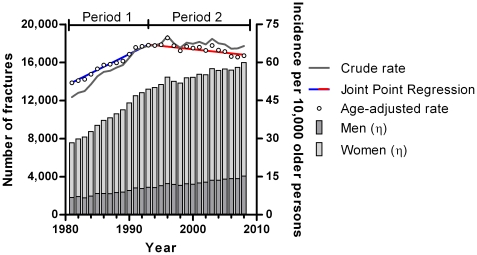
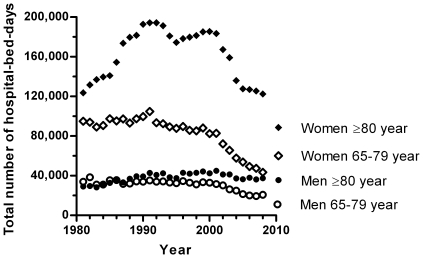
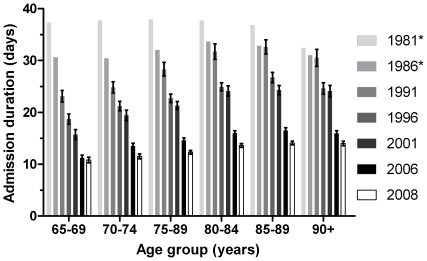
Secular trend analysis of all hospitalizations in the older Dutch population (≥65 years) from 1981 throughout 2008, using the National Hospital Discharge Registry. Numbers, age-specific and age-adjusted incidence rates (per 10,000 persons) of hospital admissions and hospital days due to a hip fracture were used as outcome measures in each year of the study. Between 1981 and 2008, the absolute number of hip fractures doubled in the older Dutch population. Incidence rates of hip fracture-related hospital admissions increased with age, and were higher in women than in men. The age-adjusted incidence rate increased from 52.0 to 67.6 per 10,000 older persons. However, since 1994 the incidence rate decreased (percentage annual change -0.5%, 95% CI: -0.7; -0.3), compared with the period 1981-1993 (percentage annual change 2.3%, 95% CI: 2.0; 2.7). The total number of hospital days was reduced by a fifth, due to a reduced admission duration in all age groups. A possible limitation was that data were obtained from a linked administrative database, which did not include information on medication use or co-morbidities.
A trend break in the incidence rates of hip fracture-related hospitalizations was observed in the Netherlands around 1994, possibly as a first result of efforts to prevent falls and fractures. However, the true cause of the observation is unknown.
髋部骨折是一个公共卫生问题,会导致住院、长期康复、生活质量下降、大量医疗费用和 1 年死亡率升高。由于跌倒风险增加和骨质疏松症的综合作用,老年人比一般人群更容易发生骨折。本研究旨在确定荷兰老年人群中髋部骨折相关住院人数和发病率的时间趋势以及住院时间。
使用国家住院登记处对 1981 年至 2008 年所有荷兰老年(≥65 岁)人群的住院情况进行了季节性趋势分析。在研究的每一年中,使用髋部骨折导致的住院人数、年龄特异性和年龄调整发病率(每 10000 人)作为结果指标。1981 年至 2008 年间,荷兰老年人群中髋部骨折的绝对数量增加了一倍。髋部骨折相关住院的发病率随年龄增长而增加,女性发病率高于男性。年龄调整后的发病率从 52.0 上升到 67.6 每 10000 名老年人。然而,自 1994 年以来,发病率下降(每年变化百分比-0.5%,95%CI:-0.7;-0.3),与 1981-1993 年(每年变化百分比 2.3%,95%CI:2.0;2.7)相比。由于所有年龄段的住院时间缩短,住院总天数减少了五分之一。可能的局限性在于,数据是从一个关联的行政数据库中获得的,该数据库不包括用药信息或合并症信息。
荷兰髋部骨折相关住院发病率的趋势在 1994 年左右出现了中断,这可能是预防跌倒和骨折努力的第一个结果。然而,观察到的真正原因尚不清楚。