Zamora Tomas, Sandoval Felipe, Demandes Hugo, Serrano Javier, Gonzalez Javiera, Lira Maria Jesus, Klaber Ianiv, Carmona Maximiliano, Botello Eduardo, Schweitzer Daniel
Department of Orthopaedic Surgery, Pontificia Universidad Católica de Chile, Santiago, Chile.
Department of Orthopaedic Surgery, Hospital Clínico Metropolitano la Florida, Santiago, Chile.
Geriatr Orthop Surg Rehabil. 2021 Jul 9;12:21514593211024509. doi: 10.1177/21514593211024509. eCollection 2021.
Hip fracture patients have been severely affected by the COVID-19 pandemic; however, the sub acute effects of a concomitant SARS-CoV-2 infection and the outcomes in highly exposed developing countries are still unknown. Our objective is to describe the morbidity and mortality of elderly patients admitted for a hip fracture during the COVID-19 pandemic in Chile, with a minimum 90-day follow-up. Also, to elucidate predictors for mortality and to compare mortality results with the pre-pandemic era.
Multicentric retrospective review of patients admitted for a fragility hip fracture in 3 hospitals during the COVID-19 pandemic, and during the same time in 2019. All clinical information and images were recorded, and patients were followed for a minimum of 90-days. Morbidity and mortality were the primary outcomes. Uni/multivariable models were performed to elucidate predictors for mortality utilizing the Weibull's regression.
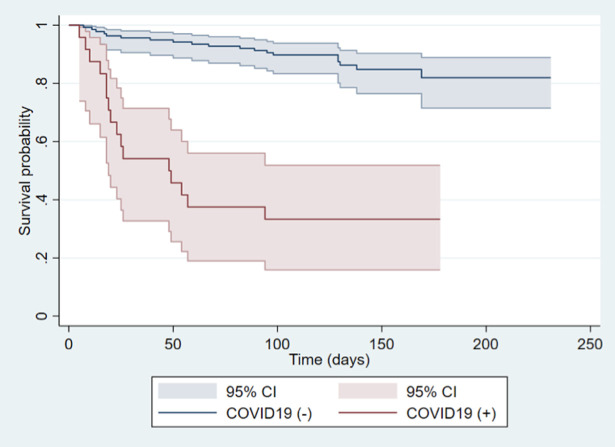
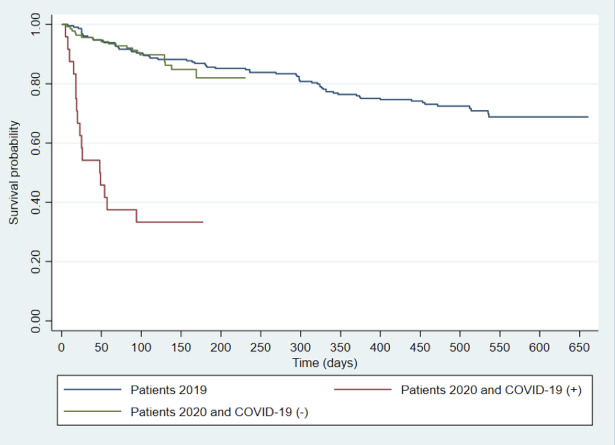
Three hundred ninety-one cases were included. From the 2020 cohort (162 patients), 24 (15%) had a concomitant SARS-CoV-2 infection. Fourteen patients (58%) tested positive after admission. The COVID-19(+) group had a higher risk of in-hospital, 30-day, and 90-day mortality (p < 0.001). They also had a prolonged hospital stay and presented with more complications and readmissions (p < 0.05). Only COVID-19(+) status and older age were independent predictors for mortality with a HR = 6.5 (p = < 0.001) and 1.09 (p = 0.001), respectively. The 2020 cohort had twice the risk of mortality with a HR = 2.04 (p = 0.002) compared to the 2019 cohort. However, comparing only the COVID-19 (-) patients, there was no difference in mortality risk, with a HR = 1.30 (p = 0.343).
The COVID-19 pandemic has significantly affected healthcare systems and elderly patients.
Hip fracture patients with a concomitant SARS-CoV-2 virus infection were associated with increased morbidity and mortality throughout the first 3 months. COVID-19 status and older age were significant predictors for mortality. Efforts should be directed into nosocomial infection reduction and prompt surgical management.
Level III.
髋部骨折患者受到了新冠疫情的严重影响;然而,新冠病毒(SARS-CoV-2)合并感染的亚急性影响以及在高暴露风险的发展中国家的结果仍不清楚。我们的目的是描述在智利新冠疫情期间因髋部骨折入院的老年患者的发病率和死亡率,并进行至少90天的随访。此外,阐明死亡率的预测因素,并将死亡率结果与疫情前时代进行比较。
对新冠疫情期间以及2019年同期在3家医院因脆性髋部骨折入院的患者进行多中心回顾性研究。记录所有临床信息和影像资料,对患者进行至少90天的随访。发病率和死亡率是主要结局指标。采用单变量/多变量模型,利用威布尔回归分析来阐明死亡率的预测因素。
共纳入391例病例。在2020年队列(162例患者)中,24例(15%)合并新冠病毒感染。14例患者(58%)入院后检测呈阳性。新冠病毒感染阳性(COVID-19(+))组在住院、30天和90天的死亡率方面风险更高(p < 0.001)。他们的住院时间也更长,出现更多并发症和再入院情况(p < 0.05)。仅新冠病毒感染阳性状态和高龄是死亡率的独立预测因素,风险比(HR)分别为6.5(p = < 0.001)和1.09(p = 0.001)。与2019年队列相比,2020年队列的死亡风险是其两倍,HR = 2.04(p = 0.002)。然而,仅比较新冠病毒感染阴性(COVID-19(-))患者,死亡风险没有差异,HR = 1.30(p = 0.343)。
新冠疫情对医疗系统和老年患者产生了重大影响。
合并新冠病毒感染的髋部骨折患者在最初3个月内发病率和死亡率增加。新冠病毒感染状态和高龄是死亡率的重要预测因素。应致力于减少医院感染并及时进行手术治疗。
三级。