EPIUnit - Institute of Public Health, University of Porto, Porto, Portugal.
Department of Clinical Epidemiology, Predictive Medicine and Public Health, University of Porto Medical School, Porto, Portugal.
Sci Rep. 2017 Jun 16;7(1):3754. doi: 10.1038/s41598-017-03847-x.
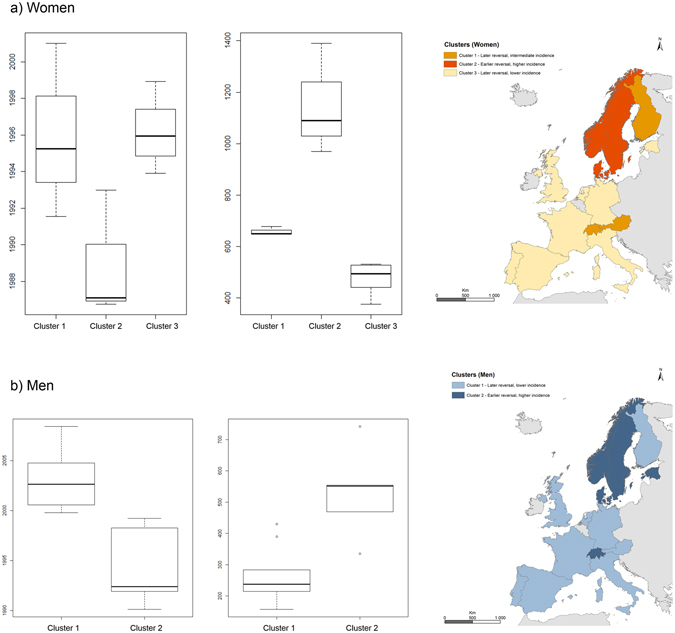
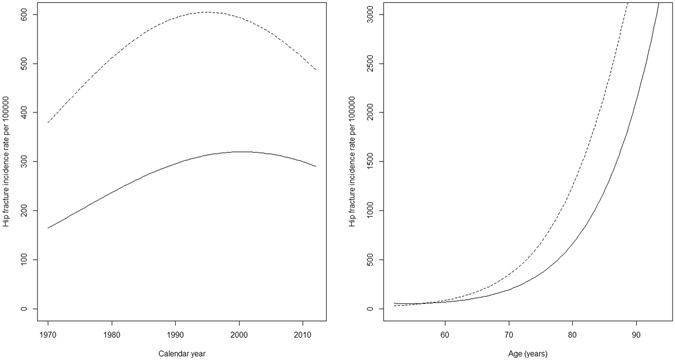
Qualitative similarities between hip fracture trends in different countries suggests variations of the same epidemic. We tested a single statistical shape to describe time trends in Europe, while allowing for country-level variability. Using data from 14 countries, we modelled incidence rates over time using linear mixed-effects models, including the fixed effects of calendar year and age. Random effects were tested to quantify country-level variability in background rates, timing of trend reversal and tempo of reversal. Mixture models were applied to identify clusters of countries defined by common behavioural features. A quadratic function of time, with random effects for background rates and timing of trend reversal, adjusted well to the observed data. Predicted trend reversal occurred on average in 1999 in women (peak incidence about 600 per 100 000) and 2000 in men (about 300 per 100 000). Mixture modelling of country-level effects suggested three clusters for women and two for men. In both sexes, Scandinavia showed higher rates but earlier trend reversals, whereas later trend reversals but lower peak incidences were found in Southern Europe and most of Central Europe. Our finding of a similar overall reversal pattern suggests that different countries show variations of a shared hip fracture epidemic.
不同国家髋部骨折趋势的定性相似性表明存在相同流行病的不同表现。我们测试了一种单一的统计形状,以描述欧洲的时间趋势,同时允许存在国家层面的可变性。我们使用来自 14 个国家的数据,使用线性混合效应模型来模拟随时间变化的发病率,包括日历年度和年龄的固定效应。测试随机效应以量化背景率、趋势逆转时间和逆转速度的国家间可变性。混合模型用于识别以共同行为特征定义的国家聚类。时间的二次函数,具有背景率和趋势逆转时间的随机效应,很好地适应了观察到的数据。预计女性的趋势逆转平均发生在 1999 年(发病率峰值约为每 10 万人 600 例),男性发生在 2000 年(约每 10 万人 300 例)。国家层面效应的混合模型表明,女性有三个聚类,男性有两个聚类。在两性中,斯堪的纳维亚地区的发病率较高,但趋势逆转较早,而在南欧和中欧大部分地区,趋势逆转较晚,但发病率峰值较低。我们发现总体逆转模式相似,表明不同国家表现出共同的髋部骨折流行病的不同表现。