Computational Systems Biology Lab, Department of Biochemistry and Molecular Biology, Institute of Bioinformatics, University of Georgia, Athens, Georgia, United States of America.
PLoS One. 2011;6(7):e22556. doi: 10.1371/journal.pone.0022556. Epub 2011 Jul 22.
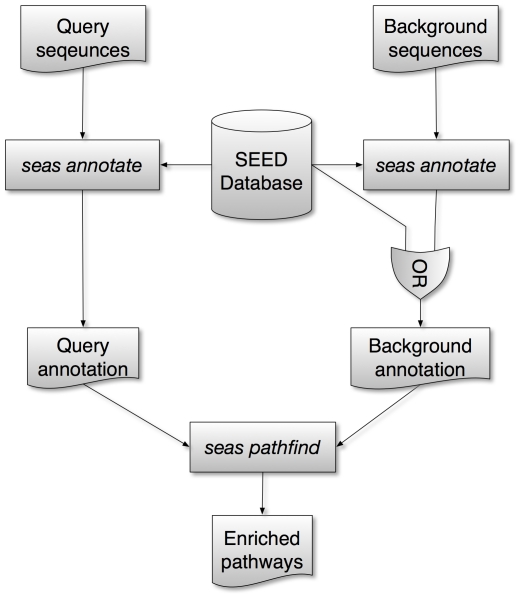
Pathway enrichment analysis represents a key technique for analyzing high-throughput omic data, and it can help to link individual genes or proteins found to be differentially expressed under specific conditions to well-understood biological pathways. We present here a computational tool, SEAS, for pathway enrichment analysis over a given set of genes in a specified organism against the pathways (or subsystems) in the SEED database, a popular pathway database for bacteria. SEAS maps a given set of genes of a bacterium to pathway genes covered by SEED through gene ID and/or orthology mapping, and then calculates the statistical significance of the enrichment of each relevant SEED pathway by the mapped genes. Our evaluation of SEAS indicates that the program provides highly reliable pathway mapping results and identifies more organism-specific pathways than similar existing programs. SEAS is publicly released under the GPL license agreement and freely available at http://csbl.bmb.uga.edu/~xizeng/research/seas/.
通路富集分析是分析高通量组学数据的关键技术,它可以帮助将在特定条件下发现的差异表达的单个基因或蛋白质与已知的生物学通路联系起来。我们在这里介绍了一个计算工具 SEAS,用于在给定的生物体中对一组特定的基因进行通路富集分析,针对的是 SEED 数据库(用于细菌的流行通路数据库)中的通路(或子系统)。SEAS 通过基因 ID 和/或同源性映射将细菌的一组给定基因映射到 SEED 中涵盖的通路基因,然后计算映射基因对每个相关 SEED 通路的富集的统计显著性。我们对 SEAS 的评估表明,该程序提供了高度可靠的通路映射结果,并比类似的现有程序识别出更多的特定于生物体的通路。SEAS 是根据 GPL 许可证协议发布的,并可在 http://csbl.bmb.uga.edu/~xizeng/research/seas/ 上免费获得。