Hospital das Clínicas, São Paulo, Brazil.
Emerg Infect Dis. 2011 Aug;17(8):1421-9. doi: 10.3201/eid1708.101546.
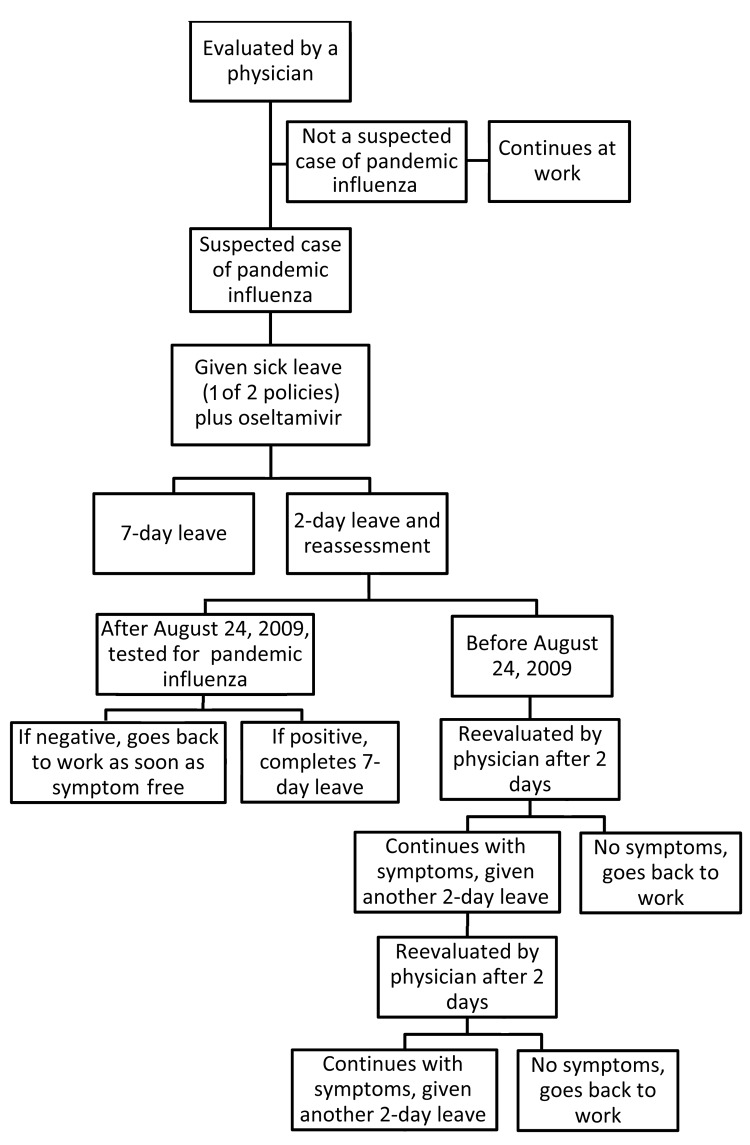
We describe the effect of influenza-like illness (ILI) during the outbreak of pandemic (H1N1) 2009 on health care worker (HCW) absenteeism and compare the effectiveness and cost of 2 sick leave policies for HCWs with suspected influenza. We assessed initial 2-day sick leaves plus reassessment until the HCW was asymptomatic (2-day + reassessment policy), and initial 7-day sick leaves (7-day policy). Sick leaves peaked in August 2009: 3% of the workforce received leave for ILI. Costs during May-October reached R$798,051.87 (≈US $443,362). The 7-day policy led to a higher monthly rate of sick leave days per 100 HCWs than did the 2-day + reassessment policy (8.72 vs. 3.47 days/100 HCWs; p<0.0001) and resulted in higher costs (US $609 vs. US $1,128 per HCW on leave). ILI affected HCW absenteeism. The 7-day policy was more costly and not more effective in preventing transmission to patients than the 2-day + reassessment policy.
我们描述了 2009 年甲型 H1N1 流感大流行期间流感样疾病(ILI)对卫生保健工作者(HCW)旷工的影响,并比较了两种疑似流感 HCW 病假政策的有效性和成本。我们评估了最初的 2 天病假加重新评估,直到 HCW 无症状(2 天+重新评估政策),以及最初的 7 天病假(7 天政策)。病假在 2009 年 8 月达到高峰:3%的劳动力因 ILI 而休假。5 月至 10 月期间的费用达到了 798,051.87 雷亚尔(约合 443,362 美元)。与 2 天+重新评估政策相比,7 天政策导致每 100 名 HCW 每月病假天数的比率更高(8.72 比 3.47 天/100 HCW;p<0.0001),并且成本更高(每个 HCW 休假的费用为 609 美元,而不是 1,128 美元)。ILI 影响了 HCW 的旷工。与 2 天+重新评估政策相比,7 天政策在预防传染给患者方面成本更高,但效果并不更好。