Marine Genomics Unit, Okinawa Institute of Science and Technology, Uruma, Japan.
Genomics Proteomics Bioinformatics. 2011 Jun;9(3):77-96. doi: 10.1016/S1672-0229(11)60011-9.
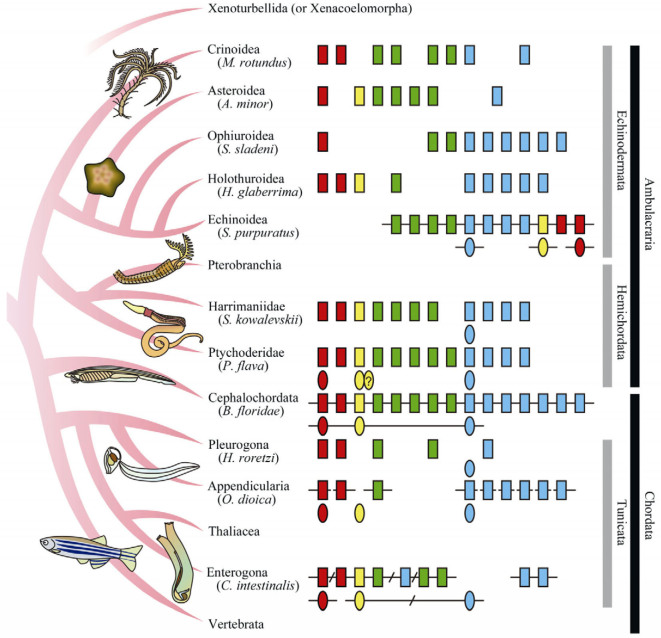
Transcription factors encoded by Antennapedia-class homeobox genes play crucial roles in controlling development of animals, and are often found clustered in animal genomes. The Hox and ParaHox gene clusters have been regarded as evolutionary sisters and evolved from a putative common ancestral gene complex, the ProtoHox cluster, prior to the divergence of the Cnidaria and Bilateria (bilaterally symmetrical animals). The Deuterostomia is a monophyletic group of animals that belongs to the Bilateria, and a sister group to the Protostomia. The deuterostomes include the vertebrates (to which we belong), invertebrate chordates, hemichordates, echinoderms and possibly xenoturbellids, as well as acoelomorphs. The studies of Hox and ParaHox genes provide insights into the origin and subsequent evolution of the bilaterian animals. Recently, it becomes apparent that among the Hox and ParaHox genes, there are significant variations in organization on the chromosome, expression pattern, and function. In this review, focusing on invertebrate deuterostomes, I first summarize recent findings about Hox and ParaHox genes. Next, citing unsolved issues, I try to provide clues that might allow us to reconstruct the common ancestor of deuterostomes, as well as understand the roles of Hox and ParaHox genes in the development and evolution of deuterostomes.
由触角同源异型盒基因编码的转录因子在控制动物发育中发挥着关键作用,通常在动物基因组中聚集。Hox 和 ParaHox 基因簇被认为是进化上的姐妹,它们是从假定的共同祖先基因复合物 ProtoHox 簇进化而来的,在刺胞动物和两侧对称动物(bilaterally symmetrical animals)分化之前。后口动物是一个单系动物群,属于两侧对称动物,是原口动物的姐妹群。后口动物包括脊椎动物(包括我们人类)、无脊椎脊索动物、半索动物、棘皮动物和可能的 Xenoturbellida,以及无腔动物。Hox 和 ParaHox 基因的研究为两侧对称动物的起源和随后的进化提供了线索。最近,人们明显发现,在 Hox 和 ParaHox 基因中,在染色体组织、表达模式和功能上存在显著的差异。在这篇综述中,我首先聚焦于无脊椎后口动物,总结了关于 Hox 和 ParaHox 基因的最新发现。接下来,我引用了尚未解决的问题,试图提供线索,使我们能够重建后口动物的共同祖先,并了解 Hox 和 ParaHox 基因在后口动物发育和进化中的作用。