Samadi Leyli, Steiner Gerhard
Department of Evolutionary Biology, Faculty of Life Sciences, University of Vienna, Vienna, Austria.
BMC Dev Biol. 2010 Jul 12;10:74. doi: 10.1186/1471-213X-10-74.
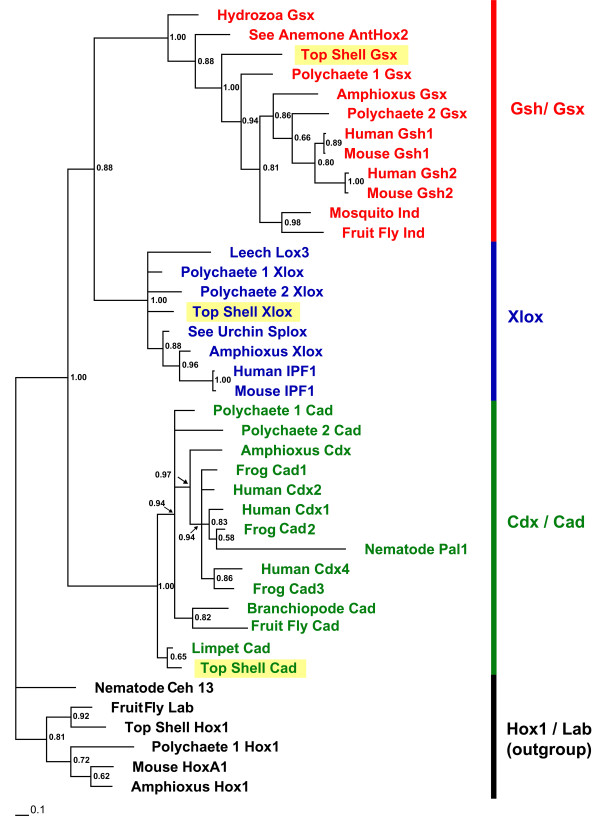
Presence of all three ParaHox genes has been described in deuterostomes and lophotrochozoans, but to date one of these three genes, Xlox has not been reported from any ecdysozoan taxa and both Xlox and Gsx are absent in nematodes. There is evidence that the ParaHox genes were ancestrally a single chromosomal cluster. Colinear expression of the ParaHox genes in anterior, middle, and posterior tissues of several species studied so far suggest that these genes may be responsible for axial patterning of the digestive tract. So far, there are no data on expression of these genes in molluscs.
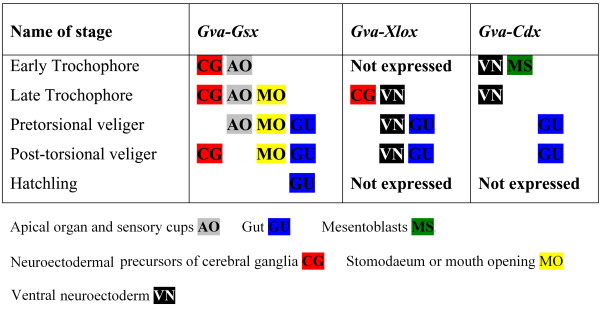
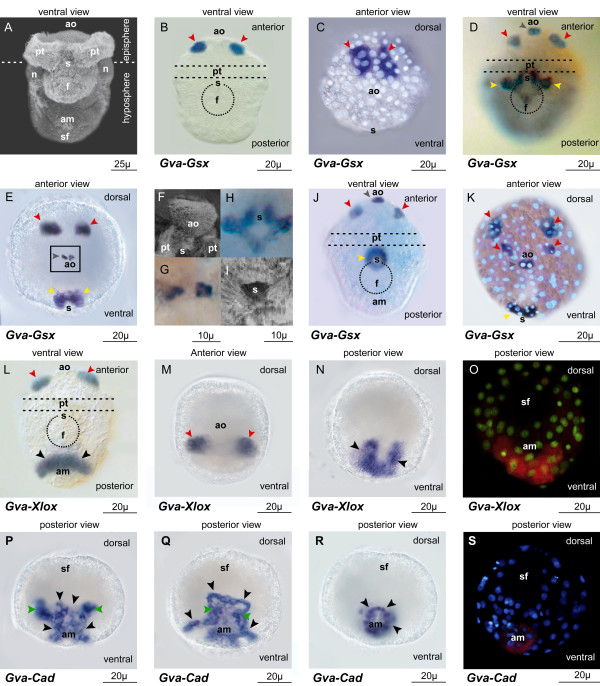
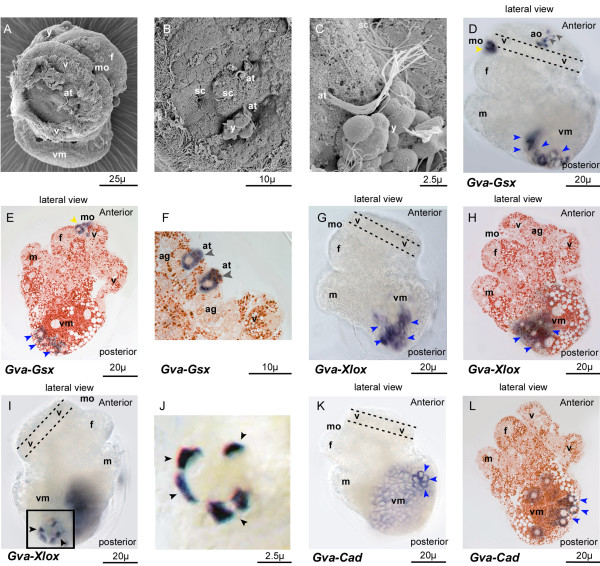
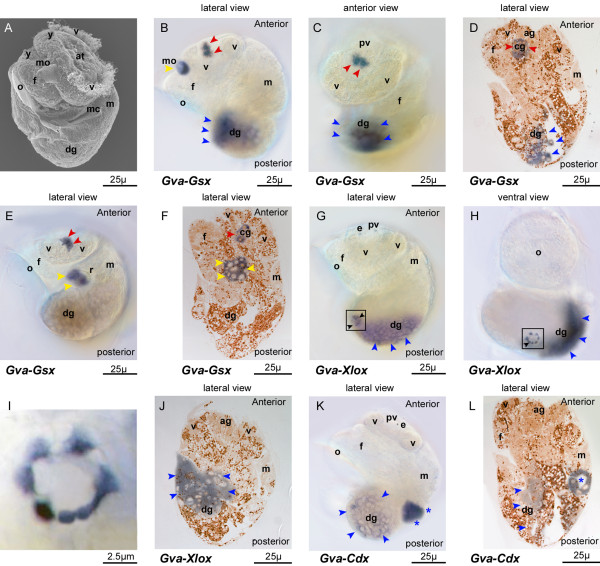
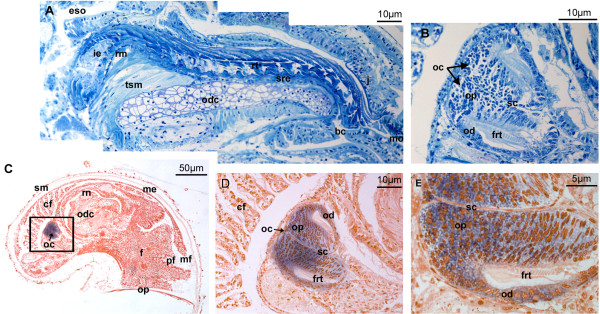
We isolated the complete coding sequences of the three Gibbula varia ParaHox genes, and then tested their expression in larval and postlarval development. In Gibbula varia, the ParaHox genes participate in patterning of the digestive tract and are expressed in some cells of the neuroectoderm. The expression of these genes coincides with the gradual formation of the gut in the larva. Gva-Gsx patterns potential neural precursors of cerebral ganglia as well as of the apical sensory organ. During larval development this gene is involved in the formation of the mouth and during postlarval development it is expressed in the precursor cells involved in secretion of the radula, the odontoblasts. Gva-Xolx and Gva-Cdx are involved in gut patterning in the middle and posterior parts of digestive tract, respectively. Both genes are expressed in some ventral neuroectodermal cells; however the expression of Gva-Cdx fades in later larval stages while the expression of Gva-Xolx in these cells persists.
In Gibbula varia the ParaHox genes are expressed during anterior-posterior patterning of the digestive system. This colinearity is not easy to spot during early larval stages because the differentiated endothelial cells within the yolk permanently migrate to their destinations in the gut. After torsion, Gsx patterns the mouth and foregut, Xlox the midgut gland or digestive gland, and Cdx the hindgut. ParaHox genes of Gibbula are also expressed during specification of cerebral and ventral neuroectodermal cells. Our results provide additional support for the ancestral complexity of Gsx expression and its ancestral role in mouth patterning in protostomes, which was secondarily lost or simplified in some species.
在后口动物和冠轮动物中已发现所有三个副同源盒基因的存在,但迄今为止,在任何蜕皮动物类群中都未报告这三个基因中的Xlox,并且线虫中不存在Xlox和Gsx。有证据表明副同源盒基因在祖先中是一个单一的染色体簇。到目前为止,在几种已研究物种的前部、中部和后部组织中,副同源盒基因的共线性表达表明这些基因可能负责消化道的轴向模式形成。到目前为止,尚无关于这些基因在软体动物中表达的数据。
我们分离出了变异滨螺三个副同源盒基因的完整编码序列,然后测试了它们在幼虫和幼体后发育过程中的表达。在变异滨螺中,副同源盒基因参与消化道的模式形成,并在神经外胚层的一些细胞中表达。这些基因的表达与幼虫肠道的逐渐形成相吻合。Gva-Gsx对脑神经节以及顶端感觉器官的潜在神经前体进行模式化。在幼虫发育过程中,该基因参与口的形成,在幼体后发育过程中,它在参与齿舌分泌的前体细胞即成牙细胞中表达。Gva-Xolx和Gva-Cdx分别参与消化道中部和后部的肠道模式形成。这两个基因都在一些腹侧神经外胚层细胞中表达;然而,Gva-Cdx在幼虫后期的表达消失,而Gva-Xolx在这些细胞中的表达持续存在。
在变异滨螺中,副同源盒基因在消化系统的前后模式形成过程中表达。这种共线性在幼虫早期阶段不容易发现,因为卵黄内分化的内皮细胞会永久迁移到肠道中的目的地。扭转后,Gsx对口和前肠进行模式化,Xlox对中肠腺或消化腺进行模式化,Cdx对后肠进行模式化。变异滨螺的副同源盒基因在脑神经和腹侧神经外胚层细胞的特化过程中也有表达。我们的结果为Gsx表达的祖先复杂性及其在原口动物口模式形成中的祖先作用提供了额外支持,而在某些物种中,这种作用后来丧失或简化了。