Institut de Recherche sur le Cancer de Lille, Université Lille-Nord de France, Lille, France.
Oncogene. 2012 Mar 15;31(11):1419-30. doi: 10.1038/onc.2011.328. Epub 2011 Aug 1.
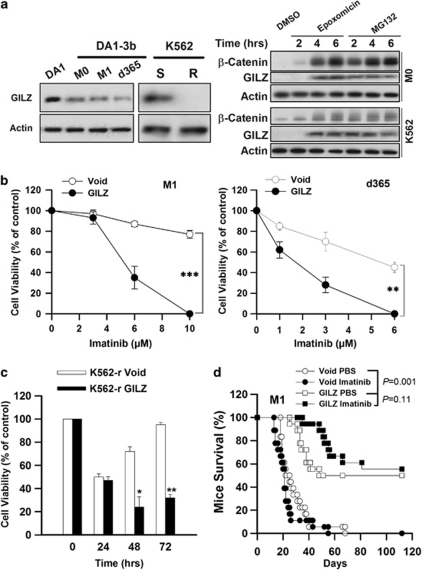
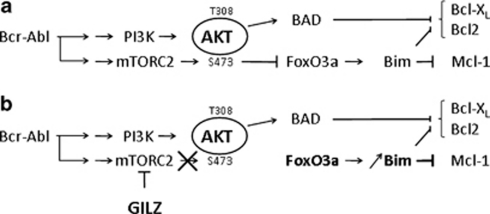
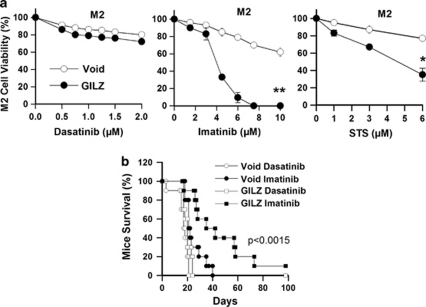
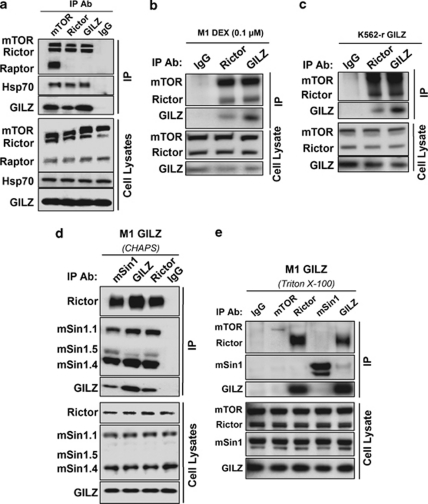
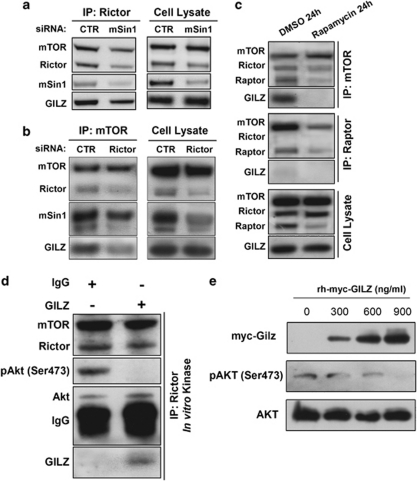
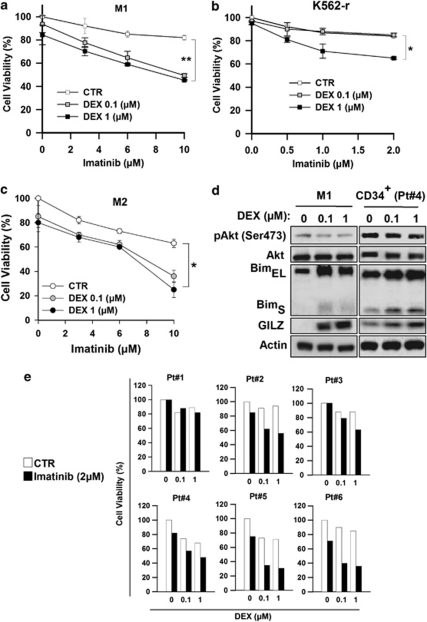
The malignant phenotype of chronic myeloid leukemia (CML) is due to the abnormal tyrosine kinase activity of the BCR-ABL oncoprotein, which signals several downstream cell survival pathways, including phosphoinositide 3-kinase/AKT, signal transducer and activator of transcription 5 and extracellular signal-regulated kinase 1/2. In patients with CML, tyrosine kinase inhibitors (TKIs) are used to suppress the BCR-ABL tyrosine kinase, resulting in impressive response rates. However, resistance can occur, especially in acute-phase CML, through various mechanisms. Here, we show that the glucocorticoid-induced leucine zipper protein (GILZ) modulates imatinib and dasatinib resistance and suppresses tumor growth by inactivating the mammalian target of rapamycin complex-2 (mTORC2)/AKT signaling pathway. In mouse and human models, GILZ binds to mTORC2, but not to mTORC1, inhibiting phosphorylation of AKT (at Ser473) and activating FoxO3a-mediated transcription of the pro-apoptotic protein Bim; these results demonstrate that GILZ is a key inhibitor of the mTORC2 pathway. Furthermore, CD34(+) stem cells isolated from relapsing CML patients underwent apoptosis and showed inhibition of mTORC2 after incubation with glucocorticoids and imatinib. Our findings provide new mechanistic insights into the role of mTORC2 in BCR-ABL(+) cells and indicate that regulation by GILZ may influence TKI sensitivity.
慢性髓性白血病 (CML) 的恶性表型是由于 BCR-ABL 癌蛋白的异常酪氨酸激酶活性,该活性信号转导几个下游细胞存活途径,包括磷酸肌醇 3-激酶/AKT、信号转导和转录激活因子 5 和细胞外信号调节激酶 1/2。在 CML 患者中,使用酪氨酸激酶抑制剂 (TKI) 来抑制 BCR-ABL 酪氨酸激酶,从而产生令人印象深刻的反应率。然而,耐药性可能会发生,特别是在急变期 CML 中,通过多种机制。在这里,我们表明糖皮质激素诱导的亮氨酸拉链蛋白 (GILZ) 通过失活雷帕霉素靶蛋白复合物 2 (mTORC2)/AKT 信号通路来调节伊马替尼和达沙替尼耐药并抑制肿瘤生长。在小鼠和人类模型中,GILZ 与 mTORC2 结合,但不与 mTORC1 结合,抑制 AKT 的磷酸化(在 Ser473 处)并激活 FoxO3a 介导的促凋亡蛋白 Bim 的转录;这些结果表明 GILZ 是 mTORC2 途径的关键抑制剂。此外,从复发 CML 患者分离的 CD34(+) 干细胞在与糖皮质激素和伊马替尼孵育后发生凋亡,并显示出 mTORC2 的抑制。我们的研究结果为 mTORC2 在 BCR-ABL(+) 细胞中的作用提供了新的机制见解,并表明 GILZ 的调节可能影响 TKI 敏感性。