UMR996-Inflammation, Chimiokines et Immunopathologie, INSERM, Faculté de médecine, Univ Paris-Sud, Université Paris-Saclay, Clamart, France.
Front Immunol. 2018 Jun 4;9:1232. doi: 10.3389/fimmu.2018.01232. eCollection 2018.
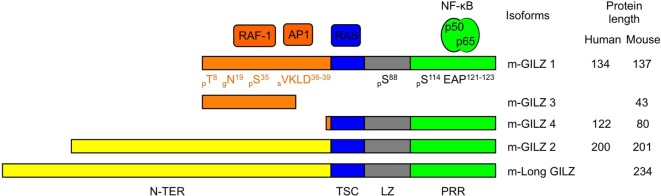
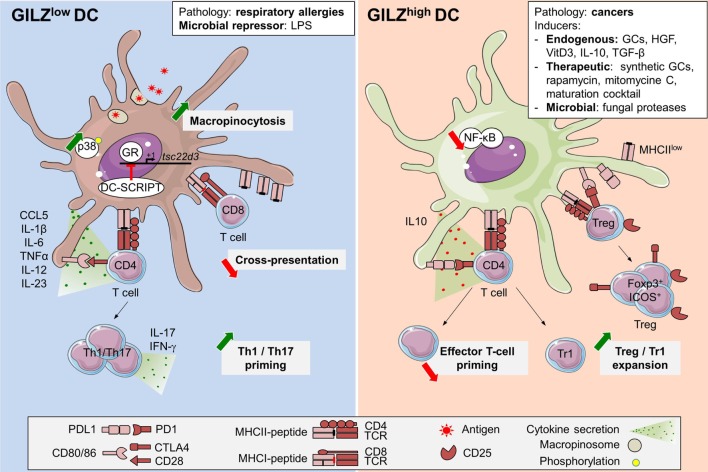
Dendritic cells (DCs) are key antigen-presenting cells that control the induction of both tolerance and immunity. Understanding the molecular mechanisms regulating DCs commitment toward a regulatory- or effector-inducing profile is critical for better designing prophylactic and therapeutic approaches. Initially identified in dexamethasone-treated thymocytes, the glucocorticoid-induced leucine zipper (GILZ) protein has emerged as a critical factor mediating most, but not all, glucocorticoids effects in both non-immune and immune cells. This intracellular protein exerts pleiotropic effects through interactions with transcription factors and signaling proteins, thus modulating signal transduction and gene expression. GILZ has been reported to control the proliferation, survival, and differentiation of lymphocytes, while its expression confers anti-inflammatory phenotype to monocytes and macrophages. In the past twelve years, a growing set of data has also established that GILZ expression in DCs is a molecular switch controlling their T-cell-priming capacity. Here, after a brief presentation of GILZ isoforms and functions, we summarize current knowledge regarding GILZ expression and regulation in DCs, in both health and disease. We further present the functional consequences of GILZ expression on DCs capacity to prime effector or regulatory T-cell responses and highlight recent findings pointing to a broader role of GILZ in the fine tuning of antigen capture, processing, and presentation by DCs. Finally, we discuss future prospects regarding the possible roles for GILZ in the control of DCs function in the steady state and in the context of infections and chronic pathologies.
树突状细胞 (DCs) 是控制诱导耐受和免疫的关键抗原呈递细胞。了解调节 DCs 向调节性或效应诱导表型的分子机制对于更好地设计预防性和治疗性方法至关重要。糖皮质激素诱导亮氨酸拉链 (GILZ) 蛋白最初在地塞米松处理的胸腺细胞中被鉴定出来,已成为介导非免疫和免疫细胞中大多数(但不是全部)糖皮质激素作用的关键因素。这种细胞内蛋白通过与转录因子和信号蛋白相互作用发挥多效性作用,从而调节信号转导和基因表达。已经报道 GILZ 控制淋巴细胞的增殖、存活和分化,而其表达赋予单核细胞和巨噬细胞抗炎表型。在过去的十二年中,越来越多的数据还表明,GILZ 在 DCs 中的表达是控制其 T 细胞启动能力的分子开关。在这里,在简要介绍 GILZ 异构体和功能之后,我们总结了目前关于 GILZ 在健康和疾病状态下在 DCs 中的表达和调节的知识。我们进一步介绍了 GILZ 表达对 DCs 诱导效应或调节性 T 细胞反应能力的功能后果,并强调了最近的发现,表明 GILZ 在 DCs 对抗原捕获、加工和呈递的精细调节中具有更广泛的作用。最后,我们讨论了 GILZ 在控制 DCs 功能在稳态以及感染和慢性病理情况下的可能作用的未来前景。